Win Wind Criticizes Thiele

Win Wind Criticizes Thiele

By
Christopher Walsh

A coalition of environmental groups called Win Wind NY is “deeply disappointed” that Assemblyman Fred W. Thiele Jr. has withdrawn his support for the South Fork Wind Farm, the 15-turbine installation proposed to be constructed 35 miles off Montauk by Orsted U.S. Offshore Wind. 

“We are concerned that a leader who has championed renewable energy — and lives in a climate-fragile waterfront community — would pull away from Gov. Andrew Cuomo’s vision and plans for a wind energy industry to service our region’s work force, health, safety, and climate future,” said a statement issued jointly by the Sierra Club, the U.S. Green Building Council’s Long Island chapter, the Green Education and Legal Fund, All Our Energy, the Edgemere Community Garden Coalition, and the Long Island Progressive Coalition.

Mr. Thiele’s about-face last month, the group said, happened “over what appears to be a breakdown in communication” with Deepwater Wind, which since its 2018 acquisition by a Danish energy giant is known as Orsted U.S. Offshore Wind, “regarding ownership of the project and its increase in size.”

The company announced last year that advances in turbine technology afforded the South Fork Wind Farm a 44-percent greater output capacity, or 130 megawatts rather than the 90 megawatts initially envisioned, which Mr. Thiele said amounted to a “bait and switch” on Orsted’s part. He also complained about a lack of transparency over the rates Long Island Power Authority customers would pay for wind energy. 

“We agree with the Assembly member that our public utilities and any developer should be transparent and accountable to the public in our democracy,” the groups wrote. “But the contract between LIPA and Deepwater Wind (now Orsted) is not the only contract that we are not privy to. LIPA never discloses details of its power purchase agreements,” the group wrote, “though we take some comfort that they are all subject to review and approval by the state comptroller and attorney general.” 

“We urge Assemblyman Thiele and Orsted to get back together and work out their disagreements,” the groups wrote. “The South Fork project is too important to the East End, to the region, and to New York State to accept a breakdown in communications.”

Government Briefs 02.07.19

Government Briefs 02.07.19

By
Christopher Walsh

East Hampton Town

New Features to Town Website

The East Hampton Town website, at ehamptonny.gov, has been updated to highlight announcements and current news of interest to the community in a regularly updated news section on the site’s homepage. 

The first stage in a systematic improvement of the website, which is expected to culminate in an extensive overhaul at the end of this year, is a “News and Announcements” section. Visitors can sign up for text or email alerts when new information is posted by selecting the “Stay Connected” button on the homepage, and then the “Notify Me” section. From there, by scrolling down, visitors can sign up for “News Flash” alerts. At that page, visitors can also elect to be notified about topics including upcoming events, meeting agendas, bids, job postings, and emergency notifications. 


Republican Committee Screening

The East Hampton Town Republican Committee has put out a call for those interested in screening for the positions of supervisor and two seats on the town board as well as town justice, tax assessor, and town trustee on Saturday and Sunday from 2 to 4 p.m. at the American Legion Hall in Amagansett.

The committee will screen candidates for the town board seats now held by Supervisor Peter Van Scoyoc, Councilwoman Sylvia Overby, and Councilman David Lys, all Democrats. All three announced their intention to seek re-election at the East Hampton Town Democratic Committee’s Jan. 16 meeting. 

The Republicans’ screening process is open to Republicans, Democrats, Independence Party members, and those unaffiliated with a party. “If you believe in East Hampton and love our community,” Kyle Ballou, the committee’s secretary, wrote in an email, “then we want you.” Potential candidates have been asked to email Manny Vilar, the committee’s chairman, at [email protected] or Mr. Ballou at [email protected]. 

The Republican Committee will hold a nominating convention at its next monthly meeting, on Friday, Feb. 15, at the American Legion Hall. Election Day is Nov. 5. 


New York State

Approve Offshore Drilling Ban

The New York State Legislature has approved a ban on offshore drilling, a measure co-sponsored by Senator Kenneth P. LaValle that would prohibit offshore oil and gas production. 

“As the original lead sponsor of the legislation, I am pleased that the bill was approved by the Senate and Assembly,” Senator LaValle said in a statement on Tuesday. “We have painstakingly worked to preserve and protect our pristine waters, and we certainly do not want to imperil all of our efforts to maintain clean water by allowing drilling off our shoreline. I request that the governor sign the bill into law, so we can further protect our waters.” 

The bill would amend the state’s Environmental Conservation Law to prohibit the leasing of state-owned underwater coastal lands for oil and natural gas drilling. It would add a new component to prevent the Department of Environmental Conservation and the Office of General Services from authorizing leases that would result in the increase of oil or natural gas production in federal waters. 

In addition, the bill would amend the Transportation Corporations Law to restrict the powers of such corporations to develop pipelines associated with the delivery of natural gas or oil from the North Atlantic Planning Area, which spans the coastline from Maine to Delaware.

Town Says Amagansett Soil Test Shows No Health Hazard

Town Says Amagansett Soil Test Shows No Health Hazard

Straw placed on the farm field north of the Amagansett business district appears to be working in tandem with snow fencing to improve the "dust bowl" conditions there.
Durell Godfrey
By
Christopher Walsh

An analysis of the soil that blew off farm fields and blanketed commercial and residential areas of Amagansett this winter revealed no pesticides, according to a letter from the environmental remediation services provider contracted by East Hampton Town.

Meanwhile, the placement of straw atop the barren fields north of the hamlet’s municipal parking lot and installation of snow fencing to help keep it in place “has been successful at largely eliminating the swirling particulates that had caused concern,” according to a statement issued by the town on Friday.

The town board had arranged for the placement of straw and snow fencing after residents complained about “dust-bowl” conditions that they feared posed a health hazard. The straw, which was laid on the fields on Jan. 22, “has addressed the problem,” according to the statement.

“We share residents’ concerns about the recent dust storms in Amagansett,” Supervisor Peter Van Scoyoc said in the statement. “I am gratified that our agreed-upon solution appears to be working and am pleased that the town board was able to work together to achieve this result. We will continue to monitor the field conditions and take necessary actions to ensure that this doesn’t happen again.”

At the town board’s meeting on Tuesday, he reiterated that. “The dust has literally settled in Amagansett, for now. We hope that the straw and fencing will continue to stop that problem.”

The FPM Group collected soil samples from windblown dust piles in three locations, two on the north side of the parking lot and one from a public right of way traversing the field. Testing for a New York State Department of Environmental Conservation list of pesticides and metals, as recommended by the Suffolk County Health Department for agricultural properties, “indicate that no targeted pesticides were detected in any of the samples,” according to a letter from a senior hydrologist with the FPM Group to Michael Sendlenski, the town attorney.

Five metals — arsenic, chromium, copper, lead, and nickel — were detected in each of the samples, according to the letter, but at low concentrations, each below state standards. Results of the tests can be found on the town’s website. The presence of those metals, Mr. Van Scoyoc said on Tuesday, “are consistent with all farm fields in Suffolk County.”

On Jan. 14, residents crowded into the Amagansett Firehouse for a meeting of the hamlet’s citizens advisory committee, where they expressed concern for themselves and their children, not only about what the airborne particles might contain, but about the negative health effects of such small particulates filling the air.

Those concerns were taken to the town board’s meeting later that week. Mr. Van Scoyoc met with Barry Bistrian, whose family owns the field north of the parking lot; Peter Dankowski, the farmer who leases the land; Corey Humphrey, district manager of the County Soil and Water Conservation District, and Alex Balsam, a farmer and chairman of the town’s agricultural advisory committee, to develop a mitigation plan.

Straw was delivered to the fields, along with a bale-shredding machine, which Mr. Balsam lent for the effort, to disseminate it.

Dust conditions were particularly bad in Amagansett this winter because of the lack of a cover crop, for which an unusually wet harvest season was blamed. While Mr. Dankowski did plant a cover crop after harvesting potatoes, the crop did not take hold.

The dust prompted Organic Krush, a takeout shop on Main Street adjacent to the municipal parking lot, to close, its owners and management citing conditions that they said had sickened employees. The Amagansett School kept students indoors during recess on Jan. 11, and Seth Turner, the district superintendent, sent a letter to parents and guardians to address concerns about their children’s health. The school also held a special meeting to address parents’ concerns. Mr. Van Scoyoc said on Tuesday that air-quality testing conducted inside the school found no cause for concern.

The town board is considering legislation to codify the annual planting of a cover crop in response to this winter’s conditions. On Tuesday, Councilman Jeff Bragman said that he and NancyLynn Thiele, an assistant town attorney, have been “working on a law that would amend some portion of our code” to require that farmers contain soil onsite. “This is not a statute that restricts farming,” he said of such legislation. On the contrary, he said, it would protect farming.

This article has been updated since it was first published with the version that appeared in print on Feb. 7, 2019. 

A Belated Recognition of Trustee Authority

A Belated Recognition of Trustee Authority

Molly Zweig constructed a revetment in front of her property at 11 West End Road in 2013, with a permit from the state, despite objections from the East Hampton Town Trustees.
David E. Rattray
By
Christopher Walsh

The East Hampton Town Trustees and East Hampton Village are nearing a settlement that would end a protracted legal struggle with a West End Road resident over a 166-foot-long rock revetment constructed on the ocean beach adjoining the resident’s property. 

At their meeting on Monday, the trustees voted to approve a settlement agreement with Molly Zweig, who constructed a revetment in front of 11 West End Road in 2013 after receiving required permitting from the New York State Department of Environmental Conservation and the village’s zoning board of appeals. This despite the persistent objection of the trustees, who own many of the town’s common lands, including beaches, on behalf of the public. 

The trustees had maintained that most if not all of the revetment would be situated on trustee-owned land, and that even if the revetment was outside of their jurisdiction, it could have a significant impact on adjacent lands they own and govern, granting them jurisdiction. Ms. Zweig had argued that the deed to her property includes ownership to the mean high water mark of the ocean, and therefore she owned the land at which the revetment was constructed. 

“We’ve been able to agree that her south boundary would be designated by the [beach] grass line, just as most properties along the south shore are,” Francis Bock, the trustees’ presiding officer, said on Tuesday. “We also got her to recognize the trustees, which she was refusing to do before.” As a consequence, Ms. Zweig recently applied to the trustees and was issued a permit to install sand fencing, and she will have to secure a permit for machinery or vehicles to traverse the beach to access the revetment for maintenance. “I know she has a set of stairs” leading to the beach, Mr. Bock said. “Anything that has to be done with stairs, she has to come back to us for a permit.” 

“She was claiming the entire beach in front of her,” Mr. Bock said, “based on a deed that seemed to have mysteriously changed somehow, many years ago. We got her to agree to recognize the beach grass line” as the property’s southern boundary. 

David Eagan, an attorney formerly representing the trustees in the matter, told The Star in 2013 that Ms. Zweig’s claim to owning metes and bounds — a legal description of land measurements — extending to the ocean was false. In fact, he said, the chain of title from the time the property was first conveyed to a private owner, in 1902, indicated that “the southern boundary concept was ‘edge of the beach grass line.’ ” 

Ms. Zweig and East Hampton Village must still sign off on the agreement. East Hampton Village Mayor Paul F. Rickenbach Jr. would not comment on Tuesday, as he had yet to review it. 

Following Tropical Storm Irene in 2011, which flattened a dune at the beach in question, and Superstorm Sandy, which caused further damage the following year, Ms. Zweig sought to remove a rock groin that had been constructed decades earlier, build a rock revetment, restore the eroded dune with 4,000 cubic yards of sand, plant beach grass, and install snow fence. In October 2013, after a lengthy and controversial hearing, the village’s Z.B.A. granted permits to do that work, over the trustees’ objection. Diane McNally, the trustees’ clerk at the time, implored the board to consider alternatives, given a revetment’s potential detrimental impact on the adjacent shoreline. 

Ms. Zweig’s revetment was to be 40 feet landward of that in front of an adjacent property, on a stretch of shoreline from West End Road to Main Beach where most properties are protected by some kind of structure. 

On Veterans Day in 2013, when courts were closed, boulders were transported to the beach and construction of a revetment commenced. The trustees filed an Article 78 court challenge to the determination, and two days later won a temporary restraining order to stop it. 

In February 2014, Ms. Zweig applied for a permit from the trustees, which they had insisted she was required to do. The following month, Ms. McNally said the application was incomplete; it was later withdrawn. But the restraining order was lifted the following month, and the project was completed. 

The Z.B.A. revisited the matter, reaching the same conclusion it did in 2013, adopting, in January 2015, a negative declaration under the State Environmental Quality Review Act, meaning that an environmental impact study would not be required of the applicant. In April 2016, a State Supreme Court Justice denied the trustees’ petition to annul the negative declaration. 

The trustees scored a victory in April 2017 when another State Supreme Court justice denied Ms. Zweig’s request for summary judgment after having reviewed deeds and a title examiner’s affidavit asserting that the trustees could not claim title to the disputed area. 

At their meeting on Monday, however, the trustees, none of whom were in that role when the body sued Ms. Zweig, expressed relief at the prospect of putting the matter behind them, and with it the considerable legal fees expended. 

“Most importantly,” Mr. Bock said at the meeting, “it brings in the grass line” as the property’s boundary. 

“That’s the most valuable thing about this whole settlement,” said Bill Taylor, a deputy clerk of the trustees, “that it restores the grass line.”

“I think it’s in the public’s best interest, and the trustees’ best interest,” said Rick Drew. “Given what this board inherited with the project, it’s a best-case outcome.”

“We can go on forever,” Jim Grimes, the other deputy clerk, said of litigation. “Every month this goes by, we are fielding bills from our attorneys.”

Christopher Carillo, the trustees’ attorney, said that he and Brian Matthews, an attorney retained by the trustees in the litigation effort, “went back and forth on the permit language to limit the precedential effect of this, because the concern among the trustees was any other homeowner saying ‘We no longer need a trustee permit,’ and using this as evidence. We narrowly tailored this permit to use the settlement language so that it’s extremely clear that this permit is a result of this settlement agreement.” 

A property owner attempting to avoid securing a permit concerning trustee jurisdiction would be required to “go through Zweig-scale litigation,” he said. 

Dems Call for Candidates

Dems Call for Candidates

By
Christopher Walsh

The East Hampton Town Democratic Committee has put out a call for those interested in screening for the positions of supervisor and two seats on the town board as well as town justice, highway superintendent, tax assessor, and town trustee. Election Day is Nov. 5. 

The committee will screen candidates for the town board seats now held by Supervisor Peter Van Scoyoc, Councilwoman Sylvia Overby, and Councilman David Lys. All announced their intention to seek re-election at the committee’s Jan. 16 meeting. Two assessor positions are up for re-election, as are all of the town trustees’ nine seats. 

Those interested have been asked to contact Betty Mazur, the committee’s vice chairwoman, by sending an email to [email protected] no later than Tuesday.

Oyster Program to Expand

Oyster Program to Expand

By
Christopher Walsh

East Hampton Town’s community oyster garden program, under which individuals and families can grow up to 1,000 oysters and keep half of them, will expand further this year, if the town trustees agree to a request made on Monday. 

John (Barley) Dunne, director of the town’s shellfish hatchery, which seeds town waterways with juvenile oysters, clams, and scallops each year, told the trustees that the program, launched in Three Mile Harbor in 2016, has been a resounding success, with “tons of people on a waiting list” to participate. In its second year, the program, intended to encourage residents to be stewards of the environment while enhancing shellfish stocks, was expanded from 15 to 40 plots in Three Mile Harbor, and a second site at Hog Creek was added. It expanded again last year, with 11 growers in Accabonac Harbor.

This year Mr. Dunne said, “we’re hoping to add Napeague to the network, if you will,” while growing the Accabonac Harbor site to around 20 plots. 

A community preservation fund purchase of a parcel at the end of Crassen Boulevard, where a house was subsequently removed, would provide access to Napeague Harbor, Mr. Dunne said. “The only downfall is it’s also very shallow,” he said of the water there. “So this one, I think, would be a little farther offshore, and would probably be a wading spot,” whereas gardeners can access oyster cages from the shore at the other sites. But as most activity will happen in warmer months, it’s “not too torturous,” he said. And, “it allows people to get out there, get in the water, get muddy.” 

Known as the East Hampton Shellfish Education Enhancement Directive, or EHSEED, the program is modeled on Cornell Cooperative Extension’s Southold Projects in Aquaculture Training (SPAT) on the North Fork. Under New York State guidelines, participants are limited to 1,000 oysters and can harvest half that number. 

Residents of the town are given priority to take part. The cost, $250 per individual or family and $150 each year thereafter, includes oysters, gear, and instruction. Last year, residents who own a dock also became eligible for the program, with one waterfront resident at Accabonac Harbor and two at Hog Creek taking part, for a first-year fee of $350. 

The program encourages residents to be stewards of the environment while enhancing shellfish stocks. A single adult oyster can filter up to 50 gallons of water a day, while the gear provides habitat for crabs, nursery fish, and other marine life. Seeding waterways with the “filter-feeding, habitat-producing, nitrogen-sequestering” bivalve mollusks, Mr. Dunne said, both benefits the marine environment and enriches its stewards. “We’re increasing outreach and local knowledge about the existence of our hatchery,” he said. 

This year’s program will launch with a lecture and workshop at the hatchery, on Fort Pond Bay in Montauk, on March 2, Mr. Dunne told the trustees. Participants will learn about brood stock conditioning, shellfish biology, and algae culture. More educational events will follow on March 30 and April 27, the latter at the South Fork Natural History Museum in Bridgehampton. 

A nursery tour is scheduled for May 25, and seed will be distributed on June 22. A tour of the gardening sites is scheduled on July 27, and Kim Teatrault of Cornell Cooperative Extension is to give a talk on the history of New York shellfish in September. The program will also include a cocktail party at Bay Kitchen Bar in Springs on Memorial Day weekend, and another event on Labor Day weekend, Mr. Dunne said. 

The trustees, who have jurisdiction over many of the town’s waterways and bottomlands, seemed agreeable to adding Napeague Harbor to the program, and indicated that they could move toward authorizing the expansion at their next meeting, on Feb. 11.

Assemblyman Thiele Withdraws Support for Wind Farm Off Montauk

Assemblyman Thiele Withdraws Support for Wind Farm Off Montauk

The Danish company now behind the South Fork Wind Farm is seeking approvals to bring its transmission cable ashore deep under the Wainscott oceanfront.
Orsted U.S. Offshore Wind
By
Christopher Walsh

In a statement issued on Thursday, Assemblyman Fred W. Thiele Jr. announced that he had reversed his position and now opposed the South Fork Wind Farm, a 15-turbine installation proposed to be constructed approximately 35 miles off Montauk.

Mr. Thiele's statement cited what he called "the classic 'bait and switch' " on the part of its developer, Orsted U.S. Offshore Wind, formerly Deepwater Wind. He had given the project his qualified support last year.

A spokesman for Orsted U.S. Offshore Wind said the company was confused by Mr. Thiele's about-face.

In his May 2018 statement, issued as the East Hampton Town Board and the town trustees were debating an easement or lease to the offshore wind developer so that it could bring the wind farm's transmission cable ashore in the town and bury it on a path to a Long Island Power Authority substation, Mr. Thiele expressed his support for renewable energy, including wind power.

"Through legislation, capital investment, and public statements, I have demonstrated support for a clean energy future for eastern Long Island and New York State that is based upon renewable energy," he wrote. "I have also supported producing and conserving energy locally to avoid the need for more above-ground transmission lines to import power to our communities."

His support for offshore wind power in May 2018 should not have been construed as a rubber stamp for every offshore wind proposal, he wrote on Thursday. He referred to the concerns of the commercial fishing industry, which is almost uniformly opposed to the South Fork Wind Farm.

"Since my statement in May, two important changes have occurred," he wrote. One is Deepwater Wind's acquisition by Orsted U.S. Offshore Wind, Denmark's largest energy company and the world's largest offshore wind developer. "Second, shortly after acquisition by Orsted, I have read that the project would utilize larger turbines and that the size of the project would increase from 90 megawatts to 130 megawatts, or a 44-percent increase."

The change in output capacity, Clint Plummer, Orsted's head of market strategies and new projects, had said in November, was a result of advances in turbine technology, with larger and more efficient models developed since the wind farm was first designed. The initial proposal for the installation, made in 2015, was based on 6-megawatt turbines, whereas 8, 10, and 12-megawatt turbines have since become available.

But this, Mr. Thiele said, "is the classic 'bait and switch.' What we were originally told about the project and its goals are no longer true. A project originally proposed by an American company to address the growing energy needs of eastern Long Island, now is to be part of the portfolio of an international energy giant, whose first decision was a 44-percent increase in the size of the project. We are left to imagine what other changes might be made or what other projects might show up on our doorstep in the future. . . . Because of the 'bait and switch' tactics of Deepwater/Orsted, I cannot trust them with my community's future."

He also cited concern about LIPA's "ill-considered policy of denying public access to the Deepwater agreement under the guise of confidentiality," for which he said there is no legitimate basis. He said that he would introduce legislation during the upcoming session "making it clear that these kinds of agreements are subject to the Freedom of Information Act. LIPA can either make the agreement public now or be compelled to make it public when my bill is enacted into law."

A spokesman for Orsted U.S. Offshore Wind said in an email on Thursday, "We are as committed as ever to building an offshore wind farm that the South Fork can be proud of. The South Fork Wind Farm is the most affordable solution for the South Fork's energy needs, and that's a major reason why the community has overwhelmingly supported the project for years. We stand ready to make historic investments in East Hampton, including support of the commercial fishing community."

"Thanks to technology advancements," Orsted's statement continues, "we can now provide even more clean energy to the South Fork, at an even lower price. We've talked publicly about what our new ownership, and our expanded project, mean for Long Island. We've requested multiple times over the course of the last four months to meet with Assemblyman Thiele to brief him on the facts -- that offer still stands. Frankly, we're confused why Assemblyman Thiele was such a strong and vocal supporter of the 90-megawatt project, but now opposes the project when it's capable of producing even more clean energy for his constituents at a lower price."

Town Okays Triune Buy

Town Okays Triune Buy

Wainscott district land to be used for housing
By
Christopher Walsh

The East Hampton Town Board last Thursday authorized the $900,000 purchase of an approximately 3.92-acre parcel on Route 114 just outside Sag Harbor on which up to 27 units of affordable housing will be constructed.

The property is adjacent to cottages owned by the Sag Harbor Community Housing Trust, and there is potential for the sites to be developed in conjunction with one another. Despite their proximity to Sag Harbor, both parcels are in the Wainscott School District, whose board registered its opposition to the plan at a public hearing before the vote.

David Eagan, president of the Wainscott School Board, which opposed a previous effort to create affordable housing in the hamlet, said that the district “takes no position on the concept of affordable housing or this board’s policy of seeking to build additional town-sponsored or initiated housing projects.” It does, however, take a strong position on “our community’s desire to preserve and continue the historical mission of our unique school district.” That mission, he said, is character-

ized by the kindergarten-through-third-grade schoolhouse’s open-classroom format, which “promotes a highly collaborative and caring learning environment,” that has been the district’s model since 1730.

Despite having just 279 year-

round residents, its 129 students from ­prekindergarten through 12th grade who live in the hamlet make up 46.23 percent of the population, Mr. Eagan said. Moreover, “Wainscott has multi-

ple multifamily units that are used for affordable housing.” 

But those statistics were cherry-picked, complained David Buda, who said that the hamlet could easily absorb an influx of school-age children resulting from an affordable housing development. The school tax rate in Wainscott, he said, is a tiny fraction of that in Springs, where he lives. “I think the Wainscott district can cope with this,” he said. “The town needs affordable housing.” 

More speakers sided with Mr. Buda than with Mr. Eagan. On behalf of the Sag Harbor Community Housing Trust, Ed Reale, who is on the trust’s board, voiced support for the acquisition, as well as a joint venture or some other cooperative arrangement by which the adjacent properties’ housing potential could be enhanced. 

Mr. Reale said that his son “had a treasured experience at the Wainscott School. He, his brother, and almost all of their childhood friends can no longer afford to live here. . . . That, to me, is very telling.” 

Arthur Schiff, representing a group called Progressive East End Reformers (PEER), spoke of a “critical need for affordable work-force, next-generation, and senior rental apartments.” 

Michael Hanson of Wainscott summarized supporters’ argument in favor of the acquisition for affordable housing. “The woman at the King Kullen that I chat with, she lives in Manorville. My mechanic lives in Riverhead. The employee at our post office in Wainscott, he lived in Moriches, and the commute in the summer was nearly three hours. . . .  That’s what we’re dealing with in Wainscott.”

After the hearing was closed and the board voted to purchase the property, Supervisor Peter Van Scoyoc said that, “We have to be able to figure out how to accommodate this need and do so as quickly as possible, without abandoning our values.” He acknowledged the concerns of the plan’s opponents, but said that, “if we’re not going to take care of our community” and allow new generations to continue living in East Hampton, “we’ve really lost some­thing important, a core of who we are as a community.”

The town will purchase the property, at 780 Route 114, from the Triune Baptist Church, which acquired the land in 1993 but fell short in its effort to raise money to construct a church at the site.

Hopper to Provide ‘Last Mile’ Shuttle

Hopper to Provide ‘Last Mile’ Shuttle

Durell Godfrey
By
Star Staff

The East Hampton Town Board voted last Thursday to authorize an agreement with Hampton Hopper to provide the town’s “last mile” shuttle service when the Long Island Rail Road expands East End service on March 4.

The shuttles will take people from Long Island Rail Road stations to commercial districts throughout the town and return them to the stations, coinciding with the introduction of expanded rush-hour train service originating in Speonk.

Hampton Hopper, which has operated an app-based shuttle network comprising converted school buses since 2014, offered the most flexibility, cost-efficiency, and reliability among the respondents to its request for proposals, according to the board. It is to cover routes using two 25-passenger buses. Exact routes are to be determined and subject to modification based on ridership.

The Towns of East Hampton and Southampton were awarded a $500,000 grant from New York State, which is to be split evenly, with each town independently contracting with a shuttle provider. Hampton Hopper will be paid an amount not to exceed $305,500 for the period from March this year through April 1, 2020.  

East Hampton Town Bans Styrofoam

East Hampton Town Bans Styrofoam

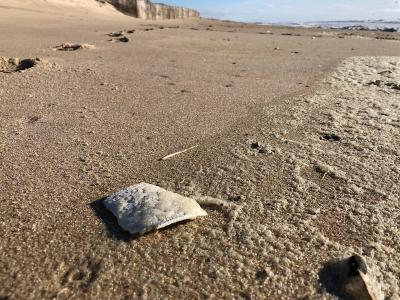
A piece of a Styrofoam cup on the ocean beach. A new ban on polystyrene in the town points to its prevalence among litter.
Carissa Katz
By
Christopher Walsh

During an East Hampton Town Board public hearing on a prohibition of polystyrene, commonly referred to as Styrofoam, on Jan. 17, nine people, some of them members of the Surfrider Foundation, spoke in support. No one spoke to oppose a ban, and the town approved it later in the meeting.

The code amendment, which adds polystyrene products to a law prohibiting single-use plastic bags, speaks to its classification as a possible human carcinogen, the difficulty in recycling it, and its prevalence among litter and in landfills in the town.

Inspired by “the power of one word in advertising,” Kathleen Kirkwood, chairwoman of the town’s recycling and litter committee, distilled her message to its essence. “Styrofoam: bad,” she said.

Under the new law, no stores shall possess, sell, or offer single-service polystyrene articles. It takes effect on April 22 or upon filing with the secretary of state, whichever is later, to allow retailers a period to dispose of existing inventory.