Price? It All Depends

Price? It All Depends

Julia C. Mead | May 8, 1997

The boundaries of parcels in East Hampton Town may seem firm, but subdivision regulations have only been around a few decades and many older lots were created by a far less precise process. Old wills, barely legible handwritten agreements, or ancient quitclaim deeds - unreliable sources that may at times conflict - are often used to document the boundaries.

Take the case of a 4.7-acre parcel off the corner of Northwest and Old Northwest Roads. Long and narrow like a bowling alley, wedged between another bowling alley and a strip of two-acre house lots along Old Northwest Road, the lot is owned by investors grouped under the name Fiona Inc.

A Bargain, But. . .

It is part of the disappearing white pine forest that once covered most of Northwest, highly coveted now by builders and homeowners for its soft light and graceful terrain. At the rear is Joshua's Hole, a freshwater wetland at the hub of trails used occasionally by hikers but mostly by thirsty deer. There are nature preserves on two sides of Joshua's Hole, with a third side about to be preserved.

The Fiona parcel is recommended by the town open space plan for preservation, not just for its wetland and white pines but as a link in the Northwest Woods trail system. However, the town has so far made no move to buy it.

Zoned for three-acre residential use and in a water recharge district, which restricts clearing, the parcel was priced at a firm $135,000. So firm, in fact, that when an offer came in a couple of months ago the principals of Fiona balked at anything under $150,000, to cover the broker's fee.

The deal went to contract. Michael DeSario of Cook-Pony Farm, the broker, said the price was a great bargain by current Northwest standards - for a buyer who was willing to wade through the complications and wait eight months for the permits.

Not So Simple

"It's not so simple to buy land anymore. All the easy lots are going, going, gone. What we have left are lots of pieces that are difficult to get to the bottom of. It shows you how small this town has become," said Mr. DeSario.

The Fiona lot's narrow width and proximity to wetlands could make it a tight fit for a house. Its length necessitates up to 1,000 feet of drive way, which could add $20,000 to the cost. The wetlands need to be flagged. And, the title is hazy.

Fiona Inc. paid just $1,000 for it in 1987, after obtaining a quitclaim deed from Howard T. Finch, a resident of Ridge. Mr. Finch inherited the property from his father, who bought it for $1 from James and Margaret Gay and their son, John Gay, in 1915.

Muddy Waters

That may sound straightforward enough but a card in the Town Assessors Office contains a cryptic note, dated 1987, saying the owner had theretofore been unknown but was believed to be the estate of John Gay.

It doesn't mention the Finches, but goes on to say that a bygone developer, Algonquin Realty, may have intended to include the parcel in a series of old filed maps in the neighborhood. It never did.

To further muddy the waters, one Margaret Gardiner sued Fiona Inc. in 1989 to resolve a dispute over the north boundary. Howard Finch has died, and his estate, which retains an interest, has not gone to probate yet.

"This lot definitely would have been more valuable if all the questions were answered and there was no risk . . . . It could take eight months of work to clear it all up, and then you're not really sure of what you're going to get," said Mr. DeSario.

He said a similarly-sized lot nearby without such physical and legal complications sold recently for $200,000.
 

Amagansett Is Still Serene

Amagansett Is Still Serene

Susan Rosenbaum | May 8, 1997

As part of The Star's ongoing series on real estate, each week will include a brief look at the market in a particular hamlet. Amagansett is in the spotlight this week.

"People are pouring millions of dollars into Amagansett," Peter Hallock, the president of Allan M. Schneider Associates, a prominent East End real estate agency, reported this week.

Nonetheless - and maybe this is why - the hamlet still retains that je ne sais quoi that used to mean "Hamptons," before sprawl, farmland development, and that hectic city feeling began afflicting communities just west.

"There are more shrinks per square foot in Amagansett than anywhere in the Hamptons," said Robin Kaplan, a manager at East Hampton's Tina Fredericks agency. "There's so much water, it's very serene."

Serenity has its price. Brokers say there is very little prime land left in the hamlet, particularly south of Montauk Highway, and no one in the business seemed fazed by the $675,000 price tag on a buildable Bluff Road acre, complete with ocean view, that recently came on the market.

Line In The Sand

Demand is "pushing east," said Mr. Hallock. Indeed, development in Amagansett's dunes has reached the final frontier - Shipwreck Drive, which borders the fragile ocean dunes preserve that makes up Napeague State Park.

Approximately 36 percent of Amagansett's 2,370 acres, which include Napeague, is preserved open space, a notch above the town's 32 percent, according to Lisa Liquori, the planning director.

From Atlantic Avenue east to Shipwreck, whatever parcels remain run from $200,000 up. The "next wave," according to Arlene Reckson, a Schneider broker, will be "rehabs and teardowns" of older, smaller cottages - something already happening in a big way on the little streets off Bluff Road.

North Of Highway

Privacy, lush land, and rolling hills still can be had north of the highway -in a 12-lot development near Fresh Pond, in Hawk's Nest, and in the Bell Estate, where brokers say lots priced from $600,000 to $1.2 million are "trading briskly."

"There's something for everyone in Amagansett," said Kevin Conboy, the manager of Schneider's office there, which opened five years ago. Some of the hamlet is still "undiscovered," he said, pointing out that properties on "the lanes" offer proximity to ocean, village, and Hampton Jitney at half the cost of similar convenience in East Hampton Village.

The rest stop the Montauketts named Amagansett, or "place of good watering," for its underground springs, seems still to hold true to its name - especially for those who love New York City, but find it difficult to be there full time.


Land Rush Accelerates

Land Rush Accelerates

Josh Lawrence | May 8, 1997

This is the third article in a series examining various aspects of real estate on the South Fork.

Even as East Hampton Town attempts to implement the "final chapter" of its new Open Space Plan, local real estate brokers are facing a strong demand for vacant land, both south and north of the Montauk Highway. The problem is finding it.

At the high end of the market, vacant land is a scarcity, brokers agree, and available oceanfront land, virtually nonexistent. So what's a millionaire to do?

The dwindling number of premium south-of-the-highway lots - coupled with the burgeoning real estate market - is having an impact on land prices in other parts of town and fostering some new trends.

Supply And Demand

Not that there is a shortage of lots in general, townwide. There are plenty out there - from quarter-acre slivers on old filed maps to expanses of woods in Northwest. But ask a broker about premium estate property south of the highway, and you may be out of luck.

"The market for prime land is really up," said Stuart Epstein, the owner of Devlin-McNiff Real Estate in East Hampton. "It's just the old supply-and-demand thing. There's just none left."

That applies especially to coveted vacant oceanfront properties. Devlin McNiff's computers list roughly a dozen such lots left between Napeague and Southampton. In Montauk, only a few parcels on Old Montauk Highway remain, with four more to be created in the Shadmoor subdivision.

No Vacancies

"I have people who want to spend $1 million. We can't find them anything," said Richard Monte, who owns his own firm in Montauk. "There's nothing available on the ocean right now."

Brokers agree the market for such oceanfront parcels and other high-end property is strong, but say the record prices accompanying them may be viewed as unrealistic.

The only available vacant parcel on Lily Pond Lane, a 3.7-acre lot owned by Loida Lewis, is selling for $7 million. In another corner of East Hampton Village, on Further Lane bordering Two Mile Hollow Beach, 12 oceanfront acres once owned by the Evan Frankel estate are listed at $10 million.

Though the 98-acre Shadmoor development is still awaiting approval, the four proposed lots overlooking the ocean range in price from $3.2 million to $5 million. The largest lot is over 10 acres.

Soon Gone

Despite such price tags, Brendan Brindise of Pantigo Realty in East Hampton predicted most of the premium vacant properties on the market will be scooped up quickly.

"There are some [prime parcels] left," he said, "but if the pace of sales keeps up at this rate, they'll be gone in probably another 18 months."

Michael DeSario, who specializes in vacant land for Cook Pony Farm Real Estate in East Hampton, pointed to two major tracts in the Georgica area that have the potential to be divided, but instead have remained single estates.

The Creeks, Burnt Point

The Creeks, Ron Perelman's 58-acre spread just east of Wainscott, could have yielded 10 lots, some along Georgica Pond, if subdivided under current zoning.

Meanwhile, 37-acre Burnt Point on the Wainscott side of the pond was recently purchased by R. David Campbell, who tore down an old house owned by the Mathews family to build a new one.

The Creeks and Burnt Point demonstrate two of the current trends in the high end of the market: one, wealthy buyers are purchasing developed properties and tearing down or extensively renovating existing houses, and, two, buyers with money have been looking to buy larger spreads, and not hesitating to head north.

Teardowns

Brokers agreed that teardowns are the wave of the future in East Hampton's estate section. "That's our new land," said Peter Hallock, the president of Allan M. Schneider Associates. "Teardowns are our new 'vacant' land."

Two years ago, Mr. Hallock said, his office sold an oceanfront estate at the end of West End Road for $6.75 million. The buyer tore down the house, which dated to the 1940s, and built a new one.

The same has occurred recently on Further Lane, Highway Behind the Pond, and Apaquogue Road, to name a few.

"People aren't as much interested in parcels of land [south-of-the-highway] as they are in tearing down existing houses to build what they want," said Dick Baker, who heads East Hampton's Amaden-Gay Agency. "That certainly has been the wave of the near past."

The teardown phenomenon will be examined in depth in an upcoming article as The Star continues its real estate series.

Buyers Seek Privacy

Not everyone in the market for an estate-quality property is willing to go to such extremes for location alone. Several brokers noted the trend toward larger, more private lots outside what used to be called the "summer colony."

"People have been deciding in the past few years they want more space," said Mr. Hallock. "There's a real trend toward having more land, more privacy."

Mr. DeSario agreed. "There's more of a demand for a lot of land," he said. "All of a sudden they're looking for 10 acres. It's almost like they're paying for space."

Farm Subdivisions

Some buyers have been looking to the farm field areas of Bridgehampton and Sagaponack, where there is heavy subdivision going on. On Guyer Road in Bridgehampton, for example, a 2.8-acre piece of vacant land off Scuttlehole Road sold recently for $475,000.

Farther east, there is Northwest Woods. "Northwest is a place where you can go and put a nice house on two acres, with all the extras, for $600,000," said Mr. DeSario. "If you went south of the highway, you'd be looking at $1.5 million.

Despite the belief that the colonization of Northwest by such luminaries as Donna Karan has helped revive interest in the area, brokers believe the trends simply point there, and to other north-of-the-highway places.

Northwest Woods

With more than 50 new house lots just approved and a number of other roads finally ready to be developed, Northwest is certainly enjoying a healthy market - on both ends of the scale.

Subdivisions like the newly opened, 17-lot Cedar Woods are finding willing buyers for acre-or-more lots ranging from $160,000 to $225,000. The subdivision went on the market in March and five of the lots are already in contract, Mr. DeSario noted.

The figures reflect a steady increase in Northwest values over the years, said Mr. Epstein, who lives on Cedar Trail, right next to the Cedar Woods development. He should know. He bought his more-than-one-acre lot for $115,000 just five years ago.

Million-Dollar Mark

Elsewhere in the area, said Mr. Epstein, there are currently two listings for developed land - not on the water - for over $1 million. The properties and their houses overlook a 14-acre meadow on Hand's Creek Road, formerly owned by the publisher Barney Rosset.

Though vacant land hasn't climbed that high in Northwest, the million-dollar mark for non-waterfront property still had significance, Mr. Epstein said.

"It means the threshold has been transcended," he said. "It wasn't that long ago when the most expensive property in Northwest went for $500,000."

North Haven

The market for prime real estate is also slim in pricey North Haven, where only a handful of vacant waterfront parcels in the exclusive North Haven Point and West Banks subdivisions remain.

One of the remaining bluff-top lots overlooking the bay in West Banks is listed at $775,000 for just over two acres. That may be a bargain, considering the development it's in - a palatial estate built on another of the waterfront lots is currently on the market for $12 million.

"North Haven continues to be a decent alternative to paying top dollar south of the highway," said Price Topping, a broker with Sotheby's International Realty in Sag Harbor.

But just as in East Hampton, when it comes to land, prime lots are scarce. "The main thing is, there's very little left, in North Haven and in Sag Harbor," said Alfredo Merat, whose firm, Overseas Connections, represents West Banks.


Recorded Deeds 05.08.97

Recorded Deeds 05.08.97

Data provided by Long Island Profiles Publishing Co. Inc. of Babylon.
By
Star Staff

AMAGANSETT

Fasteau to Tim and Amy Case, Whaler's Lane, $255,000.

BRIDGEHAMPTON

Leahy to Peter Murphy and Elizabeth Weston, Butter Lane, $422,000.

Alper to Lazaras and Ivette Mavrides, Bridgefield Road, $1,100,000.

EAST HAMPTON

Cavelli to Frank Newbold, Egypt Lane, $415,000.

Antler to Lorraine Kirke, Cottage Avenue, $2,100,000.

Brierley to Luis and Maria Mussio, Boxwood Street, $215,000.

Chester to John Shanholt, Cove Hollow Road, $220,000.

MONTAUK

Passanante to Casilda Huber and Cintra Sander, Kirk Avenue, $190,000.

NORTHWEST

Ambrosole to Cynthia Armine and Geri Klein, Alewive Brook Road, $315,000.

McPhillips to Rodney Wickline, Settlers Landing, $160,000.

Chester (trustee) to National Brand Licensing Inc. Wasting Trust, Bull Run, $185,000.

Venture Contracting Corp. to Patricia Romanzi, St. Regis Court, $525,000.

SAGAPONACK

Sagg Fields Dev. Corp. to Peter Lampack (trustee), Saga ponack Main Street, $340,000.

Tutt to Sam Linder and Arthur Alban, Farm Court, $310,000.

SPRINGS

Olsen to Guy Horne, Harbor Lane, $200,000.

WAINSCOTT

Barton to R. David and Elizabeth Campbell, Wainscott Stone Road, $1,520,000.

WATER MILL

Bebbo to Todd and Carolyn Bratton, Flying Goose Path, $313,000.


Profusion Of Squid

Profusion Of Squid

May 8, 1997
By
Russell Drumm

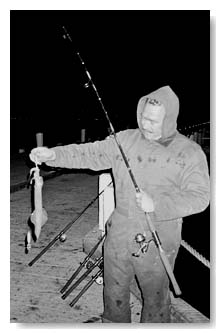
A late spring run of squid exploded along the bay side last week and continues to fill commercial pound nets and the coolers of young squid jiggers.

Nighttime jiggers reported the dark surface of Fort Pond Bay turning white on Friday and Saturday as thousands of schooling squid moved in swirls and eddies under docks and along the shore.

In response to the squid blitz, Montauk's Viking Fleet of party boats is offering squid fishing trips tomorrow through Sunday, and for the next three weekends. The squid boat leaves the Viking Dock at 7 p.m. and returns at 2 a.m. Reservations are required and can be made by calling Viking headquarters on West Lake Drive in Montauk.

Best Run In Years

Trappers are enjoying the best squid run in years. One trap in Fort Pond Bay reportedly yielded more than 3,000 pounds after a one-day set. Those located at Devon have also benefited from the surprise run, which includes hefty squid of the 8 to 10-inch size. The price is correspondingly hefty, nearly $1 a pound for the fisherman.

In addition, traps located at Devon and farther west in Gardiner's Bay are said to be filling with butterfish, porgies (scup), and bunker, along with a fluke here and there.

Butters and scup are delicious for eating, of course. These days, the bunkers - known in government circles as an "industrial species" because they have been processed for oil and meal - are bought up for bait by lobster fishermen. Brad Loewen's Hedges Banks trap reportedly has been producing a good supply of bunkers.

Frozen For Bait

Stewart Lester of Springs, who has not yet got his lobster pots in because of bad weather, said there was a promising showing of "ground keepers" - those lobsters that stand their ground over the winter and enter pots before the run of migrating lobsters shows up. It's a rare lobster indeed that can resist a slightly ripe, oily bunker. That's why lobstermen are buying up the recent bunker run and freezing them for bait.

Speaking of which, the spring run of mackerel is passing offshore of Montauk. It's time for charter captains, who chase tuna later in the season, to run out to the mackerel schools and load up. After being caught, the fish are kept on ice water to preserve freshness. They are then linked with thin twine, head-to-tail, as though chasing one another. A hook is secreted in one mackerel in the "daisy chain."

Like bunker bait, the daisy chains, along with individual tuna "chunking" baits, are frozen for later use.

Striped Bass

While the commercial striped bass fishery will not get under way until July 1 at the earliest, the recreational fishery begins today. Surfcasters have been catching small schoolie stripers at Ditch Plain in Montauk, on the north side of Montauk Point, as well as at various places on the bayside.

Regulations have not changed for sportfishermen. They are allowed to keep one fish measuring 28 inches or longer per day unless they are fishing on a charter or party boat, in which case they may catch and keep two of that size per day.

The 590,000-pound commercial quota given to New York State by the Atlantic States Marine Fisheries Commission last year will remain the same in 1997. However, the allocation among fishermen will change.

Two Kinds Of Permits

The rod-and-reel and net categories of fishermen are to be abandoned. Instead, fishermen will either get a "partial-share" permit or a "full-share" permit.

To get a full-share allocation of the tags required for the sale of bass, a fisherman will need to have a commercial food fishing license and a commercial striped bass license and show that 50 percent of earned income was derived from fishing during any of the years 1994, '95, or '96. Otherwise, they may stay in the fishery, but participate on a reduced level.

The healthy number of baitfish and squid around bodes well for bass fishermen.


Creature Feature: Beware The Pretty Poisons

Creature Feature: Beware The Pretty Poisons

Elizabeth Schaffner | May 8, 1997

Many pet owners bemoan the digging, chewing, and rampaging damage their animals do to their gardens, but they often are unaware of the damage their gardens can do to their pets.

To most of us, azaleas, lily of the valley, daffodils, and hyacinths are sweetly scented blooms bobbing in spring sunshine, but to veterinarians they present a darker picture. All of them are toxic.

Other familiar garden and landscaping plants that contain life-threatening toxins are boxwood, mountain laurel, foxglove, monkshood, yew, privet, lupine, rhododendron, and Japanese pieris. Do not let your pets chew on any of these plants.

Beautiful But Dangerous

Less toxic but still considered dangerous are wisteria, delphinium, English ivy, hydrangea, narcissus, daffodil, jonquil, amaryllis, Easter lily, glory lily, hyacinth, lily of the valley, bleeding heart, autumn crocus, trumpet vine, lantana, angel's trumpet, laburnum, and helleborus.

Given how commonly these plants occur in our gardens it is remarkable that pets are not poisoned more frequently. In fact, poisoning occurs so seldom, "It's conspicuous by its absence," said Dr. Dale Tarr of the East Hampton Veterinary Group.

Since adult animals will generally avoid these plants, the pet-owning gardener needn't rush out and dig them all up. But they shouldn't be lulled into complacency, either. Dr. Jonathan Turetsky of the Veterinary Clinic of East Hampton recently treated a cat who'd made herself very ill indeed by feasting on the stems of daffodils.

Young Animals

Pet owners should educate themselves about the contents of their gardens and the toxicity levels of the various plants, advises Dr. Alice Gwaltney of the National Animal Poison Control Center, so if they see their dog nuzzling up to the foxglove, they'll know to nip that activity in the bud immediately.

Young animals are another matter entirely.

"Puppies . . . they're the worst!" said Dr. Turetsky. With their insatiable desire to chew, puppies are continually on the verge of being poisoned.

"You have to treat them like infants," said Dr. Davis. "During their first year I tell owners they have to watch them because they'll chew on anything. The first year - that's the bad year."

Kittens are a little less likely to accidentally commit suicide, but it's not entirely unlikely. At least they mature faster. By 6 months of age, they're usually "out of the danger zone," observed Dr. Davis.

Horses And Goats

Horses and other herbivores have a great deal of sense when it comes to toxic plants - usually. "It's very unusual for them to get poisoned, but people should be aware of the possibility," said Dr. John Andresen of the Mattituck-Laurel Veterinary Clinic.

The glaring exception to this rule is the goat, an animal always prepared for gastronomical adventure. "We see a lot of goats poisoned by rhododendrons," said Dr. Andresen.

Cats and dogs are lucky; they can vomit. Their usual reaction to the presence of toxins in their systems is to throw it up.

"This makes the effect of most poisons self-limiting," Dr. Davis noted.

Remedies

Horses, on the other hand, lack the ability to regurgitate. They are therefore in greater danger when poisoned.

"All that can be done is to give them activated charcoal to absorb the toxins, and/or mineral oil to speed the poison out. Sometimes you have to keep them on supportive treatment and administer intravenous fluids and sedatives if they are convulsing," advised Dr. Andresen.

Fortunately, most poisonous plants are unpalatable to horses. But since horses are grazing animals whose digestive systems are built for all-day nibbling, in the absence of more palatable fare they may be driven to chow down on the untasty and unhealthful.

Fertilizers

When the grass in the pasture is low, supply hay to supplement it, advise the experts. And, if the pasture contains oaks, red maples, chokecherries, apple, peach, black locust, horse chestnut, or black walnut trees, strongly consider removing them, for they are all toxic to varying degrees.

Fertilizers, insecticides, herbicides, and fungicides may make our gardens more beautiful but they, too, can present dangers to a pet's health.

"Always plan fertilizing around rainstorms," said Dr. Davis. And keep the animals off the site for at least 24 hours.

If it rains after you've applied a herbicide, keep the pet away from the area for even longer. Pets can lap the rainwater from a treated leaf and ingest the chemical.

Dr. Davis has seen poisoning in horses pastured near farm fields that were sprayed with insecticides.

Insecticides

The most dramatic case of poisoning Dr. Andresen ever saw also involved insecticides. A horse went into violent convulsions after eating hay that had been grown alongside cropland sprayed with insecticides.

All garden chemicals should be stored where animals can't get to them. The pet-owning nonorganic

gardener would be well advised to keep the American Society for the Prevention of Cruelty to Animals' Poison Hotline number - 800-548-2423 - on hand.

Pet-owning gardeners can enjoy both their avocations to the fullest as long as they keep in mind Dr. Davis's advice: "If the pet is chewing on any plant, take it away from it! Except grass. Grass is okay, they can chew on that."

Sounds In The Night

Sounds In The Night

May 8, 1997
By
Star Staff

The Nature Conservancy has scheduled a children's walk through the Sagg Swamp Preserve in Bridgehampton beginning at 7:30 p.m. on Saturday. Marnie Bookbinder, director of preserves, will lead kids aged 8 to 12 in search of the sounds of peepers, owls, and "creatures that glow."

Reservations are required, and may be made by calling the Conservancy at its East Hampton offices.

The Conservancy is also offering two tours this weekend of its Mashomack Preserve on Shelter Island. The first, a hunt for woodland warblers, will assemble at 7 a.m. tomorrow at the entrance to the preserve, just off Ferry Road, for a two-hour trek led by Tom Damiani.

Tours Of Mashomack

On Saturday, a six-mile hike starting at 1 p.m. will pass by early-flowering trees including dogwood and shad as well as the remains of an early cottage, Miss Annie's homesite, and the Manor House, once known as the Bass Creek Cottage. Reservations for the walks may be made by calling the Conservancy on Shelter Island.

Earlier Saturday, the East Hampton Trails Preservation Society's Rick Whalen will guide walkers on a 10-mile hike through the rolling beechwood forest in Amagansett and the pitch pines, salt meadows, and beaches of Napeague. Hikers will look in on Fresh Pond and view Napeague's shad boom.

The society has recommended that liquids and lunch be brought along on the long walk, which will meet at the Hither Hills overlook on Montauk Highway at 10 a.m.

Mother Nature's Day

An interpretive hike through Montauk County Park on Saturday at 9:30 a.m. is the first in a series sponsored by the County Department of Parks, Recreation, and Conservation. Those interested have been asked to call Debbie Epple at Parks Department headquarters in West Sayville.

Sunday is Mother's Day, and "Mother Nature's Day" as well, says the Group for the South Fork, which has planned a family-oriented hike through mixed habitats in the Westhampton area from 1 to 3 p.m. The leader, Vikki Hilles, will be looking for evidence of maternal activities: nest-building, egg-laying, and territorial defense.

Also on Mother's Day, the Group will take canoers around Accabonac Harbor in Springs from 9 to 11 a.m. Mike Bottini, the leader, will describe the harbor's history and abundant wildlife as the paddlers glide along. Reservations for both adventures can be made by calling the Group's headquarters on Main Street in Bridgehampton.

Kids And The Bays

In other news, the annual Peconic Bays Children's Conference gets under way tomorrow at Southampton College at 9 a.m. Schoolchildren from East Hampton, Southampton, Montauk, Hampton Bays, Riverhead, Southold, and Greenport will perform and exhibit projects celebrating the Peconic Bays system.

The conference is sponsored by the Peconic Estuary Program, the Moore Charitable Foundation, and the Towns of Southampton and East Hampton.

Finally, volunteers to help the Nature Conservancy erect fencing and predator control devices on Saturday have been asked to call the East Hampton office today to receive their assignments and meeting places.

Film Festival Gets New Cast

Film Festival Gets New Cast

Julia C. Mead | May 8, 1997

The Hamptons International Film Festival, conceived as a showcase for independent filmmakers and as a community-based, year-round organization, is taking on some high-powered board members and intends to make its presence felt in New York City.

The goal is to reinforce the festival's shaky financial base and to enhance its programming with corporate support.

"We are trying to expand the board with new blood and new ideas, new money and new sponsorship," said Stuart Match Suna, a vice chairman and head of Silvercup Studios. "We're looking beyond the existing sponsorship and keeping the focus on the South Fork because we want it to truly be an international film festival."

Four Nominees

Members of the board were to have voted by phone last night on four board nominees. Festival officers declined to name them, but said they were chosen for their corporate and/or professional connections.

The Star, however, learned the nominees were Claude Wasserstein, a journalist and filmmaker who has her own production company and is the wife of the financier Bruce Wasserstein, Michael Lynne, the head of New Line Cinema, Cindy Sulzberger, who is the daughter of the publisher of The New York Times, and Jonathan Canno, the owner of a paper bag manufacturing company.

All have part-time residences in East Hampton. Ms. Sulzberger expects to take a year-round job here as a teacher. Mr. Lynne is a second vice president of Guild Hall.

Changes On Top

The festival has, since its inception four years ago, been known as much for growing pains as for its artistic and popular successes. It lost its first two executive directors, its original artistic director, a subsequent program director, and both its founders.

Six of 18 board members quit in the last few months alone, and now Toni Ross has announced that she will step down as chairwoman after this year, although she said she would remain on the board. Ms. Ross is active in the new Hayground School and co-owner of Nick and Toni's restaurant and other businesses.

Among others who have left the board are Karen Fifer Ferry, wife of the Southampton Hospital president, who resigned two months ago. Ms. Ross said Mrs. Ferry resigned from four boards altogether, citing "too much on her plate." Tinka Topping of Sagaponack, who had been a vice chair, also left this year, as did Maria Pessino-Rothwell, Robert Sands, and Frank Yablans, all South Fork residents.

Searching For Balance

"We're trying to create a more balanced board. Some of our members bring money, some bring connections, some do the work on the committees, and some have wisdom in a particular field," said Ms. Ross.

Patricia M. Weeks, whose husband is a well-known documentary filmmaker, and Rodney Miller, the festival's first black board member, were the most recent arrivals to the board. Mr. Miller, like the festival's treasurer, Robert Wiesenthal, is on the board of First Boston, an investment bank.

Ms. Ross, who has been chairwoman since the first festival, in 1993, is the daughter of the late Steve Ross, who was the chairman of Time Warner, an early corporate sponsor. This week, she emphatically denied rumors that the festival would take a one-year hiatus to recover financially and, further, that its current executive director, Ken Tabachnick, was planning to leave.

Going Professional

The festival will go on in October, as it has for the past four years, but will become "more friendly to professional filmmakers," she said.

"From the inception, we intended to be fully operating year-round but that has turned out to be much harder and more costly than we anticipated," she said. However, she noted that this was the first year its East Hampton office, on Newtown Mews, had stayed open year-round, even if it had curtailed its hours.

Despite its funding problems, the festival hosted two well-attended screenings in East Hampton and Southampton this winter and a panel discussion of "Not in Our Town," a documentary about prejudice in a small town.

"If we had the funding, we could do the kinds of things we want to do," she said.

"Partnering"

"The festival clearly needs to find more financial support. I wouldn't deny that. Every nonprofit organization out there is finding it more difficult to fund itself. The climate for corporate underwriting has changed dramatically since we started up," Ms. Ross said.

Ms. Ross, who declined to discuss the dollars and cents, said this week that the board was looking to "bring the numbers down" by soliciting donations of services and equipment and "partnering with other organizations to make better use of the funds we do have."

She said the board had decided to work more out of Manhattan "since the organization is so tied to corporate underwriting, we need to have the presence there."

In addition to handing out $100,000 in prize money to student filmmakers and spotlighting their work, the festival has been a springboard for controversial projects, and Ms. Ross said she expected the programming would "continue to challenge the parameters of people's thinking."

Student Focus

Mr. Suna said the board had every intention of continuing its focus on students and planned to expand its connections with New York City film schools.

"We have some very creative ideas that we are still in the process of developing. . . . Some very good news will come out of this," Mr. Suna said.

Board members also noted there were plans to create a program for high-school students but no start-up date as yet.

Jeremiah Newton, an educational consultant to the festival from New York University's Institute of Film and Television at the Tisch School of the Arts, said the Hamptons Festival had given more money to student filmmakers than any other. He added that there were almost no festivals with a year-round mission.

Original Concept

Naomi Lazard, a poet, author, and screenwriter who founded the festival with Joyce Robinson in an office in Ms. Robinson's basement, said she quit the board days after the 1996 festival ended because she believed it was getting further away from its original mission, which she described as bringing "the best, the most interesting, independent, low-budget films here, with a year-round program of screenings and workshops for adults and children." Ms. Robinson quit several days before the first festival opened.

"For four years, I felt I had to struggle all the time to do that. . . . When we had no money, when it was all just a blue sky dream, that first summer we had three workshops of six weeks each," said Ms. Lazard.

"This organization requires a lot of good will and dedication. And aspiration to do the right thing, not to use it for other reasons, as a power base or a glamour trip. That would be so beside the point," said Ms. Lazard.

Other board members have said the mission Ms. Lazard and Ms. Robinson envisioned in 1992 may have been unrealistic.

"As any organization grows, its needs change and the interests of the board members change. . . . In the beginning, board members were a lot more hands-on, doing everything. That was what interested Naomi, but that is not ultimately what a board mem ber should be doing," said Ms. Ross.

The festival was seeded with a $10,000 donation from East Hampton Town, which has continued to make annual contributions, although not without controversy. Town Councilwoman Nancy McCaffrey, for example, has voted against doing so each year.

As to the general financing of the festival, its 1994 report to the state showed $526,000 in contributions, more than $76,000 in revenue, $554,500 in expenses, and a balance of nearly $44,000 at the end of the year.

Its 1995 filing, the most recent sent to Albany, showed an increase of more than $143,000 in support and revenue, but a considerable jump in expenses of nearly $206,000.


A Yearlong Party For The 350th Anniversary

A Yearlong Party For The 350th Anniversary

Julia C. Mead | May 8, 1997

Representatives of some 85 organizations turned out on the morning of April 30 to hear Bruce Collins, chairman of the East Hampton Town 350th Anniversary Committee, describe how the pieces of the yearlong celebration are falling into place.

At the committee's first public meeting, a breakfast at the American Legion Hall in Amagansett, Mr. Collins reported plans were afoot to hold a parade, strike a commemorative coin, sponsor an exhibit of historical documents, and publish a souvenir book and a comprehensive calendar of events.

The town will celebrate its tricent quinquagenary in 1998, and Mr. Collins, a former Town Supervisor and retired Village Highway Superintendent, heads the committee, which includes representatives from each hamlet and incorporated village. They have been working quietly for months.

Lawyer Volunteers

Mr. Collins told last week's gathering that the committee had thought to hire a professional fund-raiser to help raise money to pay for it all, but Thomas Twomey, a lawyer who heads the East Hampton Library's building drive, has volunteered for the job, and offered free legal help, too.

Mr. Twomey has led a campaign that raised nearly $3 million for the library's almost-completed expansion.

The anniversary committee has not yet put a budget together. Any money donated to the cause but unspent when the year is up will be turned over to the library's Long Island Collection.

The town, which seeded the effort with $15,000, is acting as the clearinghouse for donations until the committee is incorporated as a nonprofit charity. In that way, even the earliest donations will be tax-deductible, Mr. Collins explained.

The East Hampton Village Board agreed to make a $7,500 donation and gave the committee an office at Village Hall as well.

Community Effort

"There are few towns that can say they've reached their 350th anniversary," Supervisor Cathy Lester told the crowd, adding she hoped every organization in town would participate in some way.

East Hampton Village Mayor Paul F. Rickenbach Jr. called the planning of the celebration "an exciting mission" for the entire community.

The East Hampton Ladies Village Improvement Society could adopt the anniversary as the theme of its 1998 fair, or the Sag Harbor Chamber of Commerce could dedicate its Whalers Festival to it, were just two of Mr. Collins's suggestions.

A representative of the Quilters Guild of the South Fork said an anniversary quilt depicting various scenes from East Hampton's history was well under way. She suggested it be used as the illustration for a commemorative poster.

Dongan Patent On View

The committee and Guild Hall are planning a two-month exhibit, possibly from September through November 1998, of historical documents and artifacts, including maps and other papers from the Morton Pennypacker Collection at the library, and the original Dongan Patent.

Kept in the Town Hall archives, the patent, signed by Gov. Thomas Dongan in 1686, conferred on the townspeople the right to manage their own affairs and created the Town Trustees as the proprietors of the common lands.

A professional curator, still to be named, will gather "documents that have seldom if ever been seen by the general public," said Mr. Collins.

He added that the exhibit was deliberately timed for the start of the school year. Teachers will be encouraged to bring their classes to Guild Hall instead of Colonial Williamsburg in Virginia, and other such destinations.

Commemorative Coin

The Harbor for Boys and Girls will dedicate its 1998 annual fireworks dis play to the anniversary, Mr. Col lins reported.

Frank Borth of Montauk, an artist and former Town Councilman, has sent the committee a proposed logo and design for the commemorative coin. Richard Mamay, head of the East Hampton Village Ambulance Association, suggested the committee contact the local schools about a design contest for students.

Hugh King, the town crier and a committee member, said he had been drumming up interest in the schools and would carry the suggestion with him from now on.

Mr. Collins said he also wanted to see the Hook Mill run again, sails and all. He said it hadn't been cranked up since Ronald Rioux was Mayor, "and we backed up the traffic for hours."

Mayor Rickenbach remarked that completion of the restoration of the Gardiner Mill was being timed to coincide with the anniversary, too.

LTV Documentary

Trail walks and house tours are also being planned, and Mr. Collins urged church leaders to find a way to take part as well.

LTV videotaped and broadcast last week's meeting. Genie Henderson, the LTV director, said LTV wanted to encourage organizations to help tape all the anniversary events.

LTV, which maintains a videotape archive of various community events and meetings, would also like to find someone to turn those tapes into a full-length documentary, said Ms. Henderson.

Eunice Meeker, president of the Eastern Gate Garden Club, recalled that in 1948 a grand pageant involving hundreds of costumed residents had been held to mark the town's 300th anniversary.

The spectacle was filmed, but the film has been lost, and a search is on to find a copy, said Mrs. Meeker.

"If there's a pageant this time, I am not going to tackle a pig on the village green," declared Trevor Kelsall, the village historian, who was a teenager then.

Mr. Collins said, though, that the committee had ruled out such an event this time. There is talk of something on a smaller scale instead, perhaps a stage play at Guild Hall.

Rough Riders, Too

An official from the Suffolk County Parks Department attended last week's breakfast meeting as well. The Parks Department is holding a celebration of its own next year, a parade and other activities in September 1998 that will mark the 100th anniversary of Col. Teddy Roosevelt's Rough Riders regiment's monthlong convalescence from yellow fever in Montauk, after the Spanish-American War.

The county has been searching for descendants of the Rough Riders, as well as artifacts and memorabilia to display at Third House, which was called Camp Wikoff at the time.

Others at the meeting included representatives of town and village governments, police departments, the Baymen's Association, the Town Trustees, the East Hampton Village Ambulance Association, various cham b ers of commerce, Girl and Boy Scouts, the Friends of Erin, and the L.V.I.S.

In Attendance

The Jimmy Ernst Artists Alliance was there, too, as were the Veterans of Foreign Wars, schools and churches, historical societies, the Devon Yacht Club, the Montauk Village Association, the Lions Club, the East Hampton Business Alliance, the East Hampton Trails Preservation Society, and more.

Among the suggestions from the audience were bus tours of historic sites, a contest for a song about the anniversary, and garden tours.

Fifty years ago, said Mr. Collins, he could have "called everyone here by name," but no more. Newer residents, he said, "know they're in a nice place, but may not know why it's a nice place."

Celebrating the town's anniversary, he said, would be a fine way to teach residents, new and native, about its history.

Worth Celebrating

"Whether we've been here a long time or whether we're new, East Hampton, what it is and what it has been, has only been developed through hard work," said Mr. Collins. "And decisions have been made that not everybody's liked. Depends on who's ox was being gored at the time, I guess. But the fact remains that we have a town worth celebrating."

The committee has been meeting every other Thursday afternoon. Mike Finazzo, who organizes the Friends of Erin's annual St. Patrick's Day parade in Montauk, offered to produce the anniversary parade, too.

Mr. Collins said the committee will publish a newsletter containing articles of historical interest and a calendar of all the commemorative events. He asked that all organizations in town send in a list of their anniversary-related events by June 12.

Letters to the Editor: 05.08.97

Letters to the Editor: 05.08.97

Our readers' comments

The Grapefruit

East Hampton

May 5, 1997

Dear Ms. Rattray:

The first time the grapefruit was pitched in an artists' baseball game was in 1954. Thomas B. Hess was the first to write the story in the introduction of Fred McDarrah's "Artists' World":

"In the summer of 1954, in East Hampton, Long Island, the artists organized a Saturday afternoon softball game. Phillip Pavia, who had enjoyed the advantages of a regular Connecticut boyhood, was the best batter - a home-run specialist. His friends decided to counter this forte."

"A day before the game, Willem and Elaine de Kooning and Franz Kline, who were sharing the Red House, bought two grapefruits and a coconut. They worked until 2 in the morning sandpapering them and painting them to look exactly like softballs, with all the essential seams, cracks, chiaroscuro, and even a trade label, 'Pavia Sports Association.' "

"The next day, when the game was about halfway over, Harold Rosenberg came up to pitch. Pavia was at bat. Rosenberg pitched the first ball. Pavia swung, and it exploded in a great ball of grapefruit juice. There was general laughter and little shouts of, 'Come on, let's get on with the game.' "

"Esteban Vicente came in from behind first base (where Ludwig Sander was stationed with a covered basket containing ammunition); he pitched his first ball over easily. Pavia swung. There was another ball of grapefruit juice in the air. More laughter. Finally they decided that fun was fun, but now to continue play, seriously. Rosenberg came back to the mound. He smacked the softball to assure everyone of its Phenomenological Materiality. He pitched it over the plate. Pavia swung. It exploded into a wide, round cloud of coconut. 'Look, look,' shouted Pavia, as if he had always suspected that if you hit a baseball bad enough to break it, there would be coconut inside. Then, from nowhere, a crowd of kids appeared around home plate and began to pick up the fragments of coconut and eat them. They had to call the game.

Suddenly after the funeral of Willem de Kooning I read in local newspapers (not The Star) that Bill de Kooning was pitching to Ben Heller. Where is this story coming from? And one week later, Patsy Southgate repeats the same story in her New Yorker piece, "Remembering Bill."

The further we move from those classic years in American art, the more the actual occurrences of the period are reported wrongly or just plain buried under the embellishments of anti-historical writers and other persons who suffer from some kind of the Woodstock complex -if all who said they were at Woodstock were actually there, there would have been 50 million people in the audience.

Who knows, maybe in 20 years they will say it was Elizabeth Taylor pitching the grapefruit in the Artists-Writers Game, and a young Steven Spielberg was at the plate. (By the way, in The Star's 27 East a few years ago, your reporter Jack Graves did a whole article on this famous incident in the original unrevised form.)

Thank you,

PAUL PAVIA

P.S. Tom Hess was a leading critic and intellectual; also, editor-in-chief of Art News throughout the '50s and '60s to 1973.

A Lousy Deal

Melville

April 29, 1997

Dear Mrs. Rattray,

Your letters page bears a close resemblance to the old-fashioned New England town meetings, albeit in print, so I hope you will indulge me as you do so many others.

Back some time ago, Congressman Mike Forbes of your area decided he couldn't back Newt Gingrich as Speaker of the House and, to be honest, I didn't see the reason to do that.

However, just recently, Mr. Forbes beat the forces that opposed him and pushed through an amendment in the House of Representatives that protects small businesses, individual inventors, and universities like our own here on Long Island, from a lousy deal cooked up by President Clinton and the Republican Congress. Their scheme was to weaken the historic protections given to American ideas (intellectual property) through our patent system.

The fraudulently named "reform" bill taken up in the House of Representatives would have required every American who attempts to protect his unique idea by seeking a U.S. patent to publish his idea 18 months after applying. (Foremost, that's well before the patent has been granted). The whole world would then see his idea, and the forces of commercial espionage most likely would put the little inventor out of the game.

The Forbes amendment, fortunately, made it into the bill, thereby exempting our most vulnerable citizens - individual inventors, small-business men and women, and universities - from what would surely be the beginning of the end of American dominance in the global economy. Remember Eli Whitney and the cotton gin, Henry Ford and the Model A, or Thomas Edison and the light bulb? These "Horatio Alger" types defined America as the land of new ideas and new opportunities.

The patent "reforms," even with Congressman Forbes's valiant, winning effort to protect the little guys and gals who are brimming with ideas to enhance American lives in the 21st century, is a terrible bill.

As someone who took his idea to use water molecules in the human body to read patient's internal problems, I saw how strong patent laws made possible my efforts to bring magnetic resonance imaging to fruition and, thankfully, benefit millions of Americans.

The G.O.P. Congress and the President want to weaken U.S. patent laws so foreign countries will give us access to their markets. It's a bad deal by anyone's standards and deserves to die in the Senate.

Sincerely,

RAYMOND DAMADIAN, M.D.

Tax-Reform Junkies

East Hampton

May 5, 1997

To The Editor,

The Sunday Times Week in Review article on the world dominance of the United States economy was a frighteningly bizarre, eerie piece. Quoting Mort Zuckerman and a head honcho at Merrill Lynch (why not Daffy Duck and Milo Minderbinder?), it extolled the virtues of the deregulated free market system over the European and Japanese systems, the economic pre-eminence of the U.S. system, and the American way of life. The article also identified the negative fallout from the system and apologized for this fallout as unfortunate but necessary. Thus the frightening part of the story.

The essence of the story is that while twice as many people now live at the poverty level, real job creation is zilch, our education system is going down the tubes, and our inner cities are falling apart, it's really okay because business is booming, and profits are through the roof. The free market is working, even though more and more people are falling through the cracks. "If it's good for the company, it's good for everybody, because we are all part of the company."

The solution. Eventually these enormous profits will trickle down to the rest of the country. Meanwhile, government programs and tax reform will readjust income distribution.

The answer. The trickle stopped 20 years ago. What's good for big business is not necessarily good for the rest of the country. Tax reform is 99.99 percent garbage.

Tax reform. Our politicians are tax-reform junkies. They gotta propose it. It's like heroin to junkies, Prozac to the depressed, oral sex to the over-50's generation. It's safe, popular, and it never happens. It makes everyone feel they are getting something for nothing. The reality is, if you don't make a lot of money, tax reform means nothing. If you don't make any money, you don't save money.

Tax reform. Two legitimate reforms are lowering sales tax (regressive) and a steeply graduated income tax. Everyone pays the same sales tax regardless of income. How much money does someone need to live phenomenally? After a point it becomes obscene.

Capital gains. Pure scam. If the biggest boom economy ever generates few jobs and more poverty, what will reduced capital gains do? Give more income to people with lots of income. It's a tithe, a taking, a cadeau for the rich. "Because you are who you are." Who does the capital gains tax affect? Five percent, 10 percent, 15 percent of the population. What about the rest of us? We do all aspire to pay capital gains some day, and we must have our dreams. No?

So, we sit here depressed, in the middle of an economic boom. New jobs pay minimum wages, government programs are cut to the bone, and tax reforms are a joke. We are scared every way we turn, and they want us to like it. It feels like a Joseph Heller novel, and we are all pretending to be someone else.

NEIL HAUSIG