Ecological tumors. The sixth great extinction. Insect apocalypse. Deathscapes.
These were a few of the terms bandied about at Doug Tallamy’s talk last week at the Southampton Arts Center, hosted by the Lake Agawam Conservancy and attended by close to 200 people.
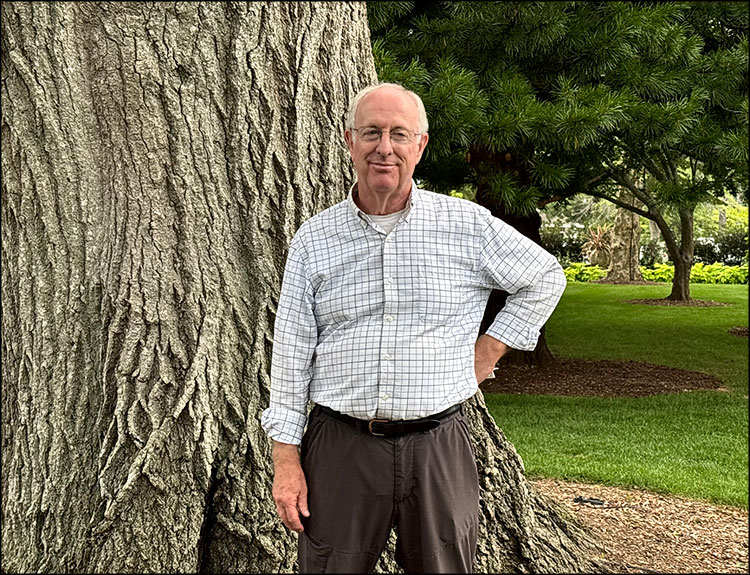
Mr. Tallamy is an entomologist, conservationist, professor at the University of Delaware, and best-selling author of “Bringing Nature Home,” among other titles.
But for all of the contextual doom, he came with a message of environmental hope and offered specific and easy instructions to exit the end times morass with a new approach to conservation.
“We can save our insects, we can save our birds, we can save nature itself, but we’re going to have to change the way we landscape to do it,” he said. “Don’t think about the entire planet’s problems. That’s just depressing. If you own a piece of property, it’s obvious, that’s where you start.”
“Our vision is very simple,” he continued. “We’re envisioning a world where conservation landscaping becomes mainstream as the default behavior of everyone and every organization. Nature is really resilient and it comes bounding back if we give it half a chance.”
Real quick, here’s what you do, in no particular order.
First, reduce lawn. Mr. Tallamy said there’s over 40 million acres of lawn in the country. That’s roughly the size of New England “dedicated to an ecological deadscape.” If that were reduced by half, the 20 million acres could be replanted with species that have ecological benefit.
(That idea is the crux of Mr. Tallamy’s “Homegrown National Park” homegrownnationalpark.org, which he co-founded.)
One easy way to reduce lawn is to create large beds around the base of trees and make these “no-mow” zones, where leaf litter remains. This also helps the survival rate of caterpillars, which turn out to be essential food items for birds (more on that later).
Second, plant native. “All I’m trying to say is that plant choice matters,” said Mr. Tallamy. “We want to rebuild ecosystems, but that’s not going to happen unless you have functional food webs and you’re not going to have functional food webs, unless you choose the plants that support those food webs.”
“If we lose our plants, we’re going to have to eat sunlight, and then we will all lose weight.”
He spoke at length about specialized interactions between insects and plants, between plants and birds, and said most of these relationships are threatened.
For example, blue jays are the primary disburser of acorns. They take one from an oak tree and fly up to a mile and a half away to bury it for later consumption. Thing is, for every four acorns they bury, they’ll only remember the location of one. This means they plant three oak trees each time, and since a single jay can bury 4,500 acorns every fall, a lot of trees get planted.
Plant a green giant instead and as far as ecology is concerned, you might as well install a statue. (Mr. Tallamy suggested visiting nativeplantfinder.nwf.org/ to find native plants.)
Third, turn off, or at least modify, outside lighting. “Light pollution is one of the major causes of insect declines,” he said. Leaving for the season soon and have your lights on a timer? Turn them off completely for the winter. Save money, the insects, and the night sky. If you must have them on, use amber bulbs, which don’t attract insects.
Fourth, stop spraying for ticks and mosquitoes. Studies continue to show that not only is spraying ineffective to kill the target pests, it negatively impacts non-target insects. The best way to protect yourself against ticks is treating clothes, understanding which ticks are active, and doing a nightly tick check.
Further, spraying for ticks and mosquitoes inadvertently interrupts the life cycle of many species of caterpillars.
“Caterpillars are enormously important in terms of transferring energy from plants to other animals,” said Mr. Tallamy. “As a matter of fact, they’re transferring more plants to other animals than any other type of plant eater, which is why Dan Janzen, a very famous ecologist, calls them the meat and potatoes, the bread and butter, of terrestrial ecosystems. If we design landscapes without a lot of caterpillars, we’re going to have failed food webs and eventually failed ecosystems.”
For most birds, caterpillars are essential: 5,000 are required to raise one clutch of chickadees and birds forage close, usually 50 meters or less, to their nests. “If you want chickadees to breed in your yard, and I would think you do, you’ve got to have all those caterpillars,” he said.
Fifth, remove the invasive plants from your yard. “They’re just ecological tumors,” Mr. Tallamy said, using a dark metaphor. “They escape and they keep spreading, spreading, and spreading.” Removing invasives such as bamboo, barberry, wineberry, miscanthus (Chinese silvergrass), ailanthus, autumn olive, Japanese stilt grass and garlic mustard leaves more real estate for natives, which add to, instead of subtract from, the food web.
“We need to start practicing conservation outside of parks and preserves,” he said. “We have to find ways for nature to thrive in human dominated landscapes. We cannot ignore private property because most of the country is privately owned: 78 percent of the lower 48 states is privately owned; 85.6 percent east of the Mississippi is privately owned. If we don’t practice conservation on private property, we’re going to fail. And failure is not an option.”
Mr. Tallamy’s universe is populated by a world of insects that most people have never seen, heard about, or can even imagine: acorn weevils, the solitary oak leafminer, the yellow-shouldered slug moth, and the goldenrod stowaway are just a few that he name checked. He used beautiful photography to show this secret and disappearing place.
At one point, like a beat poet, he quickly and hilariously ran through a long list of caterpillars that live on oak trees. Breathless at the end of his catalog, he yielded to wild applause.
He was making one of his main points: If we want to save our big stupid world, we have to save the beautiful invisible world first. The fates of both are as intertwined as an insect is with its host plant.
For all the talk of conversion of plant matter to energy, he spoke of another type of conversion. “We want to convert hope into action: Hope is good, but action’s even better.”
Autumn, by the way, is a great time to plant an oak tree.