
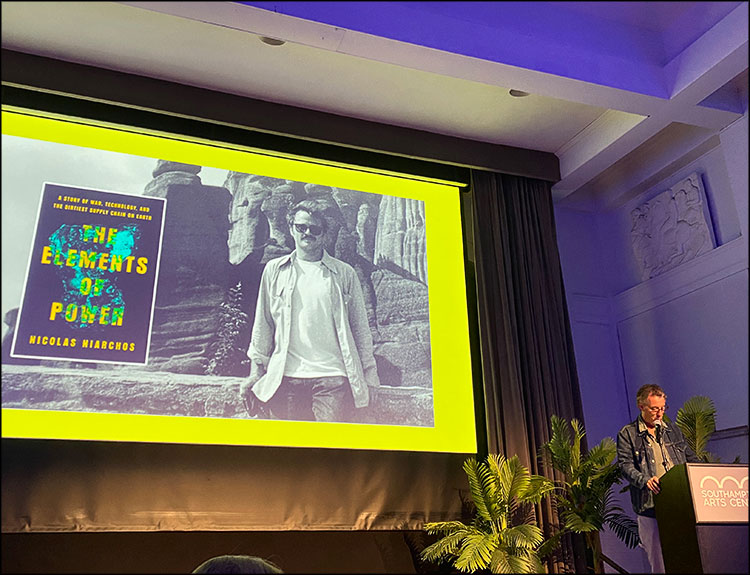
The Peter Matthiessen Center, named for the novelist, naturalist, and Zen teacher who lived in Sagaponack for 60 years, welcomed Nicolas Niarchos, an author and journalist, to the Southampton Arts Center on Tuesday, where he discussed his new book, “The Elements of Power: A Story of War, Technology, and the Dirtiest Supply Chain on Earth,” and the launch of Now Voyager, a magazine he co-founded and edits.
“The Elements of Power,” said the Matthiessen Center’s Alex Matthiessen, documents the green energy paradox: How the demand for clean energy technology and the minerals that power them, including the lithium-ion batteries that power electric vehicles, mobile phones, and computers, is a leading cause of inequality, instability, violent conflict, and environmental degradation in resource-rich nations like Congo and Indonesia.
The book “refuses to let us look away from the cost of good intentions,” Mr. Matthiessen said. “We talk a great deal about clean energy and the future we’re building, but Nic has gone to the mines, the borders, and the factories where that future is being extracted. In doing so, he’s highlighted a reckoning we must face: about war, about exploitation, about the people whose lives and lands are paying the price for a transition meant to save the planet. It’s precisely the kind of unflinching, deeply human storytelling that my father devoted his life to and that this organization exists to amplify.”
Paraphrasing Albert Camus, Mr. Niarchos said the responsibility of the writer is to speak for those who cannot speak for themselves. “What’s so important about what the Peter Matthiessen Center is doing,” he said, “is bringing some of the people whose worlds are being destroyed by globalization to speak about these issues.”
Referring to the recent floods in Nepal and Tibet, he noted that more than a thousand people are confirmed dead. “We saw it all — walls of water, buildings swept away, nature destroyed, children’s bodies on the street. And yet we scrolled through it” on our smartphones, he said. “If this is not a clarion call for activism against climate change, I don’t know what is.”
A dignified form of storytelling requires telling stories at length, he said. “If there is anyone who cannot tell their story, it is the artisanal miners of Congo, and especially those miners who are children.” Some are as young as 3, he said, “scraping away the rudiments of our technological world: cobalt, lithium, copper, and various other metals.”
Mr. Niarchos writes in “The Elements of Power” that on his first visit to Congo, in 2019, “I saw firsthand how some of the poorest people toiled in the country’s copper and cobalt mines, employing techniques that had been abandoned as far back as the 1700s in many other countries.”
It is very likely that “the phone in your pocket actually consists of minerals” that came from Congo, a “giant and troubled country at the heart of Africa . . . a place in which civil war and corruption have conspired to immiserate the population who were already immiserated by Belgian colonialism.” But it has always had resources the world wanted: enslaved people, then ivory, then rubber for tires, and then copper for wires as the world electrified.
“In many ways, we are living the same history over and over again in Congo,” he said, “and the people of Congo continue to lose out from global supply chains and global trade as people outside get rich.”
“I started looking at who was to blame for the system, and the system is in many ways baked into the way that business happens in the world,” Mr. Niarchos said. “The mining companies were surely to blame. We know how to mine cleanly, and yet we don’t because there is this rush for profit.”
But these elements are essential for green technology. “To meet climate goals that will make a dent in global warming, we need to massively invest in environmentally responsible mining,” he said. “One way to reconcile the goals of the new energy revolution with the terrible toll it takes on communities is fairly simple: We should listen to the people from the places where we get our minerals. We must listen to them about pollution in their communities and consider their dreams for a healthier, more balanced world.”