
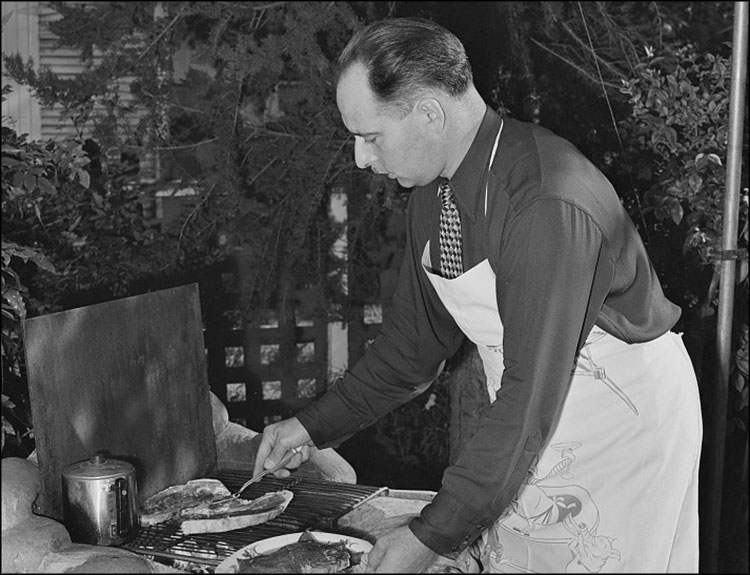
Open the heavy steel lid.
Place the chimney on the grimy steel grate.
Fill it with wood charcoal, the big lumpy kind, but not before placing a cedar fireplace starter stick in vertically. (Pick up the coals that miss the chimney and wipe off hands later.)
Stuff newspaper into the bottom compartment of the chimney, under the coals.
Light the paper.
Then wait.
Sometimes there’s not enough paper, or too much, or it’s a little damp, so the coals don’t catch. Remove or add paper and relight, and wait again.
(While we’re waiting: My grill is made by an 80-year-old Oklahoma company called Hasty Bake. It’s a large stainless-steel box built into a stone enclosure. I bought it because my Weber wasn’t up to my ambitions as a griller. It has a feature that’s hard to find, a crank that adjusts the height of the charcoal. But it also has its flaws: The crank shaft rusts and requires regular squirts of WD-40; doors don’t stay closed, drawers don’t slide, vents don’t open.)
After 15 minutes or so, the coals catch and start to burn red hot. Thick white smoke wafts from the chimney. It’s lit.
In another five minutes, flames pulse from the top of the coals. Most have turned white. Sparks fly, along with tiny explosions that sound like a kid’s cap gun.
Reassure my guests. There will be no fire, burns, or incineration. Here, it’s grilling as usual.
Open the aluminum door below the grate, revealing the slotted tray for the coals below. Turn the crank to lower it, and, when it’s low enough to clear the lip of the opening, pull it out.
Now, the pour.
Wear shoes, not flip-flops. (Most of my shoes, including my slippers, have burn marks in the soles because errant coals end up on the patio and are impossible to avoid.)
Put on a mitt and spread the coals evenly onto the tray. The heat on my face makes me turn my head away. Add more coals.
Wait 10 minutes. By then, the new ones are also white hot.
Use the crank to raise the tray with the coals and close the aluminum door behind it.
How high to raise the coals? Depends on what you’re cooking.
New York strip steak: About halfway, because the butter, olive oil, and fat from the meat drip and cause too much flame and charring.
Striped bass: Higher, because fish has no fat and chars more slowly, so put it closer to the flame.
Burgers: Don’t make them, because a perfect rare burger is almost impossible to deliver.
Funny, I don’t really smell much, either the food cooking or the charcoal. I smell other people’s barbecues, but not mine. Maybe it’s like our bodies.
In the TV show “M*A*S*H,” Hawkeye was temporarily blinded and described the rain on his metal roof like a steak being grilled. I can’t get that out of my mind, regardless of what I’m cooking.
Is it worth it?
I have a wood screen door. Every spring is the same.
Scrape the peel from the winter. Sand until smooth. Paint.
Pull out the brads that secure the trim. Replace the screens Lila tore. Renail.
Adjust the spring so the door closes, even when swung all the way open.
A wood door sounds better when it slams.
Jonathan Cranin is a retired advertising executive. He lives in Water Mill with his wife and rescue dog.