
The heavy rains the other day sent me sorting through the piles of papers on my desk. There I found a letter my grandmother wrote in May of 1954, three months after my grandfather’s death. I read the first lines and stopped.
In her looping handwriting, with sentences filled with dashes and ampersands and underlines, it begins: “The whole place is in bloom — all Daddy’s planting — the magnolia is in full bloom — the pear tree is out — the peach & plum trees are still in color — the apple trees and quince trees are coming & the wisteria. Still blooming all over are jonquils and daffodils. Narcissi & tulips come along each day — all colors. It is a beautiful sight all over.”
I was taken back to an early summer day of my childhood, weaving clovers into crowns and necklaces in my grandparents’ Southampton yard.
As a child, their garden was a place for games. My sisters and I not only braided clovers, we held buttercups beneath our chins to see who loved butter, and bent close to peonies in June to scrutinize the ants racing over the pink petals. Though tempted to brush them away, we were admonished to leave the ants alone; they protected the blossoms from beetles. Later, we competed with my brothers, jumping from the rope swing on the chestnut tree. And in the deep summer evenings, we all chased the bright sparks of fireflies.
After lingering with these memories, I returned to Nanny’s letter: “Today is Daddy’s birthday. I’ve been working in his study & I hope he knows the new curtains are there for his birthday & bouquets of flowers, etc.”
With that, I sank back into my desk chair that once belonged in my grandparents’ house, and closed my eyes. Gazing outward through tears, I realized that the orchard and garden she described as still “in bloom” in the midst of loss was the place that first taught me how to notice beauty and trust the seasonal cycle of flowering, dormancy, and regrowth.
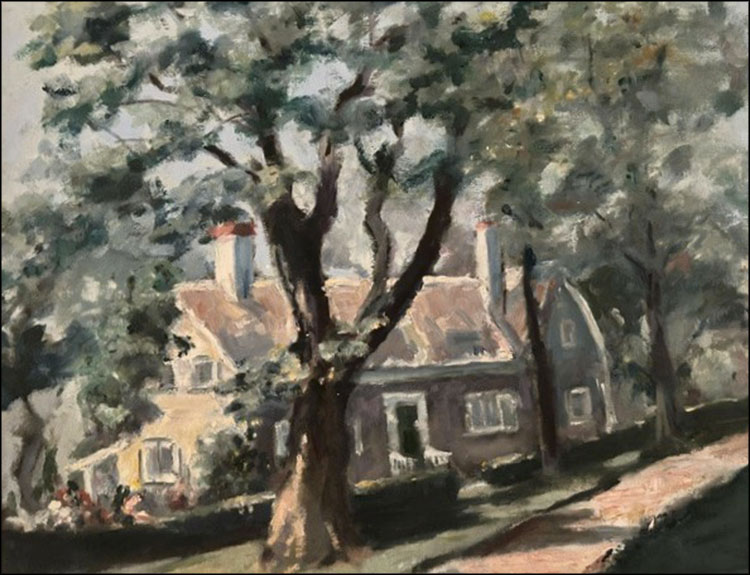
During the early years of my grandparents’ marriage in the 1910s, they began transforming his inherited property from a Federal farmhouse and barnyard into a gambrel-roofed summer house and English-style cottage garden. They kept the former orchard and named the property “Old Orchard” following Southampton’s tradition of naming summer houses after some quality of their locations. Letters arrived simply addressed to The Rev. and Mrs. Jesse Halsey/Old Orchard/Southampton, Long Island, New York. I know this because they kept every letter they received, and we have spent years going through them.
What survives from the orchard and gardens is the quince tree, some of the French lilac bushes, and a row of pink peonies. The hedges have grown high. After finding this letter, my sister Sally has planted hollyhocks, pear, and apple trees.
Two other family archives tie us to the orchard: a poem and a concrete plaque. The poem was written in 1943 by my grandfather’s sister, Abigail Fithian Halsey. She writes about her mother’s favorite oxheart cherry tree. After her mother’s death, the poem continues, “Little ones she never knew” played under its spreading boughs. Abigail includes the names of those little ones and describes a plaque bearing their handprints that later marked the spot where the cherry tree once stood next to the garden gate.
Nanny’s letter lists the garden’s May flowers. My early memories begin in June with white lily-of-the-valley clusters and fragrant French lilacs. By the end of June, the salty air filled with the intermingled scents of privet and honeysuckle. Later, regal delphiniums and foxgloves jostled for attention with high-stemmed hollyhocks that lined the south side of the house. In August, two “ponds” of orange day lilies bloomed until Labor Day.
My memory is that Nanny maintained a relaxed cottage garden; each plant came to full bloom and was left to fade. She may not have actively tended the garden, but she was never too busy to cut flowers and create vibrant bouquets to place throughout the house. As she selected an appropriately proportioned vase, cut-glass urn, ewer, or sugar bowl, I often watched her compose fresh cut blossoms. Nanny did this with the eye and precision of what I later came to know as a botanical artist.
With this thought taking me to the present, I went back to read the rest of Nanny’s letter: “I took some bulbs Daddy planted and transplanted them at the cemetery. They are doing beautifully.”
Two succeeding generations of headstones now stand where those cemetery bulbs once grew. The garden still blooms. New apple and pear trees are thriving in the orchard, and Nanny’s great-great-grandchild, Lucien, still races around the garden, drawn without knowing it to the flickering light of the fireflies.
Cynthia Schaffner, a decorative arts historian, is co-author of “Heart Art” (Pointed Leaf Press, 2026). She lives in East Hampton.