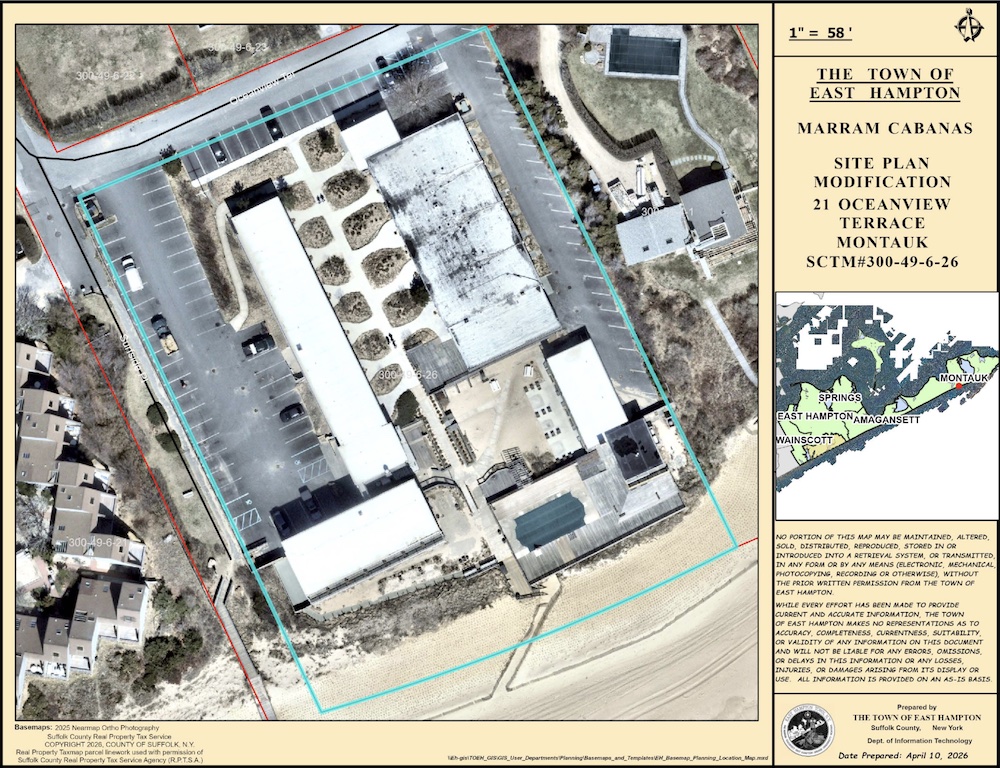
“Builder’s error” was the excuse that Ocean View Holdings L.L.C., better known as Marram, a hotel at 21 Ocean View Terrace in Montauk, used to defend a handful of poolside cabanas that were each placed five feet closer to a dune crest than what the zoning board of appeals had originally approved in 2024.
Marram also put in a new unapproved shed.
The poolside at the hotel is crowded. Theresa Berger, a Z.B.A. member, showed pictures during an Aug. 18 public hearing on the matter. The cabanas are only a few feet from the pool and the shed is crammed into a corner, just off the hotel.
According to town code, each of the six structures is supposed to be 150 feet from the bluff crest. In the end, the cabanas were only 30 feet from the crest, and the shed just 47 feet away.
Lauren Wiltshire, a land planner, spoke for Marram.
“This is a very small presentation on the slight shift of location of these cabanas,” she began. The cabanas are seasonal. They’ll be up May to September and then stored in the shed.
The important point, in her opinion, was that the cabanas, while five feet closer than originally approved, were still farther from the dune crest than the pool and the decking.
She agreed with the Planning Department assessment that there was no environmental impact.
Jaine Mehring, a Z.B.A. member, raised the idea of moving them to their approved location.
“If you took up all 20 of these metal footings you would destroy the underlying deck, and that would then have to be rebuilt as well, which would actually have more of an environmental impact than would just leaving the cabanas where they are,” said Ms. Wiltshire.
A month later, at the Sept. 15 meeting when the Z.B.A. made its decision, her argument still hadn’t convinced Ms. Mehring. For her, in this instance, the environmental impact wasn’t the important point.
“I do believe that the applicant has the responsibility, when this board approves something, when it goes through the system, takes time, they have a responsibility to oversee what’s happening relative to what was approved,” said Ms. Mehring. “As such, procedurally, I will, on that basis . . . be denying the added variance in the modification for the cabanas.”
“I don’t know what to say about this,” said Theresa Berger, a Z.B.A. member. “The planners thought that there would be no real added-on environmental impact on this, but I feel differently.”
Like Ms. Mehring, she voted against the cabanas and the shed.
However, the rest of the board reluctantly agreed with Ms. Wiltshire.
“I don’t like the idea that you can just add a shed in a spot like this without having gone for full review,” said Ed Johann, a board member. “I don’t like the idea that we keep getting told that it’s a ‘builder’s error’ every time somebody puts something where it doesn’t belong.”
“I don’t like it,” he continued. “I don’t like the way it came to us. I don’t like the fact that they did the shed without full review. But I’m afraid that this is one of those. . . . I don’t think it rises to the level where I can deny it based on that alone.”
James Kiley, another board member, agreed with Mr. Johann. “I don’t know that the public gains anything by denying it right now.”
Denise Savarese, the board’s chairwoman, noted that, like her fellow board members, she had concerns with how the changes took place, but agreed with Ms. Wiltshire that the cabanas weren’t a bigger environmental problem than the existing pool, which was even closer to the dune.
She offered a “strict condition of approval”: That the shed, with only sliding doors and no windows, could never be used for occupancy.
“The shed is only to be accessed for insertion and removal of cabanas,” she said. “No occupancy, storage of other materials or utilities proposed. And the cabanas themselves are seasonal structures.”