
It’s been nice to finally see some large schools of bunker swimming along our ocean beaches in recent weeks. For a good chunk of the summer, they were missing.
Now that they’re back, humpback whales have been on the feed very close to shore, munching on the oil-laden fish, much to the delight of beachgoers. Dolphins too have enjoyed the bunker buffet. How long this spectacle of nature will last is anyone’s guess.
However, schools of bunker — also known as menhaden, pogies, or mossbunker — have been have been harder to find in the past few years, some people note. The bony, silver-sided baitfish can reach up to a pound in weight and used to jam up coves, bays, and harbors.
“We have all seen it in the industry,” said Ken Morse, the proprietor of Tight Lines Tackle in Southampton and Sag Harbor. “There’s been a downward trend in the amount of bunker in our waters.”
When not working behind the counter, Morse spends much of his free time fishing from shore, both at the ocean and on the bay side. He’s personally seen a difference. “The large schools we used to see are much less frequent.”
Others who make a living working on the water disagree, and have seen a good amount of bunker, both big and small.
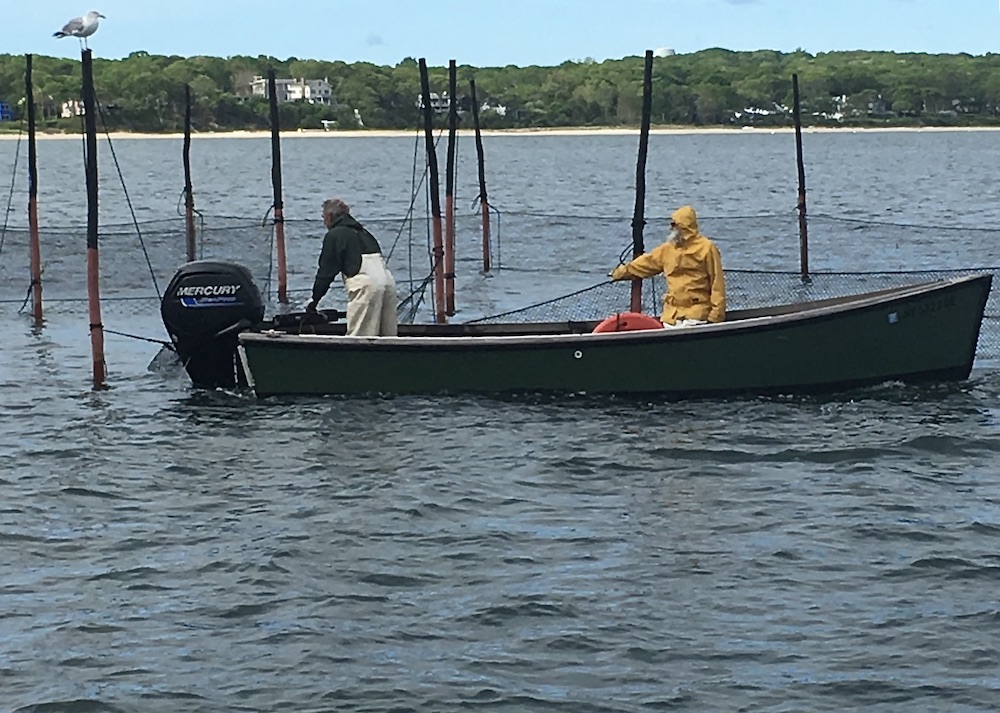
“There’s plenty of bunker,” observed Nat Miller, a commercial fisherman in East Hampton who tends to three-pound traps. “And there are tons and tons of peanut bunker this way. Real tiny ones. And tons of other bait like white bait, sand eels, and mackerel.”
What Miller is also seeing, much to his dismay, is a large influx of seals. “It’s now impossible to trap in the summer and fall,” he lamented. “There are just too many seals everywhere. The fishing has been horrible.”
“I think the bunker are still around, but they’ve been appearing in different locations,” said Danny Lester of Amagansett, a commercial fisherman. “The other guys I talk to say the same thing.”
Lester used to fish upward of a dozen pound traps, but as of this year, for the first time ever, he did not set any nets. Like Miller, he blames the seals.
“We would get bunker, but the increasing seal population has made it impossible to fish,” he said. “You couldn’t make any money.” Lester now fishes full time dragging for bottom fish in Gardiner’s Bay and Block Island Sound.
Seals notwithstanding, the bunker debate will linger on. And that’s not good news for many species, including whales, dolphins, striped bass, bluefish, and other predators that forage on the nutrient-rich fish.
In fact, some feel that the lack of bunker, which is especially acute in the Chesapeake Bay area, is likely resulting in the demise of young-of-the-year ospreys in record numbers. Ospreys are heavily dependent on bunker to feed their hatchlings.
Last year, the Group for the East End, a nonprofit environmental organization, observed that there was on average one chick each for the 385 nesting osprey pairs it monitors. Three years earlier it was 1.3 chicks per nest, and in 2020 it was 1.7. While the overall population remains strong, it’s an alarming trend. Are bunker playing a part? Or is it just a natural twist at the hands of Mother Nature? Nothing is definitive.
Morse, who lives on Big Fresh Pond in North Sea, noted that this spring numerous ospreys were on the hunt for alewives, another favorite food for the fish hawk. “I never saw so many ospreys hunting for them before,” he said. “Some days I counted at least 25 of them working the pond. It was clearly their only readily available food source.”
As for the scarcity of bunker in some regions, fingers point to Ocean Harvesters, a Virginia-based fishing operation of 30 large purse seine boats and spotter planes as the main culprit. The company exclusively fishes for bunker along the Atlantic and Gulf coasts. Omega Protein, its processing partner, crushes and presses the bunker for fish oil, fertilizer, and animal feed.
Marine regulators and scientists are now examining the situation, in particular in the expanse of Chesapeake Bay, where nearly 30 percent of the total coastwide quota is caught. In some years, it has approached 50 percent.
Magnifying the issue was a significant error in the bunker stock assessment, which confirmed there are roughly 37 percent fewer bunker than previously estimated. That’s a big miss in any book.
A number of conservation groups and fishermen are advocating for cutbacks in the allowable catch, and even a ban within 12 miles of the coast on industrial bunker fishing in Chesapeake Bay until the stock recovers. In November, the Atlantic States Marine Fisheries Commission, which overseas quotas on bunker, plans to meet and discuss possible solutions.
“Hopefully the regulators will get it right and let the bunker stock grow back,” Morse said.
As for the ever-expanding seal population here, that’s a separate issue.
Fred Golofaro Classic
Listen up, surfcasters. It’s time to get your casting rod and favorite lures out to sign up for the 2026 Fred Golofaro Memorial Montauk Classic Bluefish and Striped Bass Surf Fishing Tournament. The popular weekend competition begins at noon on Oct. 2 and concludes at noon on Oct. 4.
Fish must be landed from the beach, surf, jetty, bank, or pier beginning at the westernmost tip of Napeague State Park and encompassing all points east. All areas must be accessible on foot or by wading. Swimming is prohibited. Hither Hills State Park in Montauk is the official weigh-in and photo verification station for the tournament.
This year, the striped bass category will be a catch-photo-release format. Prizes will be awarded to the three largest bluefish and the three longest released striped bass. New York State minimum qualifying weight and size limits will be in effect.
A drawing for raffle prizes will be held at the award ceremony on Oct. 4 at 12:30 p.m. at the lower lot of Montauk Point State Park. The entry fee for the tournament is $20 per angler. The deadline to sign up is Friday, Sept. 25, at bit.ly/4dbZBG8.
The tournament honors the legacy of Golofaro, a longtime Fisherman magazine editor, while bringing the surfcasting community together for a weekend of competition and camaraderie.
—
Fishing tips, observations, and photographs can be sent to [email protected].