
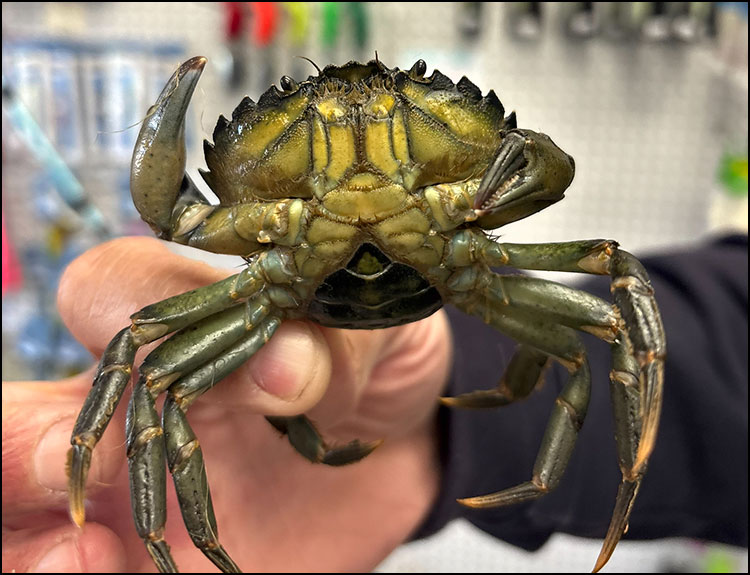
It’s not exactly the great Dutch tulip bulb bubble, also called tulipmania, of 1635, when speculative trading drove the price of rare tulip bulbs to extreme, unsustainable levels before crashing. But this fall, the price of green crabs, the bait that’s widely used to catch tautog from North Carolina to southern Maine, has climbed to dizzying, wallet-busting heights.
Why is that? Well, it’s a simple case of demand exceeding supply.
While some air has been released from the bubble in the past week or so, the news of the shortage and price spike has been felt by many when the season for tautog, a.k.a. tog or blackfish, opened in mid-October. Case in point, while slowly walking on Main Street in Sag Harbor on Saturday morning, I bumped into a fishing acquaintance I had not seen since the spring. He had a puzzled look on his face.
“Hey, what’s the deal with green crabs?” he said. “They are very hard to find, and even if you get some, the price is just crazy.”
Just as marine diesel fuel approaches $8 per gallon at many docks, a bushel of green crabs now costs upward of $125, if they can even be found. Last year, a bushel was in the neighborhood of $75.
Like tulips, green crabs are native to Europe, in particular the waters of the North Atlantic and the Baltic Sea. They first arrived in North America in Massachusetts in the early 1800s, most likely traveling in the ballast water of merchant ships. Since then, they have greatly expanded their domain from Labrador/Newfoundland all the way south to South Carolina.
To top it off, the invasive crabs cause economic and ecological damages. In particular, they are ravenous consumers of juvenile clams, especially steamers, and also undermine and destroy eel grass beds and creek banks. And it’s not just an East Coast issue. They are also wreaking havoc in the Pacific Northwest.
For tautog bait, green crabs are harvested and trapped across the New England states, primarily Maine and Massachusetts. A large portion of the catch is then shipped down to regional bait dealers, including those in New Jersey and Connecticut and on Long Island.
“The green crab shortage is real, and my supplier is going all the way to Maine to get enough for me,” said Capt. Rich Jensen of the Nancy Ann IV, a charter boat he has run out of Orient Point for over 50 years. “It’s lucky for me, as I’ve been with them for a long time and they take care of me.”
“But from what I hear, it’s not just one area that’s been affected,” he added. “I’m not sure if it’s a disease, but if this continues to get worse, it could be a really huge problem by next year.”
Over at Tight Lines Tackle in Sag Harbor and Southampton, Ken Morse said it’s been a real challenge to get green crabs from his suppliers, but he was also unsure of the exact cause of the shortage. He did not rule out the lack of labor playing a part.
“Let’s face it, there are less and less people who are working as baymen today,” he said. “It would not surprise me if this factor were playing a part in the shortage, too. It’s a tough way to make a living.”
Those locally who trap their own green crabs for bait have also noticed a decrease in their catches over the past few months. On the positive side, it appears that a large number of tiny crabs, too small to be used, have been noticed. Green crabs are prolific spawners, so it’s possible that a rebound in their stocks could be coming.
Speaking of tautog, the fishing, if the tides are not flowing like a raging river, remains pretty solid from Orient Point eastward to Fishers Island and beyond. Find a nice cluster of rubble, rocks, and boulders to anchor up on, and in most cases you are in like Flynn.
Fishing for striped bass, whether by boat or beach, remains a struggle for most, however.
Early Sunday morning, a surfcaster still in his damp waders came in for a quick cup of coffee at Goldberg’s in Sag Harbor after hitting the ocean beach.
“Catch anything?” I asked.
“Nothing but a beautiful sunrise,” he replied. “But I will try again tomorrow.” Now that’s a real fisherman.
Back at Tight Lines Tackle, Morse was a bit more positive. “More or less, it has picked up a bit,” he said. “The Shinnecock beaches had an epic blitz the other day. At Montauk, the outgoing tide has been the best.”
Squid, anyone? They are still thick as fleas at night at Montauk and Three Mile Harbor. If you’re not nocturnal, fear not. You can still catch plenty during daylight hours.
—
Fishing tips, observations, and photographs can be sent to [email protected].