
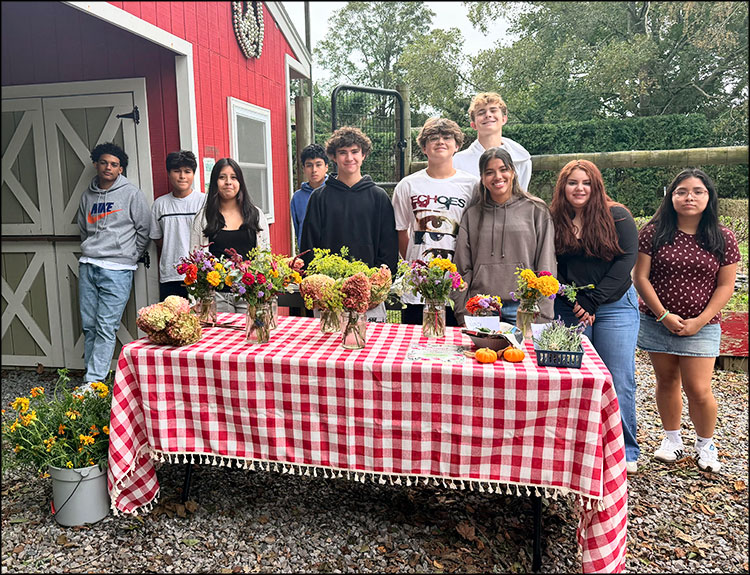
A tiny farm stand by the side of the highway in Bridgehampton is hiding something much larger. While it has operated for many years, first as a Christmas tree farm and then as a farm and flower stand, now, some are seeking a new lease on life for it and what lies beyond its surface — a school-led agriculture program that immerses students in what it means to nurture the land they live on.
The Bridgehampton School owns the little red stand known as Sprouts on Montauk Highway next to school grounds. Some might remember buying a family Christmas tree there but now, the school plans to reopen it with the help of a group of students, their teacher, and a full-time horticulturist who started working at the school just last year.
“It’s a living classroom,” said Alexandra DeSouza, the school’s agriculture teacher. She has been working with students at the district’s expansive farm, greenhouse, and pollinator garden.
Sprouts is open now just a few hours a day a few days a week during school hours. Cut flowers and bouquets made by students are offered on a donation basis, but the hope is to open more frequently and to offer more items.
Ms. DeSouza took the reins from Judiann Carmack-Fayyaz, a technology and agriculture teacher who started the program and has since left to run the Stony Brook Food Lab. Ms. DeSouza said the two now collaborate. The Food Lab offers continuing education and internships.
“It’s our secret garden,” Ms. DeSouza said last week during a tour of the grounds. All of the planting happens on the west side of the school. It is humble and picturesquely rural.
Christine Tylee, the school’s horticulturist, was busy in the greenhouse. A flock of hens — there are 10 of them — and Oscar the rooster clucked away happily in their large coop, which Ms. DeSouza said was built several years ago by parents.
Late-season tomatoes twisted up their cages, rows of herbs sat starkly, and loofah gourds hung from a nearby trellis. Earlier this month, Ms. DeSouza said, the younger students were harvesting potatoes from that very garden. “It was like an Easter egg hunt,” she said.
Students’ exposure to working the land changes as they grow, both the women said. The youngest groups start simply, by learning what plants need in order to grow and how to plant seeds, and talking about what they like to eat. The education extends past school hours to an after-school program.
Ms. DeSouza said that most of the kids love snap peas and peppers, and that she and Ms. Tylee were surprised how many of them were curious about different varieties of radishes and nasturtium — which are not exactly for vegetable novices.
“They all want to try it,” she said.
The harvests are used in the school’s cafeteria and culinary program, a lineage the students can follow personally. The farm stand is actually the last stop for the harvest if it can’t be used in either of those programs, particularly in the summer when school is closed.
Older students learn about more complex things like rooting hormones and taking soil samples. Landscape design is also touched on, as are native plants and their role in local habitats. A group of 14 high school students are enrolled in the class, which is an elective this year, Ms. DeSouza said.
With the help of ReWild Long Island, a group dedicated to restoring native ecosystems, the school planted a pollinator garden. Ms. Tylee said this year they saw a large number of hummingbirds and species of wasps they have never seen before. The garden also serves as an open-air classroom and is open to the public.
The Food Lab plays a role there too, Ms. Tylee said, adding that for those students who can’t study away from home after graduation, the Southampton campus offers a great opportunity.
They are hoping to get more high school students to volunteer their time during the summer harvesting season, and certainly, once the farm stand opens, “we’ll need help,” Ms. Tylee said.
“By introducing kids to agriculture at such a young age we hope it will follow them,” Ms. Tylee said.
Ms. DeSouza said she hopes to expand and “build more connections to local farms.” Bridgehampton’s storied farming history could offer some unique opportunities today, she said, adding that the goal is to connect with members of the farming community who could share their experiences with the students.
Even allied tradespeople would be helpful for the students to meet, Ms. Tylee said, noting that irrigation experts and heavy equipment operators could inspire the children toward future career paths. “We are open to the community in any way.”