
Property Taxes to Drop in Southampton

Property Taxes to Drop in Southampton

Supervisor Jay Schneiderman with Councilwoman Christine Scalera at a recent town board meeting
Taylor K. Vecsey
By
Taylor K. Vecsey

Jay Schneiderman has completed his first proposed Southampton Town budget since becoming supervisor, a $94.7 million operating budget for 2017 that falls below the allowed 1-percent cap. The budget calls for a 1.6-percent reduction in the property tax rate, the largest tax rate reduction in recent history, despite a 3.9-percent increase in spending over the current year.

“We went back 10 years, there wasn’t anything like it,” Mr. Schneiderman said as he presented the spending plan to the town board last Thursday.

While the supervisor is looking to raise the budget by $3.6 million next year, the tax rate will go down due to a $5 billion increase in assessed valuation, according to Leonard J. Marchese, the town comptroller, who crafted the budget with Mr. Schneiderman. As of May, the assessed valuation townwide increased to roughly $60 billion due to new houses or the increased value in others, he said.

The proposed budget offers $3.2 million for road and highway infrastructure improvements. Also, there is $1.4 million for improvements to the beaches and park facilities, and $1.3 million for upgrades to the emergency services networks. There is $1 million set aside to upgrade the town’s fueling facilities, which the supervisor said are “aging out,” and $1 million for various land management studies, including supporting the Riverside Revitalization Action Plan.

Included in the supervisor’s budget is the consolidation of code enforcement, animal control, and emergency preparedness into a newly formed division of public safety. The Code Enforcement Department reports to the town attorney’s office, but there is no head of code enforcement. East Hampton Town saw a similar consolidation under Supervisor Bill Wilkinson. “I would like there to be a director of public safety that would oversee that code enforcement unit,” Mr. Schneiderman said. In addition to that position, he budgeted for an additional part-time code enforcement officer.

To address Southampton’s “crisis in terms of housing availability,” he proposed the creation of the office of housing and community development, which he said most other towns have. The housing authority manages the federal Section 8 program, but the new office, in a division under land management, would oversee housing registries, lotteries, buyer-benefit programs, and grants. The new office would work with an accessory apartment amendment he will propose in the coming months.

Under his proposed budget, he will increase the number of town employees by 7 to 518. The figure is still a far cry from the 554 people employed by the town in 2008. The additional positions include a police officer and public safety dispatcher — paid for with the more than $300,000 in extra sales tax money from the county for which Mr. Schneiderman negotiated — and the part-time code enforcement officers and director of public safety. Also, two parks maintenance mechanics would be added. He said there are not enough personnel and with the addition of Good Ground Park, “it wouldn’t be fair to the residents of Hampton Bays not to provide adequate funding for this park.”

A capital budget of $9.3 million is also proposed. East of the Shinnecock Canal, that budget calls for installing new restrooms and a lifeguard office at Scott Cameron Beach in Bridgehampton, where the current modular restrooms and office are “falling apart as they cannot withstand the elements of the ocean beach,” the proposal said. Also, the bridge on Job’s Lane will be replaced. The work at the Bridgehampton Community Center will continue, with the next phase being the replacement of plumbing, flooring, and fixtures in the restrooms.

For the additional capital expenditures, Mr. Schneiderman proposed the town borrow $8 million. The rest will be raised through state aid or grants, Mr. Marchese said. Even so, the town is reducing the overall debt by $7 million. 

About $2.6 million was appropriated from the fund balance, but the town will still have $30.4 million, more than 30 percent, in surplus for 2017, Mr. Schneiderman said, adding that the surplus is much of the reason why the town has its AAA credit rating.

Work sessions on the budget are slated for Oct. 6 and Oct. 20. The first hearing on the budget will be held on Oct. 25 at 6 p.m. at a town board meeting that will be held at the Hampton Bays Senior Center. Another will be held at Town Hall on Nov. 9 at 1 p.m. By state law, the budget must be adopted by Nov. 20.

House on Dunes Hearing

House on Dunes Hearing

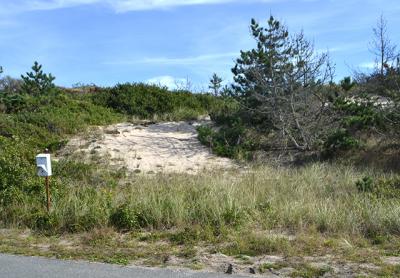
The owner of the final undeveloped beachfront property on Shore Road is awaiting a decision from the East Hampton Town Zoning Board of Appeals on a permit for a house on the dune.
T.E. McMorrow
By
T.E. McMorrow

An application for permission to build a 3,602-square-foot house in and on top of the dunes on the last undeveloped oceanfront lot on Shore Road near Marlin Drive on Napeague was the focus of a two-and-a-half-hour hearing before the East Hampton Town Zoning Board of Appeals on Sept. 20.

The applicant, represented by Eric Bregman of Farrell Fritz, a Long Island law firm with an office in Water Mill, is a limited liability corporation called East Hampton Gerard Point. Its address is that of Heatherwood Luxury Rentals of Commack.

It is the second time in a little over a year the property, which is between the White Sands Motel and a private house, has been before the board. Last year, the board held a hearing on an application for a 4,320-square-foot house there, but it was withdrawn after members indicated it would be denied.

The property is long and narrow and runs from Shore Road through the dunes to the beach. It is in a Federal Emergency Management Agency high velocity flood zone, which means the house would have to be raised over 12 feet above grade.

The dune closest to the road rises on a fairly sharp angle almost from the pavement, and the house would cover 2,975 square feet of dune. The lower level of the structure would contain only an entrance or foyer and a garage, which would have knock-away walls in case of flooding. The living space would be on the first full floor.

“Why can’t the design be reconfigured to put square footage into a second floor?”  John Whelan, chairman of the board, asked Mr. Bregman, who responded by pointing to what he called proposed improvements since 2015. There would be minimal excavation, he said, because there no longer was a foundation.

“The house has been moved back, substantially,” he said about the location on the dune. “There is no erosion of the dune’s benefits,” he said.

Mr. Whelan, however, apparently was not convinced. “I would love to have seen from the architect why this project could not have a smaller footprint,” he said. The architect, Andrew Glambertone, then said his client had originally asked for a two-story house, but was concerned about having to apply for pyramid variances, due to the narrowness of the lot.

The proposed configuration of the house clearly troubled Jeffrey L. Bragman, an attorney speaking for the opposition. He said the living space would be about six feet higher than the Federal Emergency Management Agency requires, which neighbors objected to.

“They are reaching for a view,” he said. “My ears perked up when I heard the chair say this is an awfully large footprint. It makes it a very imposing house.” He also said that if the house were moved closer to the street, its flood zone status would change, and it would not have to be raised so high. The plan appeared to include about two and a half stories, he said, with a dormer offering the possibility of another floor being added in the future.

“Under town law, a dune is a protected feature. A big footprint is bad for the dunes,” he said. He presented an illustration of a proposed alternate site for the footprint closer to the road. He also presented the board with a sketch of the house to the west of the property to provide a sense of scale.

Nick Gregory, one of the neighbors, addressed the board. He said the dunes were fragile and pointed to the potential for flooding. “We don’t have anything against a house being built, but all houses built since the 1980s have been two stories with a smaller footprint,” he said.

Mr. Bregman then responded to Mr. Bragman’s points. “Jeff is always very eloquent. Sometimes it is a little off-base.” He reiterated that the excavation would be minimal.

Finally, the board, clearly weary, voted to close the hearing, and the participants left the room. A few minutes later, however, both attorneys returned.

Mr. Bregman complained that his architect had not gotten a look at the sketch of the neighboring house presented to the board by Mr. Bragman as an illustration of scale. Mr. Bragman asked for the right to respond. But Mr. Whelan said he did not want a back and forth, and the board instead gave Mr. Bragman one week to confirm the accuracy of the sketch and closed the record.

The attorneys then left the room for a second time. After a minute, Mr. Whelan looked at the vice chairwoman, Cate Rogers, and quietly said, “We should have locked the doors.”

Government Briefs 09.29.16

Government Briefs 09.29.16

By
Star Staff

East Hampton Town

New Clean Water Committee

A new clean water and community preservation committee, with members from local conservation and advocacy groups such as the Nature Conservancy, businesses, elected officials, and other concerned citizens, will meet tomorrow morning at 11 at the East Hampton Town commercial dock at Gann Road on Three Mile Harbor. To be discussed is the case for a “yes” vote on Election Day on a referendum that would extend the life of the community preservation fund program and expand its use for water quality protection.

The group, which is urging residents to approve the proposal, will discuss the importance of the preservation fund in land preservation as well as the key role it can play in stemming nitrogen pollution in local waterways.

Now, $10 for Airport Parking

Long-term parking at East Hampton Airport now costs $10 per day, after the institution of a paid parking system this week. The meters require use of a credit card. Short-term parking, for up to 30 minutes, remains free of charge.

Other projects at the airport that are moving forward, according to a report last week by Jemille Charlton, the airport manager, to the town board, include the construction of a new aviation fueling facility, anticipated to take place this winter, construction of a new section of taxiway, for which plans will soon be solicited, and an investigation as to the state of repair of runway and taxiway pavement at the airport, which is in process.

Other ongoing projects include extension of a perimeter fence and clearing or topping trees in an area along Daniel’s Hole Road, in order to meet Federal Aviation Administration runway clear-zone requirements. The town was put on notice some time ago that that situation must be remedied.


Southampton Town

Regarding Energy Efficiency

The Southampton Town Board approved two amendments to its code regarding energy efficiency at a meeting on Tuesday night. The first promotes solar energy systems as an accessory use. Ground-mounted solar panels with at least a 5,000-kilowatt output that take up no more than 4,500 square feet will be exempt from clearing restrictions. Homeowners could clear up to 2 percent more to make way for such a system. The amendment also more clearly defines solar energy equipment.

The second was in response to changes to the State Energy Conservation Construction Code, effective Monday. The town decided to adopt more stringent requirements for the energy efficiency of newly built or substantially reconstructed houses of between 4,501 and 6,500 square feet. Applicants will have to submit a certificate verifying that the house design meets the home energy rating system index, a nationally recognized industry standard.

Bullying Awareness Month

The town will recognize October as bullying prevention and awareness month with two programs that will provide information and resources for families about bullying and cyber-bullying through the Southampton Youth Bureau. The programs are scheduled for Oct. 20 and 27 at the Hampton Bays Community Center and Southampton Town Hall. According to a town board resolution, the youth bureau’s 2011 Teen Assessment Project Survey showed that 21 percent of teenagers reported having been bullied or harassed.

To Maintain Noyac Roads

Four roads in Noyac are now part of the town’s highway system. Northview Drive, Old Noyack Road, Northview Hills Court, and Eastview Court have been accepted after review by Southampton Town Highway Superintendent Alex Gregor, which means the roads will be maintained by the town, including plowing during snowstorms.

Grants Available

The town will soon be accepting applications for 2017 grants for organizations that provide services to town residents. Human services grants are available for organizations that provide services like counseling and child care, while cultural arts and recreation grants can help organizations that offer visual or performing arts and recreational programs.

Applications will be available on the town’s website starting Monday. Copies are also available at Town Hall. The deadline for submission is Nov. 18 at 4 p.m.

Political Briefs 09.29.16

Political Briefs 09.29.16

By
Star Staff

Zeldin Focuses on Veterans

Representative Lee Zeldin, a Republican seeking re-election in New York’s First Congressional District, hailed the unanimous passage in Congress of the No Veterans Crisis Line Call Should Go Unanswered Act. The act requires the Department of Veterans Affairs to establish a management plan for a suicide hotline for veterans and to develop a plan to ensure that every communication received by the hotline is answered individually in a timely manner. Mr. Zeldin is a member of the House Veterans Affairs Committee.

“There is absolutely no reason that a struggling veteran who calls the suicide hotline should ever be sent to voicemail, especially since the V.A. receives tens of billions of dollars each year for veterans’ health,” Mr. Zeldin said.

Last week, Mr. Zeldin participated in a Veterans Affairs Committee field hearing at the Northport Veterans Affairs Medical Center intended to assess deficiencies at the center. Last month, a 76-year-old veteran committed suicide in the parking lot of the medical center, where he had been a patient, and the center’s operating rooms were shut down in February due to decaying conditions.

“All allegations regarding the care of our veterans must be taken very seriously, which is why my office shared this information with the House Veterans Affairs Subcommittee on Oversight and Investigations in order to conduct a full and fair review of the information,” Mr. Zeldin said at the hearing.

Last weekend, Mr. Zeldin attended a fund-raiser in Patchogue to raise awareness of the epidemic of veteran and active-duty service member suicides.


Throne-Holst Hits Zeldin on Guns

Former Southampton Town Supervisor Anna Throne-Holst, the Democratic Party’s candidate to represent New York’s First Congressional District, continued to criticize Representative Lee Zeldin on gun policy this week. A release issued by Ms. Throne-Holst’s campaign said that Mr. Zeldin’s position is more conservative than that of Donald Trump, the Republican nominee for president, who announced his support for legislation that would prevent people on the terrorist watch list from buying firearms. Mr. Zeldin endorses Mr. Trump’s candidacy.

“Lee Zeldin’s hard-line position on common-sense gun safety is so extreme even his party’s presidential nominee cannot support it,” said Andrew Grunwald, Ms. Throne-Holst’s campaign manager. “First District voters deserve a representative in Congress who will address gun reform head-on and put forward legislation that will protect Americans from senseless gun violence.”

Gabrielle Giffords, the former representative from Arizona who was critically wounded by a mentally ill gunman in 2011, and her husband, the retired Navy captain and astronaut Mark Kelly, endorsed Ms. Throne-Holst’s candidacy last Thursday.

In endorsing Ms. Throne-Holst, Gov. Andrew Cuomo also criticized Mr. Zeldin on gun policy. Mr. Zeldin, he said, “has voted time and again against common-sense gun legislation on the federal level, and has reinforced the inaction and gridlock crippling Washington.”

Wainscotters Say ‘No Way’ to Car Wash

Wainscotters Say ‘No Way’ to Car Wash

By
T.E. McMorrow

The East Hampton Town Planning Board faced a stormy, three-hour session at Town Hall on Sept. 14 when a site plan for a proposed car wash in Wainscott came before it.

 James Golden wants to put up a 4,435-square-foot steel and glass building with 15 vacuum stations. The facility, which requires a permit from the board, would have a detailing area, room for 18 cars to line up, and nine parking spaces. The property now contains a former discotheque, which has fallen into disrepair and is considered unsafe.

As the initial discussion went around the table, and after a lengthy presentation by experts representing Mr. Golden who told the board he had already invested $75,000 for an analysis, Job Potter, a board member, said, “I feel badly for you, in a way. This is a bad place for a car wash.” The room exploded with applause.

“As chairman of this board, I have to think of planning,” Reed Jones said. “I don’t think it fits. This is the most congested part of town,” he said, as the room again broke into applause.

According to a traffic study presented to the board by Mr. Golden, the time it would take to make a left turn onto the highway from the car wash would increase from about one minute during the summer to six minutes. But Eric Schantz, a senior town planner, had previously said the traffic study submitted was outdated and had not been done during the peak summer season.

Besides the traffic study, the board has been presented with studies of the sound emanating from the car wash and its ecological impacts.

Before the board could consider the details further, Mr. Golden complained that the room had been stacked against him. If he had known that would be the case, he could have had 100 supporters on hand, he said.

“Is there a business you would want to see?” asked Gail Golden. “What business would make you all feel good?”

Diana Weir, a board member, responded that a neighborhood business would be appropriate, but Ms. Golden said, “I don’t think HomeGoods fits into a neighborhood business,” referring to the large nearby retail store on the Montauk Highway, which had received board approval. “No, it’s not,” Ms. Weir said.

 “It was all before your time, I get it,” Ms. Golden retorted. “We live here, too.”

She went on, saying, “If you had this feeling from the beginning, you did us a great disservice by asking us to do all these studies, which cost us $75,000. You should have right from the start said, ‘No, we will never approve a car wash,’ because we would not have proceeded. That’s on you, and not on us. Secondly, this is supposed to be a working meeting, not a meeting where people can voice their opinions. That’s the format you set up. I think it is unfair that the room is filled, stacked with people who oppose it.”

 The car wash proposal had been in the news previously and drawn the attention of the Wainscott Citizens Advisory Committee. Ms. Weir asked those in the audience if the planning board had invited them. They responded with a loud, “No!”

Ms. Weir, who has been on the planning board since 2012, pointed out that this was only the second time the proposal had come before the planning board. She added, however, that if the applicant was unhappy with whatever the final decision turned out to be, he could sue the board.

Kathleen Cunningham, a board member who called herself “agnostic” with regard to the proposal, said that given the site’s zoning, “We are going to have to approve some kind of business.” Nancy Keeshan, another member, said, “We haven’t made a decision.”

When the Wainscott residents were given an opportunity to make brief statements, over a dozen made it clear that they thought the proposal was unacceptable. Several mentioned the HomeGoods store.

“A few years ago, another planning board gave an approval,” Frank Dalene said,  referring to HomeGoods, and calling it “an approval for the biggest boondoggle in East Hampton history. . . . We can’t afford another screw-up,” he said.

New Town Hall In the Works

New Town Hall In the Works

By
Joanne Pilgrim

Conceptual plans for a new East Hampton Town Hall — a series of linked, wood-shingled, barn-like structures that would be built on the footprint of the old Town Hall building, which would be razed — got a preliminary nod from the East Hampton Town Board at a meeting on Tuesday, at least to proceed to the next planning stage.

The estimated $8.5 million project presented to the board would include the new building as well as the addition of more parking and better pedestrian and handicapped access to all the buildings on the Pantigo Road municipal campus, as well as final renovations to two historic buildings for use as office space.

The Peach House and Baker House were among the historic buildings donated and moved to Pantigo Road in 2007; several others were linked and transformed to create the present Town Hall, and the old building was abandoned. It has been sitting empty, and, said Peter Gumpel, an architect and member of the town’s architectural review board who has been working with a committee on the new Town Hall proposal, has “very serious environmental issues,” including mold and possibly asbestos. “It just wouldn’t make economic sense” to try to salvage it, he said. Besides, he added, its configuration does not lend itself to the type of open-plan, flexible, spatial design envisioned for the new building.

“That building is deplorable; it’s a falling-down, leaking building,” Town Supervisor Larry Cantwell said.

New construction could include energy-efficient elements, Mr. Cantwell said, including solar or geothermal energy systems, enabling the town to save in the long run on energy and upkeep costs.

The estimated cost of the new Town Hall, excluding the added parking, renovations, and other improvements, is $6.7 million, covering a one-story complex with a basement for storage, totaling 21,000 square feet. The construction would enable the town to house all its offices at one location. At present, a number of town offices are in condominiums on Pantigo Place, adjacent to the Town Hall campus.

“This is a very inefficient system,” said Mr. Cantwell at the meeting on Tuesday. “It’s inconvenient, and it’s confusing to the public.” Having town departments working close to one another would increase communication and make for “more significant interaction,” Mr. Gumpel said.

In addition, said Mr. Cantwell, while the town is moving to a system of electronic records storage, it must still follow legal storage requirements, and “we don’t have a safe place to do that.”

The supervisor said the sale of the Pantigo Place office condominiums could raise $3 million to $4 million. The property on Springs-Fireplace Road in East Hampton from which the defunct wastewater treatment plant was recently removed could also be sold, he suggested. “Together, those sales would pay for this project, essentially.”

“It’s long overdue,” commented Councilman Peter Van Scoyoc.

Under the prior administration, the town received a $500,000 state grant award for efficiency, which was earmarked to develop a new Town Hall campus. Some of the money has gone to the planning and design of the project.

Board members agreed Tuesday to have the building committee, which includes Mr. Gumpel, Drew Bennett, a consulting engineer; Scott Wilson, the town’s director of land acquisitions and management, and Alex Walter, Mr. Cantwell’s executive assistant, develop and present a more specific design, based on the concept presented this week.

Seek Comment on Moratorium

Seek Comment on Moratorium

By
Joanne Pilgrim

East Hampton Town officials will listen to comments from the public on a proposed moratorium on the development of commercial sites in Wainscott at a hearing at Town Hall on Oct. 6, beginning at 6:30 p.m.

During the moratorium, no approvals for subdivisions or site plans for certain properties would be issued for one year in order to allow the town to complete a planning study of the hamlet and to implement any new land-use regulations that might arise from the study.

In-depth studies of the commercial centers of each of the town’s hamlets were called for in the town’s most recent comprehensive plan, adopted in 2005, but were not undertaken until earlier this year. Consultants held meetings last week focusing on Montauk, the final hamlet to come under scrutiny in the process. Draft recommendations and options for policies or regulations will be prepared and submitted for review by town staff, elected officials, and the public, and hearings will be held on proposals before their adoption by the town.

Wainscott is unique among the hamlets, according to the town board resolution that set the hearing, because of its high traffic volume and its commercial development stretched along Montauk Highway. “Anticipated recommendations include plans for a walkable hamlet center,” according to the resolution, which said that a planning workshop focusing on the hamlet “revealed a great potential for transforming the Wainscott commercial area to remedy this situation while creating a traditional-style hamlet center.” But, it continued, “if development continues along this portion of the Montauk Highway while the study is pending, and the town is unable to implement recommended changes prior to further approvals being issued, opportunities to improve safety and mitigate traffic and other impacts may be lost. “

The moratorium would affect properties that are zoned for central business or commercial-industrial uses and properties in residential zones being used for nonresidential purposes in an area generally along the Montauk Highway corridor in Wainscott. The area included would be south of the Long Island Rail Road line and bordered by Town Line Road in the west and by Hedges Lane and the East Hampton Village boundary to the east. It would apply to applications for new development as well as expansions of more than 25 percent of an existing building, if the increase would result a larger legal occupancy of the site.

Subdivision or site-plan proposals for which the planning board has already held a public hearing and issued an approval would be allowed to proceed. Landowners affected by the moratorium would be allowed to apply to the town board for an exemption, and the board would hold a hearing on the request. Exemptions could be issued only if the board found that a proposal would have no adverse effect on the town’s goals or objectives outlined in the hamlet study plan, that the proposal was in accord with the character of Wainscott and the town as a whole, as well as the comprehensive plan, and that failure to grant an exemption would cause hardship to the property owner “substantially greater” than any harm to the public.

A Golf Range Is Preserved

A Golf Range Is Preserved

By
Taylor K. Vecsey

In a move that Southampton Town Supervisor Jay Schneiderman called among the first of its kind, the town is preserving the Southampton Golf Range on County Road 39 in Tuckahoe through the community preservation fund. The town purchased a recreational easement on the 13-acre property for $6.5 million in a deal that closed on Friday.

The easement allows for the continuation of the existing uses: a golf range, a miniature golf course, a peddle-cart track, and a seasonal ice-skating rink.

While 4,040 acres in the Town of Southampton have been preserved through the C.P.F. since it was established in 1999, the only other recreational property acquired was the Poxabogue Golf Center in Sagaponack.

“We wanted to make sure it stays affordable. It’s kind of an unusual agreement,” Mr. Schneiderman said at a work session last Thursday. The Southampton Golf Range has been a family-owned-and-operated business since 1957, and the Hansen family has no plans to stop.

Councilman Stan Glinka said he had already received a lot of positive feedback from the community about preserving such “an iconic place.”

The preservation of the property also maintains the mostly open vista on the property. That area of County Road 39, a main corridor to the rest of the South Fork, is zoned highway business and could have become a car dealership or a restaurant, Mr. Schneiderman said. Under the recreational easement, 80 percent of the property must remain open.

The town will have control over the types of recreational activities allowed and the fees charged.

Government Briefs 09.22.16

Government Briefs 09.22.16

By
Star Staff

Southampton Town

LIPA-Town Settlement

The Town of Southampton and Long Island Power Authority have reached an agreement that ends a multiyear dispute and ensures that taxpayers west of the Shinnecock Canal will not have to pay for lines that were buried. In 2008, the town asked LIPA to bury transmission lines along a four-mile stretch from Southampton Village to Bridgehampton after residents complained 60-foot-tall poles would destroy open vistas. LIPA agreed to bury the lines at a cost of $11.1 million, which was to be paid over a 20-year period from customers in a “visual benefit” assessment area. The town was responsible for any unpaid charges.

In 2013, however, LIPA filed suit against the town in State Supreme Court seeking to recover more than $200,000 in delinquent payments. The charges have accrued to more than $470,000.

After taking office in January, Supervisor Jay Schneiderman and LIPA officials sat down and agreed that $150,000 in interest would be waived and the billing process for past-due charges for customers in the visual benefit area would pay the fees rather than the municipality. LIPA also agreed to waive future interest.

The supervisor said it would have been unfair to charge taxpayers west of the Shinnecock Canal for visual improvements that only benefited residents east of it.

While the settlement has been signed by the supervisor and Thomas Falcone, LIPA’s chief executive officer, is also must be approved by the court.

$5 Million for Clean Water

New York State has granted the State University of New York at Stony Brook’s Center for Clear Water Technology $5 million for the creation and testing of alternative wastewater treatment systems in pilot projects to address pollutants threatening ground and surface waters, according to Assemblyman Fred W. Thiele Jr. In partnership with the Town of Southampton and Suffolk County, Gov. Andrew M. Cuomo established the Center for Clear Water Technology in 2014.

To Demo a House and Build Anew for Second Time

To Demo a House and Build Anew for Second Time

The homeowners of this Seabreeze Lane property want to tear down a house they just built.
T.E. McMorrow
By
T.E. McMorrow

The venture capitalist Fred Wilson and his wife, Joanne Wilson, are planning a family compound on Seabreeze Lane in Amagansett and to do so want to tear down a house they received permission to build there in 2010. A permit from the East Hampton Town Zoning Board of Appeals was, and would be, required because of the proximity of dunes and wetlands.

The Wilsons bought a house at 15 Seabreeze Lane in 2000 for $1.47 million, and, in 2012, two years after receiving their permit, replaced it with a larger one with Z.B.A. approval. On Aug. 30, Joel Halsey of Lighthouse Land Planning, representing the couple at a public hearing, explained their new plans.

They recently purchased an adjoining property where they intend to put up a house with several bedrooms for their three grown children and their families, he said. Doing so would mean they need fewer than the seven existing bedrooms at 15 Seabreeze Lane. Instead, they would like four bedrooms and meeting and theater rooms. “It is more expensive to retrofit the old house than to build a new one,” Mr. Halsey said.

The Z.B.A. gave the proposal its stamp of approval. “It is an aggressive project,” Roy Dalene said. He and David Lys expressed concern about drainage and water runoff from the new house, however, and the board agreed the town engineer should look into the matter. The board saw no reason, however, not to grant approval. The Wilsons will be able to demolish a house and build a new one for the second time in six years.

Not all applications that night were greeted positively. Joseph Eschenberg owns a house at 1919 Montauk Highway, at the intersection of the highway and Napeague Meadow Way. He has asked the board for retroactive approval of a 100-square-foot hot tub and a 330-square-foot deck, as well as fencing, which he built without permits. Several variances would be needed to legalize the additions.

The property is extremely constrained, Mr. Lys pointed out. Besides being at an intersection, the Long Island Rail Road tracks are directly to the north. Mr. Dalene noted that a 2010 survey of the property did not show a hot tub.

John Whelan, chairman, said the board had to look at the application as if it were an entirely new proposal. “If this was a new application, I would not approve the hot tub,” he said.

The board voted 4 to 0 to deny the application, with the board’s new member, Theresa Berger, abstaining. Later in the meeting the board tabled several applications to allow her to study them. Another applicant seeking variances for structures built without permits met much the same fate. Michael Scaraglino owns property at 189 Old Stone Highway in Springs, where he added a 489-square-foot first floor deck, enlarged the second floor deck, and added a pergola.

Cate Rogers started the discussion by pointing out that wetlands connected with Accabonac Harbor are to the north. “The applicant has to make his case for how this occurred,” she said. Further, she said, the lumber used for decking was treated with alkaline copper quaternary, a preservative that is environmentally damaging. She called for the board to “deny all aspects of this project.” The board did so, by the same 4-to-0 vote.