
U.S. Senator Calls Montauk ‘Dirtbag Beach’ a Boondoggle

U.S. Senator Calls Montauk ‘Dirtbag Beach’ a Boondoggle
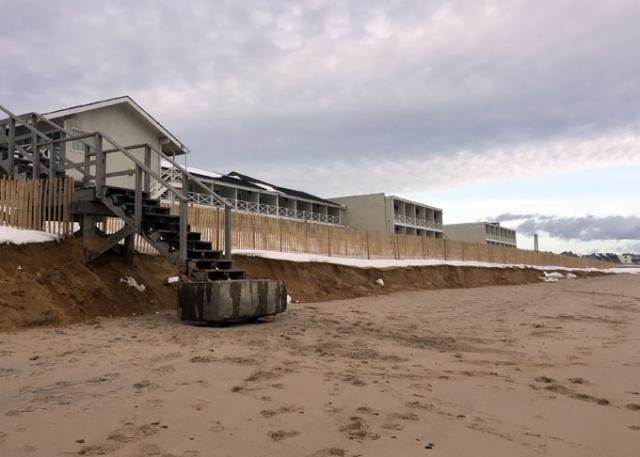
An erosion-control project installed by the Army Corps of Engineers on the Montauk beach, dubbed “Dirtbag Beach,” has made it into Senator Jeff Flake’s annual “Wastebook,” a compendium of government pork and boondoggles.
By
Joanne Pilgrim

A 3,100-foot-long sandbag sea wall installed last year by the Army Corps of Engineers on the downtown Montauk beach is included in the latest edition of “Wastebook,” an annual survey of “government pork and boondoggles” by Senator Jeff Flake of Arizona. Environmental activists here were critical of the seawall from the start and it has now, through erosion of sand seaward of it, narrowed the beach at times to a wet, impassable strip.

“Dirtbag Beach,” as it is called in Mr. Flake’s report, is among projects he identifies as having frittered away federal dollars that could be better spent on “true national priorities,” such as infrastructure repair and critical health research.

“We can do more without spending more by simply making better sense out of how we spend every cent,” Mr. Flake writes in the introduction.

This year’s version, with a comic book-illustrated cover blaring “Senator Jeff Flake Presents: Wastebook PORKémon Go,” lists 50 projects the lawmaker considers a waste of federal money and an example of “upside down spending priorities.” Montauk’s “Dirtbag Beach” is number 17.

“Wastebook PORKémon Go” provides an index of just some of the questionable expenses lurking throughout the federal budget that collectively cost taxpayers more than $5 billion,” the report alleges.

“Just like the monsters in the Pokémon Go game that took America by storm this past year, government boondoggles come in all shapes and sizes and pop up just about everywhere.”

The $8.4-million Montauk installation is listed in the “Wastebook” table of contents along with other projects and their dollar amounts, including a “High- Speed Train Going Nowhere Fast” ($3.1 billion); a “Giant Glow-in-the-Dark Doobie” ($35,000), a 28-foot-tall billboard against driving while high; a $1.7 million “Hologram Comedy Club Laughing All the Way to the Bank,” at which resurrected dead comedians are brought back through technology to do their shtick; a $460,000 project in which “Computers Try to Learn Human Behavior by Binge Watching ‘Desperate Housewives’ ” and other shows, and a $3.4 million “Hamster Cage Match” using Syrian hamsters in a study of aggression and anxiety.

A four-page entry details the history, status, and local responses to the Montauk Army Corps project, and includes photos, including an aerial of protestors who tried to stop the installation.

“Is an unwanted government project the end of the world for the beach in Montauk, New York, the self-described ‘end of the world?’ ” the “Wastebook” asks in the entry. “The once pristine beach, known for its natural landscape and lack of development in the tiny hamlet at the tip of Long Island is now being derided as dirtbag beach.”

“The U.S. Corps of Engineers plowed away the beach’s natural dunes and constructed a wall made up of 14,000 1.7-ton geotextile bags holding orange non-beach sand topped with three feet of whiter beach sand. The sandbag wall stretches along more than a half-mile of shoreline and is surrounded by fences. The beach is now only accessible via four narrow, elevated walkways,” the Wastebook states.

“The unsightly barrier, however, has residents and visitors ‘wondering if the town has destroyed the shore in order to save it.’ ” Local coverage in The Star proved “an invaluable resource” for examination of the issue,” according to Roland Foster, a senior policy advisor for Senator Flake.

Meanwhile, contractors for the Army Corps have come and gone but the project is still not ready to be declared finished and handed over to the town, which, along with Suffolk County, is to be responsible for ongoing maintenance, town officials said this week.

According to Alex Walter, an assistant to Supervisor Larry Cantwell, the contractors last visited early last month to make some fixes after storms damaged sandbags and wiped out fencing around the buried seawall. New fencing was installed and beach grass replanted, he said, and an outflow pipe on the beach near Lowenstein Court was repositioned after it was found to have been installed in a way that caused water to undermine the footings of one of the new wooden stairways leading over the seawall onto the beach.

More work is also expected to be done at the South Edison Street vehicle access to the beach, where interlocking hollowed concrete blocks were laid to create a “drainage mat.” Specifications called for the blocks to be buried, filled with stones, and covered with sand, Mr. Walter said at a town board meeting on Tuesday. But the sand put on top of them was quickly washed away, and they remain exposed.

Further causing dismay, Mr. Walter reported that a 50-foot-long protective sand berm installed seaward of the buried sandbag wall has also washed away and not been replaced. The beach now drops to a lower level right along the piled sandbags, with a gap at the bottom of exposed wooden stairs.

The berm is mentioned in a State Department of Environmental Conservation document that outlines the maintenance responsibilities that are to fall to the town, but “we don’t want to be responsible for maintaining a berm that doesn’t exist,” Mr. Cantwell said Tuesday. The Army Corps had proposed doing a final walk-through during the first two weeks of this month, he said, before turning over maintenance responsibility, but has not been in touch. The estimated costs of maintenance remain uncertain given the effects of recent tidal action.


 

Film Permits in the Spotlight

Film Permits in the Spotlight

Morgan McGivern
By
Joanne Pilgrim

The filming permits issued by East Hampton Town to producers, filmmakers, and still photographers seeking to use local sites for TV shows, movies, and ads are expected to take center stage before the town board in the coming days of this new year.

Filming on private property, either outside or in, would for the first time require a permit, according to proposed changes to the existing law. Currently, permits are needed only when filming is to take place in public places.

That loophole has had a couple of turns in the spotlight involving two cable TV shows. “The Affair,” a Showtime drama series set in Montauk that premiered in 2014, used a house in Amagansett’s Beach Hampton neighborhood as a home base for some of its characters. Filming there into the night, with trucks and lights, set off complaints from neighborhood residents and prompted the town board to call in the producers. With a round of filming for the show’s second season anticipated, and hoping to keep using the same house, they worked with the town to negotiate a compromise. The show, which won a Golden Globe for Best Television Series, launched a third season in November.

Last summer, town officials turned down a request for a filming permit for “Summer House,” a Bravo reality show that premieres later this month. But the producers, who have publicized the show as chronicling 20-somethings partying at a share house in Montauk (the actual house was on Napeague), went about the hamlet on their own, seeking permission to film from shopkeepers and owners of private property.

With the Montauk Chamber of Commerce and others decrying the show’s depiction of the hamlet as a wild summer playground full of debauchery, they got a number of cold shoulders, and locals discussed ways to sabotage the filming that did take place.

But the experience stung. Sitting in at a Dec. 21 town board meeting where revisions to the film-permit regulations were discussed, Laraine Creegan, the Montauk chamber’s executive director, asked the board, “Do you take into consideration what is being filmed?”

“As much as we might have a personal opinion,” Supervisor Larry Cantwell told her, “we do not have the constitutional authority to regulate the content.” The “lawful concerns” that the town may assess, he said, are those related to public safety, such as traffic, or to health. “Governments do not regulate freedom of speech.”

At present, applications for film permits are evaluated by the same committee that assesses requests for mass-gathering permits. The committee includes town board members, police, a fire marshal, and so on. Approved permits are issued by the town clerk. Shoots with a cast and crew of five or fewer are exempt from the permit process.

Repubs to Hail Inauguration

Repubs to Hail Inauguration

By
Christopher Walsh

The East Hampton Town Republican Committee will celebrate the Jan. 20 inauguration of Donald Trump and Mike Pence as president and vice president of the United States with a party at the American Legion Hall in Amagansett.

Guests can “feel free to dress in formal attire,” according to an invitation. Tickets to the celebration, which will take place from 6:30 to 11:30 p.m. the day of the inauguration, cost $50 in advance and $60 at the door.

The celebration will simply be about having a good time, Reg Cornelia, the committee’s chairman, said on Tuesday. “This is certainly not a boring transition, from the status quo slightly this way to the status quo slightly that way,” he said. “I think we have a neo-Marxist in the White House until the 20th, and now a guy” — Mr. Trump — “who believes in capitalism. I’ll take that for starters. I wish his delivery was a little smoother, but he’s getting better. I think he means it when he says he’s going to change the rules.”

For East Hampton Republicans, the election of Mr. Trump and Mr. Pence, the re-election of Representative Lee Zeldin, and the party’s success in maintaining control of the Senate and House of Representatives have provided reasons to celebrate after local elections did not. In November 2015, the party’s candidate for town supervisor, Tom Knobel, was defeated by Larry Cantwell, the incumbent. Its two candidates for town board also suffered lopsided losses, and the composition of the town trustees swung from a 5-to-4 Republican majority to a 3-to-6 minority.

Soon after, Mr. Knobel was fired from his job at the Suffolk County Board of Elections and resigned as the committee’s chairman. In April, Mr. Cornelia, a longtime member of the committee and its vice chairman since 2014, was elected to lead it. Rebuilding morale was among the first items of business, he said at the time.

Nix a Second Story on Dunes Beachfront

Nix a Second Story on Dunes Beachfront

By
T.E. McMorrow

A request from the owners of one of the last undeveloped beachfront parcels on Marine Boulevard in Amagansett to add a second story to an already approved one-story residence was denied on Dec. 13, at the year’s final meeting of the East Hampton Town Zoning Board of Appeals.

Much of the property at 161 Marine Boulevard is duneland, where a building setback of 100 feet is normally required. In April 2012, the owners, a limited liability company called Pandion, received approval to construct a house with decking about 40 feet from the dune crest. Both the East Hampton Town Planning Department and the town trustees opposed the application, and none of the members who voted to approve it are still on the zoning board.

The applicants were hoping to modify the 2012 decision without having to go through another public hearing.

In a memo dated Dec. 5, Brian Frank, the town’s chief environmental analyst, told board members that they should look to the wording of the 2012 approval, particularly the sections of it regarding Federal Emergency Management Agency regulations. The decision, written by the then-attorney to the board, Robert Connelly, noted in particular that “the current FEMA requirements preclude the construction of a two-story residence on the subject parcel.”

The 2012 board had wrestled with the location of the house, wondering if moving it about eight feet closer to Marine Boulevard would be beneficial. It ended up siding with the applicant’s argument that such a move would create the need for the kind of septic system not approved by Suffolk County.

Now, however, according to Mr. Frank, Pandion seeks to move the house seven feet closer to the road, while increasing building coverage from 2,202 square feet to 2,432 square feet, and total lot coverage from 4,726 square feet to 5,374. “There are a number of inconsistencies and apparent contradictions with the modification and the board’s [original] determination,” he concluded.

Board members agreed, voting 4-0 to reject the request. David Lys had to leave the meeting before the vote was taken. Cate Rogers summed up the feeling of the board, saying the requested modification was “too contrary” to the original approval.

One problem the board is likely to take on in the new year is the practice by landowners of getting approvals for variances or special permits but failing to act on them, and then requesting extensions. Several such requests were before the board that night. One, by a Montauk man, Thomas Muse, involved an approval granted 14 years ago, a point Roy Dalene questioned.

The problem, board members agreed, is that while zoning laws change over the years, approvals have been treated as if they last forever. John Whelan, the chairman, gave the example of swimming pools, where setback laws have changed with the passing of time.

The board did okay Mr. Muse’s request, but Mr. Whelan said he would start to flag aging applications for extensions of time to get building permits and certificates of occupancy. Elizabeth Baldwin, the attorney to the board, encouraged members to discuss the matter in the new year.

See Dollar Signs for 2017

See Dollar Signs for 2017

By
Joanne Pilgrim

With the new year approaching, East Hampton Town officials have looked ahead to the $4.6 million they estimate the town will receive annually from the Peconic Bay Region Community Preservation Fund for water quality improvement, or $152 million over the life of the program.

The community preservation fund is derived from a 2-percent transfer tax on most real-estate transactions. Voters in the five East End towns, for which it was established, overwhelmingly approved a referendum last month to extend the fund through 2050, and to allow up to 20 percent of the money to be used for water quality projects.

As a result, beginning in 2017, the revenues the towns receive will be able to be tapped for clean water initiatives as well as preservation of open space and historic or recreational properties. The projects must fall within parameters described in the law voters approved and included in town water quality improvement plans.

The East Hampton Town Board approved such a plan this year, making wastewater treatment systems, pollution prevention, stormwater diversion, aquatic habitat restoration, and similar projects eligible for funding.

With recent Suffolk County approval of two “new-generation” sanitary systems, the town board is expected to design a program that would provide financial assistance or rebates, using the fund, for property owners to install advanced systems. The systems are seen as key to improving and protecting water quality by treating wastewater and removing much of the nitrogen, which is the cause of much of the pollution, before it seeps into the ground and surface waters. Areas around harbors are likely to be targeted, although the details have yet to be discussed.

The five East End towns have derived more than $1 billion since the fund was initiated in 1999. It has enabled East Hampton to preserve more than 2,000 acres of open space as well as historic and recreational properties.

Overall, however, the fund has had an average decline for the year so far of 7.3 percent. In November alone, the five towns collectively received $7.4 million compared to $9.5 million during November 2015, a 22-percent drop.

East Hampton, whose revenue from the fund peaked in 2014, at $32.3 million, shows a small decline so far this year, 2.7 percent, or $25 million in comparison to $25.7 million in the same period last year. Revenue in Southampton Town dropped by over 11 percent in this period, but Riverhead, Shelter Island, and Southold Towns had increases. Southold had the largest increase, 5.82 percent or $5.6 million.

  In a press release early this week, State Assemblyman Fred W. Thiele Jr. said the overall decline in the regional fund could “be attributed to the Hamptons, primarily the Town of Southampton, which has seen revenues dip by $6.29 million.”

Larvicide to Be Banned at Test Site in 2018

Larvicide to Be Banned at Test Site in 2018

By
Christopher Walsh

A small step toward curtailing the use of methoprene, a mosquito larvicide, in the Town of East Hampton was taken this month when the Suffolk County Department of Public Works agreed to work with the town trustees and other town officials to that end.

On Dec. 8, Francis Bock, Tyler Armstrong, Jim Grimes, and Bill Taylor of the trustees met at Town Hall with Kim Shaw, director of the town’s Natural Resources Department, Tom Iwanejko, the county’s director of vector control, Gil Anderson, the county public works commissioner, and Legislator Bridget Fleming. There, it was agreed that the county, town, and trustees would work together toward wetlands management and education efforts, with the goal of reducing or eliminating use of methoprene, which the trustees fear is harmful to nontarget aquatic species including lobsters and crabs.

Historically, the vector control division uses helicopters flying at low altitudes to apply methoprene and Bacillus thuringiensis israelensis, or Bti. At the urging of Ms. Fleming and the trustees, however, the county and town are planning a three-year trial, starting in 2018, in which methoprene would not be applied to a specific area. The county would continue to take larval samples from the area to determine if mosquitoes, which can carry West Nile virus, Eastern equine encephalitis, and other diseases, can be controlled without methoprene.

“It’s a very, very small step,” Ms. Fleming said yesterday, “but it’s the first time there’s been a specific goal of reducing or eliminating the use of methoprene in the plan. Knowing how challenging it is sometimes to change past practices in government, I feel that, even though it’s a very small step, it’s an important step forward.”

At the urging of commercial fishermen, Connecticut prohibited the use of methoprene in coastal areas in 2013. Fishermen and environmentalists in New York have long advocated a ban, and the town board has repeatedly voiced its opposition to methoprene to the county.

At their meeting on Monday, the trustees considered sparsely populated areas that could serve as a test site. Mr. Armstrong suggested a western section of Napeague, a marshland area bordered by Napeague Meadow Road, Lazy Point Road, and Napeague Harbor, to which his colleagues largely agreed. “I’m all for this as a way to move forward and get a working relationship with them, so that in the future we can work more to craft a plan . . . that’s more tailored to our region,” he said, citing fisheries and wetlands. “But I think we need to show them that we can do something here to get some credibility under our belt with them.”

The county also applies methoprene to marshlands around Accabonac Harbor, but, said Rick Drew, a trustee, a trial prohibition there might be difficult because of extensive residential development. Diane McNally, a trustee and the body’s former longtime clerk, suggested that the group solicit public comment as to a suitable location.

It was agreed that the trustees’ aquaculture committee would be tasked with identifying a location for the test site, while also receiving comment from the Natural Resources Department.

“There’s a lot more work to do here,” Mr. Armstrong said, “but if we keep this going and stay on it, we can make some headway on this issue that we could not in the past.”

In the meantime, though, on Dec. 12 the Suffolk Public Works, Transportation, and Energy Committee approved its 2017 work plan, which includes aerial and ground application of methoprene. That approval, however, followed Ms. Fleming’s move to table the adopting resolution at a Nov. 28 meeting, as it did not include the goal of reducing methoprene use. The full Legislature approved the 2017 plan on Tuesday.

Frisbee Golf? New Trails?

Frisbee Golf? New Trails?

By
Joanne Pilgrim

A 25-acre tract of land in the Buckskill area of East Hampton will be purchased and preserved by East Hampton Town, and could become a recreation destination, according to a vote of the town board last Thursday. The $8.6 million purchase of land fronting on Buckskill Road and Towhee Trail was approved after a hearing.

The money will come from both the community preservation fund and from a capital project budget. The property, owned by the Pasquale J. Trunzo Qualified Personal Residence Trust, the Nancy T. Trunzo Qualified Personal Residence Trust, and Buckskill Realty, a limited liability corporation, contains a house, two barns, a pool, and other structures. All but one barn will be removed at the owners’ expense before money changes hands. The barn will be used for “recreational opportunities” and for equipment storage.

Because use of the preservation fund is restricted to open land, the town will use capital funds to pay $131,000 toward the purchase — the appraised value of the barn. The remainder of the cost will be covered by the C.P.F.

The 25-acre site is in a water-recharge area, and its preservation will not only provide opportunities for recreation, Supervisor Larry Cantwell said, but will help protect groundwater.

A management plan detailing how the property will be used and cared for will be drafted after the purchase, to be discussed by the board after a public hearing. Recreational uses that would not require personnel on site are under consideration, Scott Wilson, the town’s director of land acquisition and management, said last Thursday, including the installation of handicapped-accessible trails, an area for Frisbee golf, and a “human-scale chess” board.

David Buda, a Springs resident who often raises questions about proposed land purchases, said at the hearing that given the cost, the board should have had “long and considered” discussions about the land’s use before voting to move ahead, rather than adopting a stance of “buy it now and we’ll figure out something to do with it later.”

“This is not an area that cries out for a need for recreation,” he said.

Mr. Buda took issue with the potential for development on the site, as depicted by Mr. Wilson. But Mr. Wilson said that he and town Planning Department staffers had examined the pertinent zoning and other regulations, and that, if developed, the land could yield up to 15 new houses.

A Rally for Offshore Wind

A Rally for Offshore Wind

By
Christopher Walsh

A rally hosted by environmental groups, elected officials, labor unions, and civic organizations drew more than 100 people to the Long Island Power Authority’s headquarters in Uniondale on Tuesday. Participants sought to build momentum for offshore wind and other renewable, emission-free energy sources.

The rally was intended to praise LIPA’s support for offshore wind farms and encourage its board, which was meeting at the time, to formally approve a proposed 90-megawatt, 15-turbine wind farm that would be located 30 miles from Montauk.

“We had more people there than ever before,” said Gordian Raacke, executive director of Renewable Energy Long Island and a member of the town’s energy sustainability advisory committee.

The board meeting and rally came one week after Deepwater Wind, a Rhode Island company, announced that the Block Island Wind Farm, the nation’s first offshore wind farm, had commenced operation. Deepwater Wind has proposed the larger South Fork wind farm, which LIPA’s chief executive officer signaled would be approved in July, before the New York State Energy Research and Development Authority asked it to delay a vote so that the project could be examined in the larger context of the Offshore Wind Master Plan that was still under development. A blueprint of the master plan, which is expected next year, was released in September.

Participants in the rally also called on LIPA to move forward on an islandwide renewable energy request for proposals that could include another 210 mega­watts of wind power off Long Island.

In August, Gov. Andrew M. Cuomo announced that the New York State Public Service Commission had approved the Clean Energy Standard, which requires that 50 percent of the state’s electricity come from renewable energy sources by 2030.

Government Briefs 12.22.16

Government Briefs 12.22.16

By
Joanne Pilgrim

East Hampton Town

Organizational Meeting

The East Hampton Town Board will hold its 2017 organizational meeting at Town Hall at 10 a.m. on Jan. 3, just before a work session.


Seeking a Perennial Garden

Matthew Lester of Boy Scout Troop 298 in East Hampton, who is a beekeeper, wants to plant a garden of perennials at the East Hampton Farm Museum on Cedar and North Main Streets. Along with Prudence Carabine, who oversees the farm museum for the town, he described his proposal to the town board last Thursday. The plantings would be chosen to provide food for the bees throughout the year, with plants that bloom in spring, summer, and fall, he said.


For Coastal Management

A town committee focused on developing long-range strategies for dealing with coastal issues in the face of sea level rise, increased erosion, and flooding continues to meet monthly and has divided the town into nine coastal areas, or reaches, for research, Councilman Peter Van Scoyoc reported to the town board this week. Information will be compiled on each parcel within the sectors, he said. The process will result in a Coastal Assessment Resiliency Plan, called CARP, which will guide coastal management decisions.


About the Old Fowler House

Outdoor cleanup has been completed around the former George Fowler house on Springs-Fireplace Road in East Hampton, which was purchased by the town for historic preservation. The house, believed to be the only surviving 19th-century dwelling of a member of the Montaukett tribe, was moved from Indian Field in Montauk to the area once known as Freetown.

Councilman Van Scoyoc said at a board meeting on Tuesday that stabilizing the rundown structure is the next goal before full restoration, and that a management group for the property could be formed. The site is “likely to become an interpretive site,” he said, highlighting the history of the Montauketts and of Freetown.


Reports of Shoaling

The town’s Marine Patrol has taken soundings in the Lake Montauk inlet after reports of shoaling there that could interfere with navigation. The inlet is dredged every five years by the Army Corps of Engineers. The last dredging was only two years ago, Supervisor Larry Cantwell reported this week, but the shoaling could indicate that it needs to be done more often. The sounding reports were sent to the Army Corps, he said.

Say Bias Sparking Suicides

Say Bias Sparking Suicides

By
Christopher Walsh

The East Hampton Town Anti-Bias Task Force, concerned about what its members say appears to be an increase in young adult and high school suicides that may have been related to gender identity and to bullying, is seeking support for increased mental health services here.

In a presentation last week at an East Hampton Village Board meeting, Councilwoman Sylvia Overby, who is the town board’s liaison to the committee, summarized the task force’s recent activities and said its members believe the town faces “a bias issue.”

Looking back over the last few years, Ms. Overby said the task force had recently updated a brochure that includes resources and is printed in both English and Spanish.

Among its accomplishments, Ms. Overby said, was the screening of two documentaries at LTV Studios in Wainscott, “A Time For Justice,” which begins with the Supreme Court’s 1954 decision that outlawed school segregation and continues to the Voting Rights Act of 1965, and “Mighty Times: The Children’s March,” which chronicles a nonviolent protest in Birmingham, Ala., in 1963. A panel discussion moderated by the Rev. Katrina Foster, formerly of St. Michael’s Lutheran Church in Amagansett, followed.

The task force also sponsored a student film contest on suggested themes, such as anti-bullying, diversity, and acceptance of others. The films were presented at LTV Studios and at Town Hall.

The group also sponsored events at Town Hall featuring Lucius Ware, president of the Eastern Long Island chapter of the National Association for the Advancement of Colored People, and Rabbi Steven Moss, chairman of the Suffolk County Human Rights Commission and Interfaith Anti-Bias Task Force.

The East Hampton Town Anti-Bias Task Force is chaired by Rosa Scott and includes East Hampton Village Mayor Paul F. Rickenbach Jr. and 19 others. It is scheduled to meet on the second Wednesday of each month.