
Connections: Deer Abby

Connections: Deer Abby

By
Helen S. Rattray

    Even if Larry Penny, The Star’s resident expert on flora and fauna, hadn’t said so last week, I had already noticed that, as he put it, “In deer culture, learning to avoid cars and trucks is a trend that is gathering momentum.”

    My own observation does not come from data, of the police or wildlife-society sort, but from my interaction with the family of four-footed ungulates that hang out in my neighborhood.

    There are six of them, a family, I suppose. They had been habitués of my yard last winter but, during the warmer months, were fenced out of the garden behind Clinton Academy and from at least two of my neighbors’ verdant grounds, so they summered elsewhere. They made their reappearance with the first chill.

    My guess is that they either are bedding down in the hedgerow between my house lot and the East Hampton Library, or perhaps on the far side of two huge evergreens near the property line on the other side, where a year’s accumulation of clippings and brush is soon to be removed. (Poor things. I hate to deprive them of their sleeping quarters.)

    What convinces me that deer, in the village at least, are getting street-savvy about both sidewalk behavior and traffic are my own driveway encounters with them. Walking down the lane I live on, I’ve interrupted a gang of deer, only to have them stop, look about casually, and, after a nonchalant minute or two of further haughty looks, blithely prance over the split-rail fence to the library as if that were where they were going anyway. I’ve frozen them in the headlights of my car on arriving home after dark, only to have them hold their ground till I got tired of the standoff and slowly drove around. I’ve seen six hanging about on several recent mornings, when I was afoot, only to have a big doe actually chase me down the lane! The other day, sensing something behind me, I turned and gave Mme. Doe a hard look. She took it in stride, then ambled back in the direction from which she had come.

    I enjoy seeing these deer even though they’ve destroyed the hydrangea and chewed off the ends of rosebushes in the yard. They remind me that this area is, despite all odds, still somewhat rural. Instead of arguing about whether deer should be fair game and if shooting them with contraceptives instead of arrows and bullets would work, could some entity or other create a preserve onto which they could be herded? They do it with much wilder animals in Africa, don’t they? Folks might not mind being taxed for one huge fence if they knew their own gardens would be safe from harm. Of course, this is not an original idea. The problem is that it requires open space, lots of it. And a large passel of deer wranglers.

    In England some years ago, we picnicked at Woburn Abbey, a deer park not far from London. I checked it out today on the Web: Woburn Abbey encompasses 3,000 acres. That’s the size of all of Gardiner’s Island and almost as large as the City of Bayonne, N.J., where I grew up. So much for a game preserve.
The Mast-Head: Car Shopping

The Mast-Head: Car Shopping

By
David E. Rattray

    You might think shopping for a new car would be fun. After all, you get to drive lots of them, maybe get a free hot dog, and spend the day tooling around showrooms peering at vehicles you might never consider actually calling your own.

    But after two trips to Riverhead, several hours of sales pitches, and winding up no closer to making a decision than when we started, my wife, Lisa, and I had had it. The two sessions we have had so far were not without their amusements, however.

    A Honda salesman told me a great story about working some years ago as a Federal Express driver. When he knocked on Billy Joel’s Further Lane front door, a woman in a big, floppy hat and a bathing suit came to it and signed for the package. But as the salesman told it, he was unable to make out her scrawled signature. He said Christie Brinkley had been distant to him ever since he asked her who she was so he could key the name into his handheld delivery recorder.

    At the Volkswagen and Subaru dealership, we met a salesman who had once worked at the Madison Market in Sag Harbor, well before it became one of a succession of Mexican takeout joints. I told him that the old market sign still hung on the building, but that it had become nearly illegible.

    As to cars, we drove this one and that one, then looked at the interior space of yet another. Lisa was to return yesterday for some more. The trick is that we are apparently looking for the impossible — a leased vehicle big enough for our family of five that is good on gas mileage but does not cost a bundle in monthly payments. And it has to be safe, of course. Lisa has been spending hours and hours studying Consumer Reports online and combing the federal crash-test statistics without finding a clear answer or guidance.

    If it were up to me, I’d probably lease the Volkswagen, though I guess we need to drive the Subaru first. It looks like yet another ride to Riverhead is in the cards for me, too. I can only hope I get some more good stories out of it.

Point of View: Pardon My Frisson

Point of View: Pardon My Frisson

By
Jack Graves

    Putting my money where my mouth was I redistributed a chunk of my wealth this past weekend in the city, living large, as it were, and tipping lavishly, though remaining all the while humble and thankful for my good fortune — a pluralist despite exceptionalist tendencies.

    At the Oyster Bar, and having ordered six Blue Points and six round ones from Maine, I knew that while I was no Diamond Jim Brady, I was blessed — all the more so because Mary, who I had thought would be sharing, contented herself with shrimp.

    All about us, waiters whirled as shuckers, their backs to the bar, shucked — their timing impeccable, a mesmerizing balletic performance worthy of an opening night at the Met.

    Wherever that is. We get to the city so infrequently and we’re so forgetful that we never lose that frisson of being there for the first time, giddy yet at sea. Global positioning would spoil the fun. . . . “See, I told you I could get us to the Algonquin . . . and we didn’t make one wrong turn.”

    In the city all is movement, purposeful movement, no time to watch the leaves fall or the birds at the feeder. These people, I think, seem to be on top of things, prompt, confident, in step. Meanwhile, Mary periodically stops to wait for me, an ambler rather than a purposeful strider, to catch up.

    There are bons mots by Roundtablers all over the doors at the hotel. Ours had one by Dorothy Parker, who, when told a woman she knew had come back from a stay in London with her ankle in a cast, presumed that it had resulted from “sliding down all those barristers.”

    The New Yorker cartoon wallpaper in the halls had one of a guy reading the obituaries and thinking, “Twelve years older than me . . . Two years younger . . . Just my age. . . .” I could relate to that. I don’t want to die with a pleasure deficit in my account. I thought of going down to Zuccotti Park and commiserating, but there would be time for that. Things need fixing for sure, but Roy Hargrove and Jimmy Heath were at the Blue Note playing Dizzy Gillespie songs.

    There there was joy and soaring and heavenly flights. Notes leaped, dived, and streaked about like quarks — a wonderful beauty, a pluralist universe of exceptional musicians soloing and jamming together — just as it should be.

    Just as it should be. 

Relay: Beware, Black Cat! No, Really Beware

Relay: Beware, Black Cat! No, Really Beware

By
Janis Hewitt

    I have the perfect prop for Halloween — a black cat, made even scarier because she’s a smelly black cat. I’ll put her in my front window and pick her up whenever a large group of trick-or-treaters arrive so she’ll release what we delicately call a windy. That’ll teach them to threaten me with a trick or treat.

    I’m not the type of person who has a house full of cats, but I do have one now that’s full of something. I’m just not sure yet what it is. The problem is every time you pick her up, she lets one rip. I hate to use the word in print, but — here goes — she farts. A lot. Her poops are real stinky, too.

    Fart was considered a bad word in my childhood home. We were instructed to use the term “breaks wind,” which doesn’t carry as much leverage when you’re yelling that a brother broke wind and stank up the room. As a parent, I, too, did not much care for the word fart, so my children called it a windy.

    She’s a stinker, this little black kitten I adopted the night before Tropical Storm Irene hit our area. We named her Storm. But now we’re calling her Stinky Storm because of her flatulence problem. You pick her up and she poofs. She’s like a children’s toy; you press on her belly and she poofs the scent of rotten seafood, once over. She jumps up on you and releases a poof.

    Stinky Storm loves to cuddle. But you have to be careful when you pet her or the air around you will fill with the aroma of not-yet-digested ocean whitefish and tuna in sauce or salmon and beef in gravy or chicken and tuna in gravy.

    When I feed her in the morning, which is something she demands quite loudly, I gag on the scent of these cat food delicacies. I don’t even eat breakfast in the morning because of my sensitive stomach, and now I’m inhaling Prime Filets seafood favorites at 7 a.m.!

    She suits her name in other ways, too. Since she’s arrived on our premises out here in Montauk, my house looks as if a gale wind passed through. She chews the covers off my precious fashion magazines, loves to tear up and shred newspapers, and knocks down everything in her path. For a while she was even eyeing my houseplants as a litter box, but we quickly stopped that.

    I caught her peeing on my daughter’s comforter. Thank God my daughter lives far away in Hawaii or Stinky Storm may have gotten the boot. At the very least, I would have been made to throw the comforter away rather than wash it and hang it in the sun to dry, as I did. Don’t worry, she won’t read this — no one in my family reads my columns. That’s why I can write about them. Heh, heh.

    One night as we were finishing dinner, which didn’t have one shred of ocean whitefish in it, there was a loud crash. Stinky Storm had knocked over a coat tree that I hang all my scarves on near our front door and it crashed into a nearby cupboard with glass doors and sides. The coat tree fell directly through the bottom pane and shattered the glass into thousands of tiny pieces. Oh, that Stinky Storm.

    She’s also a vixen, as any self-respecting female black cat should be. She teases my dog, Brodie, a large golden doodle, unmercifully. She has no fear of him and never has. She swats at his large plume of a tail whenever he passes. A gentle giant, he’s amused by her, especially when she wraps her whole little body around his head and bites on his ears. If a dog could laugh out loud, I expect Brodie would be doing just that as he shakes Stinky Storm off of him.

    Stinky Storm has good qualities, too. She’s beautiful, with a shiny black coat and bewitching green eyes. I haven’t yet seen a mouse in our house, which is a problem we sometimes have when the weather turns cold. Our woodpile is pretty close to our backdoor, and when the real chill seeps in, the mice find a warm, cozy nook to spend the winter. Unfortunately, that nook is often in my pantry or in the bottom drawer of our stove. And we’re not talking Mickey mice here.

    She also loves us with all her heart and purrs loudly and poofs whenever she’s cuddled. So we’ll put up with Stinky Storm and hope as she grows she’ll be better able to control her bodily functions. Either that or I’ll have to try non-seafood delicacies. In the meantime, I’ve started collecting the most delightful spiced apple air fresheners, none of which have even the slightest hint of salmon and tuna in gravy.

—

    Janis Hewitt is a senior writer at The Star.


GUESTWORDS: Ah, October

GUESTWORDS: Ah, October

By Jacqueline Beh

    On a crisp October day in the 1960s, with the sky azure and Kennedy’s New Frontier just emerging, Dad said to us, “It’s Columbus Day weekend, where’ll we go? Amagansett — remember there’s no heat in the house — or the mountains of Vermont?” We’d never been to the mountains . . .

    The following morning we headed for foliage country in our dependable silver ’61 Rambler — brisk golden leaves flying, purple heather, maple trees, and ski slopes, albeit green ones.

    We traveled as always by the seat of Daddy’s pants. No reservations, no plan for food or a place to lay our heads. Just drive. Like gypsies, we anticipated the next wild turn with fascination.

    Navigating 91 North we encountered one majestic mountain occluded by the next. Verdant landscapes, horses corralled behind white fences, cotton bolls, and turkey farms passed like so many movie frames. It grew cold as twilight sank into the meadows. Stretching our legs on the roadside we could see our breath. Daddy stopped by a syrup stand where we chose maple leaf sugar candies as big as Chunkies and a few bottles of syrup shaped like little log cabins.

    Crossing a scarlet covered bridge we sailed into Killington, a fledgling ski resort with a still-rudimentary lodge. It had a few rooms, a fireplace and minimal heat, a slope as yet untouched by snow, and a gondola skirting the mountaintop.

    In the children’s room with two single beds side by side, the four of us snuggled close when we found that our blankets afforded little warmth from the bitter cold. We were shivering like the little match girl in “My Fair Lady.” We all clumped around my sister, an oasis of heat — she always seemed to have a slight fever — and we slept like fawns snuggled up to a doe.

    We awoke as one the next morning, ran to the bare window, and cried, “Snow!” With our breath visible we sensibly dressed under the cover of our mismatched quilts. Mommy and Daddy took us out to the fireplace, where orange flames leaped, welcoming. Daddy rubbed chilled hands together while Mommy ordered breakfast. By the time the poor eggs made it to our picnic-style table they were shivering too. Daddy was not daunted.

    “Get ready for a gondola ride,” he instructed. We were ready, dressed in our winter warmest. Our scarves were so tight around our necks we could barely breathe.

    The gondola was not unlike the one in the movie “The Crawling Eye,” but Forrest Tucker was nowhere to be seen. Though our cable car lurched and stopped, lurched and stopped, we were mesmerized by the evergreens far below dotting peaks and valleys. The firs were coated with a layer of snow like frosting dripping from the side of a cake.

    We returned to New York on a rain-slicked highway covered with blankets of leaves. I had fallen in love.

    This Columbus Day weekend — long after the New Frontier had receded and with global warming turning our Saturday and Sunday into an 80-degree weekend — I returned to New England. We were hoping for foliage; we settled for sun. Our bed-and-breakfast boasted a main house dating to 1780 and we were privileged to occupy a vintage room. Original heart-of-pine floors shined to a burnish, Victorian windows, and a keyhole the size of a horse tooth graced our quarters. The original key still fit a lock protected by a cover to prevent peeping.

    We traveled to Hanover, N.H., home of the hallowed halls of Dartmouth College, dating to 1769 — one of the first learning institutions in this country. You could almost smell the leather of old volumes as we toured the smart shopping area in the center of the campus. The features of its intellectual community — handsome young people crossing campus late for classes, a fellow practicing yoga on the square, the nearby church of St. Denis with its smiling Virgin — embodied all you could want in a site of higher education.

    Traveling the back roads, one mountainside afforded a better view of the one behind it as we searched for covered bridges and that elusive maple sugar candy. We discovered that one covered bridge had been washed out by Tropical Storm Irene and that maple candy was nowhere to be found, but by Monday on our return trip we were finally rewarded with falling leaves and chiaroscuro mountains. Ferry virgins on our trip over, we caught the last Bridgeport vessel to Port Jeff Monday night. What a show.

___

    Jacqueline Beh has been a Star contributor for more than 20 years. A resident of Sayville, she writes a column for Great South Bay magazine and works in human services.

Connections: Voter Fraud?

Connections: Voter Fraud?

By
Helen S. Rattray

    Voting-reform legislation, which  has been proposed in 34 states, brings me back to 2004, when John Kerry tried to unseat George W. Bush.

    The purpose of this new legislation is to prevent voter fraud. According to the Brennan Center for Justice at the New York University School of Law — an academic think tank that took pains to represent both sides of this issue in a recent report — the way the new laws would help prevent voting fraud is, simply put, by making it harder for people to vote. Across the board, this legislation would place additional restrictions on what someone must do or produce at the polling place before pulling any levers, punching any cards, or pressing any touch-screens.

    These restrictions, which invariably require photo identification,  fall most heavily on young, minority, and low-income voters,  according to the authors of the Brennan report, published this month. It notes that 11 percent of citizens, or some 21 million people, do not have photo IDs.

    In 2004, I was among a throng of East End residents who traveled to Florida to try to get out the vote for Senator Kerry. A friend and I signed up with the Election Protection Project, which was supported by a coalition of organizations. We wound up in Fort Lauderdale, going door to door and trying to assist people headed to the polls. As volunteers, we worked under the auspices of the National Association for the Advancement of Colored People.

    In looking back, I think our participation was most effective as a means of educating us, the volunteers, about the crazy hoops many Americans, especially poor Americans, must jump through to exercise their most fundamental democratic right. We saw scores and scores of citizens — mainly black, mainly from working-class or poor neighborhoods — who stood patiently in ine by the hundreds, in the Florida heat, for five, seven, nine hours before they reached the voting booth.  

    We did our best to help anyone who appeared to be having difficulties (mainly with their registration or transportation), but, really, most of the people we spoke with were thoroughly familiar with the process — and, in most cases, had already put aside their lives and jobs to spend Election Day waiting in line. Some parents brought along small children for the duration, having nowhere else to park them.

    In any case, although it was a wonderful experience, I don’t think our Election Protection efforts swayed the result in our district. Fort Lauderdale is in Broward County, which is heavily Democratic.  President Bush won Florida by five points, 52.1 percent to 47.1, and Broward was the only county to go for Senator Kerry. There, he took 53.7 percent of the vote to President Bush’s 45.8.

    Because my late parents lived in a retirement community not far from Fort Lauderdale in the 1980s, I was also struck on Election Day by the number of elderly voters being bused to the polls. Some needed help walking, while others needed Good Samaritans in the voting booth. It was gratifying to be there.

    Meanwhile, we kept a wary eye on a different group of volunteers gathered near the entrance to our assigned polling place: a group of distinctly hefty, thuggish-looking men who kept watch on the lines while one of their number checked a mysterious clipboard and made phone calls. Honestly, they reminded us of well-dressed extras from a gangster movie, brought in to look menacing and scare off anyone who might make trouble. We never did figure out what they were doing.

    We had been instructed to move along the lines of waiting voters, offering to try to answer any general questions about the process. We carried the phone number of the N.A.A.C.P. headquarters, where lawyers stood by in case advice or intervention was needed. I saw only one instance when a lawyer was called.

    The Brennan Center’s report is nonpartisan and comprehensive. It describes what proponents of these laws as well as what the opponents have to say about them. It gives detailed information about why the laws impact disproportionately the elderly, minorities, students, those with low incomes, and even the disabled. It notes that although strict photo ID requirements for voting have been suggested for almost a decade, the push for them escalated after 2010, when Republicans took over many state legislatures.

    In a state-by-state analysis, the Brennan Center report notes that Texas and Florida now even have laws on the books that target groups that undertake voter-registration drives.

    The Florida law, which dates back to 2005 and has been subsequently rewritten, is under federal review to determine if it violates the Voting Rights Act. Nevertheless, the League of Women Voters has discontinued its registration drives in Florida, saying the law would  “place thousands of volunteers at risk, subjecting them to a process . . . [that] could result in their facing financial and civil penalties.”

    While many of us can personally remember the days, not so long ago, when millions of African-Americans were disenfranchised by intentionally draconian voting requirements and institutionalized intimidation, there has simply been no evidence in this country of widespread voter fraud, according to the Brennan Center. The report says our registration system already provides among the most significant barriers to voting, resulting in the disenfranchisement of millions of American during every federal election. 

    It is easy to find the report on the Web if you are interested. Draw your own conclusions.

The Mast-Head: Gone Too Soon

The Mast-Head: Gone Too Soon

By
David E. Rattray

    On Monday morning, all the pews in the Bridgehampton Catholic Church were filled for Jack Musnicki’s funeral. Jack was the father of a number of my friends, Bridgehampton kids whom I got to know only later in life, the divide between that hamlet and East Hampton being what it is.

     I met Jack relatively recently, too, but in him I found someone who reminded me of my own father, had he lived, as Jack did, into his 70s. The similarities between the two were of temperament and background. Both were sons of the land: Jack, of a Bridgehampton farming family, my father, from people whose roots here went back centuries on his mother’s side.

    I got to know Jack through his garden at the back of a long, narrow field well south of the highway in Bridgehampton, where he grew trees and ornamental shrubs. I was honored to be among a select few invited to pick tomatoes there when the crop was good, which was most years other than this one.

    The handful of times I made it there, Jack would be on hand with specific instructions about which rows to pick and how to do it. It was clear that not just anyone would be allowed into his rows. I tried to repay his generosity with slabs of bluefish fresh from our home smoker and beach-plum jelly if and when I made some. I may still have a jar or two of tomatoes from Jack’s field that I put up last year.

    Jack’s funeral Mass was, I heard later,  among the largest, if not the largest, the Queen of the Most Holy Rosary had seen for an event of any sort in quite some time. The Rev. Ron Richardson made a point a couple of times about the bittersweet confluence of the harvest and Jack’s death. At this time of year, he said, life comes into its fullness, and in one way of thinking, so did Jack’s.

    Only a couple of weeks before Jack died, of complications of hip surgery, my wife and kids and I were in his field for a late-summer dinner. I brought oysters and smoked fish, which I set down at his end of the table. He would be appreciative, I knew, and I valued his opinion on the quality of the batch.

    For my own reasons and for the large family he has left, Jack Musnicki is gone far too soon.

Point of View: The Right Words

Point of View: The Right Words

The fruition of a lifetime’s laboring in journalism’s roiling, buffeted, poignant vineyard.
By
Jack Graves

“My head is swimming,” I said during some recent long-distance swims in Sag Harbor, referring not just to that early morning’s hyperactivity, but to the summer here in general, which found me either up and out at dawn or during the cocktail hour at a baseball, soccer, or slow-pitch game.

In between, I’d usually take a long nap, which I’ve found restorative insofar as the arrangement of salient quotes and electrolytes (Mary says they’re key) are concerned. 

Were I to have a young person to mentor — my 12-year-old grandson in Ohio would certainly do, but he’s still in school — I would say, should he ask me for advice, which he might not need to, “Show up, ask a lot of questions, and, when your notebook is pretty much filled, go home and take a nap so your head, which is swimming, can sort things out. Oh, and while you should scribble liberally, don’t quote too literally — there always being room for improvement.”

Yes, I think that would do it nicely insofar as wisdom accumulated down through the ages is concerned, the fruition of a lifetime’s laboring in journalism’s roiling, buffeted, poignant vineyard. 

I’m not sure when roiling caught on, but it’s used all the time now, as well as buffeted and poignant — as in profound, I guess — and referenced, as in so-and-so referenced this and referenced that, not to mention memes. And now everyone’s flipping. Houses are being flipped, those cooperating in investigations are flipping, the president has flipped his lid, people are flipping the bird, not that I mean to be flip. Indeed, I probably need a flip replacement. I think most of us do, especially in this fidgety digital age. 

Language is our supreme gift, Lewis Thomas said, given to us, he thought, by children chattering while at play and traveling from their lips to their elders’ ears, so that in time their parents also began to converse, and rather than pointing, they began to say, hesitantly at first, “Please pass the salt,” and, rather than groping, they would blurt out, “Will you be my valentine?” And, rather than reaching for a club, they might stay their hand and say, “I hope I’m expressing myself clearly.”

Somebody had to, right? Else we wouldn’t be here today, on the verge of scientific breakthroughs that could benefit all humankind and thermonuclear Armageddon, two other subjects that drew Thomas’s attention, and about which he wrote clearly and elegantly. 

I do not think we express ourselves all that clearly anymore — and certainly not elegantly — because we don’t reflect enough to choose the right words, tweeting and twittering and emailing instead, shooting from the flip, as it were, which can be dangerous. 

We heard a letter — remember them? — being read the other night on television, a letter from a brother in California to one in New Mexico, and while simple and clear, it had in its leisured rhythm and in its sincerity the ring of poetry, of sweet reason even. As I listened my head wasn’t swimming, it was at peace.

Relay: City Girl Goes Country, Part II

Relay: City Girl Goes Country, Part II

By
Heather Dubin

    Here it is, the second installment of neurotic observations from an urbanite transplanted to a small town.

    Fall is here, and I’m not sure how that happened. Steeped in a new job and locale, my learning curve has kept me busy, but it feels like things are starting to slow down. Or maybe it’s that I’m finally gaining a better hold on the whirlwind of happenings out here.

    Town is emptier, which has pros and cons for someone who finds safety in numbers, yet seeks solace in the quiet of nature. Less traffic on the road is perhaps the biggest bonus for me, as driving on a regular basis is a new endeavor. While left turns are somewhat of a challenge, my trepidation in making them has abated slightly. Also, I’m amazed that I have the confidence to drive and park a truck (yes, it still makes me laugh that I have one). The way people talk about winter out here — which is a source of alarm — I’m thinking practice sessions will be in order so that I can drive that sucker into the city, and parallel it for the weekend.

    When people hear that this will be my first winter here, their reaction is mixed. “The first one isn’t so bad; it’s the third one that really kills you,” a well-intended adviser joked. Others talk about how much they love it when no one else is here.

    My take-away thus far is that I’m going to have to create a list of activities to keep me busy, and make sure that standing at the end of a bar isn’t one of them. Accustomed to living in a place where yelling outside my apartment window at 3 a.m. isn’t an unusual occurrence, the boarded-up store windows and desolate feeling in town is starting to freak me out. The change of seasons might play into it, but whatever it is, I definitely have an eerie feeling.

    There was a recent flurry of activity lately with the film festival and other social events. Like in the city, you have to make some kind of effort to have stuff going on. Granted, walking out of my apartment into the East Village practically guarantees instant entertainment. One of my favorite aspects of the city is watching characters (myself formerly included) interact and try to one-up each other. The natural banter between New Yorkers is its own form of performance art.

    Lately, I’ve been missing that. But, rest assured, there is no dearth of a-touch-of-crazy out here, it just manifests itself in a decidedly different way.

    A friend from my old neighborhood recently moved here full time to a house around the corner from the farm where I live. The first time we met up, he devised a plan for weekly get-togethers. Thrilled to have an accomplice close by who also has that city wit, my winter dread is less consuming, at least for now.

    As for farm life, there was a goat slaying on the farm a month ago. It didn’t have a name, and my housemate and his brother took care of business on an afternoon when I was thankful not to be around. They put the goat meat in the dehydrator, and my housemate tried to trick me into tasting it by telling me it was a plantain. And for a second (he doesn’t know this until now) he almost got me.

    A few days later, I received a text from another housemate telling me not to let the dogs out until after noon — there was a goat head in the driveway. Wow. Not exactly the kind of text message a city girl usually gets. Needless to say, the dogs and I stayed inside until the late afternoon.

    While I’m better adjusted to the different types of noises out here, the thought of staying alone on the farm fills this city girl with dread. My housemates were away a few weeks ago with the dogs, and I had no choice but to face it. A friend came over for dinner the first night and helped me secure the house. She jumped on the Bilco doors to close them, and there I was, wishing I had a country girl’s know-how.

    Everyone insisted I was safer here than in the city, but the urbanite in me knows better. It is the absence of people that causes alarm, not more of them.

    Perhaps this will change over the next couple of months as the “shoulder season” comes to a close, and there are even fewer people around. For now, this city girl is about to embark on a new decade, clutching a container of eye cream. This fall, I’ll attempt to make the most of country living by doing all the leaf-stomping I can.

—

    Heather Dubin is a reporter at The Star.


GUESTWORDS: Springy Banks Camping Club

GUESTWORDS: Springy Banks Camping Club

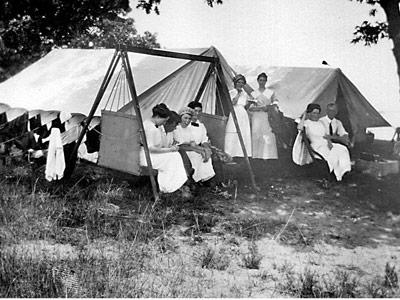
Edith Banister Huntting, third from right, and her fellow campers on Three Mile Harbor in 1910.
Stanley Family Photo
By Steve Rideout

    Women hikers and campers are as common as men these days, or so it seems, but 100 years ago? My grandmother-in-law was one, a concept I could not imagine until I saw the evidence that didn’t fit my stereotype of Edith Banister Cordes — until someone dropped the notion in my lap. Ede, as she was known by her friends at the time, was the older sister of Jud Banister, the East Hampton Village mayor from 1936 to 1954.

    That someone was Everett T. Rattray and the vehicle was his book “The South Fork: The Land and the People of Eastern Long Island,” the paperback version of 1989. One of many sources for our research on Banister, my wife, Carol’s, great-uncle, it carried a number of stories by Everett’s maternal grandmother, Florence Huntting Edwards. He dedicated the book to her for passing on the urge to story-tell. The stories he tells are wonderful and those about his grandmother contain the connective tissue to Carol’s family, as Ede first married Jeremiah Miller Huntting, Florence’s cousin.

    When the “Oh my God” passage hit me, Florence’s character had been well set. She had a personality that Everett strongly admired, with good reason. He was relating an encounter with a new resident of the Hampton Waters subdivision near Springy Banks, an area historically important to the native Indians. He told about childhood family picnics on what he and many assumed was public land. He concluded by relating, “My grandmother had camped there with her friends in the early 1900s . . . a group of women in their late twenties with children already entering their teens, smoking cigarettes and digging clams and singing around fires in an attempt to regain the girlhoods abruptly ended when they had married a decade or so earlier at sixteen and seventeen.” As soon as I finished the sentence I knew I had seen pictures of these women.

    Eleven photos of women camping, including annotations identifying Ede in most, were in Carol’s family documents. The young lady who went on to become principal of the Hamilton School in Mount Vernon, N.Y., who lived and loved the city life, was smiling and enjoying the company of her female companions on the west shore of Three Mile Harbor in the early 1900s. Carol never knew her as anything other than a city-loving lady who retained a great fondness for East Hampton, and yet she was in every camping photo.

    Tents with taut guy ropes draped with swimming suits say, “This is camping.” So does cooking gear, a big wooden picnic table under a large shade tree overflowing with cups, plates, glasses, and, oh my, that looks like a wine flask, and a pie with just two slices left. Some pictures with husbands and bench swings set up reveal a little help from their friends. But photos of women in below-the-knee bathing suits in ankle-deep water, or climbing aboard for a boat ride, or doing a cheerleader pose for the camera with the harbor in the background, these reveal a camaraderie built from the bonds of camping.

    A small dog with a black left eye patch belonged to one camper but loved them all. Full-length dresses, ties and hats, and really big hats were the dress code of the day if the women weren’t swimming or clamming. Six women — rarely a seventh or eighth, and sometimes one or two men — were in most photos. A studio picture taken at another time has eight camping club members smiling and posing for the photographer. Who were these women? We know Ede was one, Florence Edwards another, but the rest remain a mystery.

    Ede, the only married teacher, began her final year at the Union School on Newtown Lane in September 1909, giving her time and attention, once again, to the sixth grade. She assigned grades to 42 pupils during the February 1910 reporting period. Students included Bennetts, Fields, Fithians, Goulds, Hunttings, Hedges, Kings, Lesters, Mulfords, Parsons, and Pharaohs among the longtime East Hampton families, and many newer but established names like Collum, Grimshaw, Loris, and Ross, names that played important roles in East Hampton’s history.

    As the school year ended, the June 1910 federal census found Ede, her daughter, Beryle Huntting, and the entire Banister clan boarding at the Christian Schenck house on the corner of Main Street and Newtown Lane. The family included Jud, his wife, Harriet, his sister Stella, brother, Howard, mother, Lucy, and grandmother Wealthy Burrows. The 1910-11 East Hampton-Southampton Register’s September 1910 survey listed Jerry Huntting, Ede’s husband and Beryle’s father, as a clerk in New York City, no longer an East Hampton resident. By summer’s end, probably sooner, Ede had no husband and Beryle no father at home.

    “The camping club, consisting of seven young women of East Hampton, returned yesterday from its annual week’s outing at Springy Banks. The ladies report that they enjoyed themselves immensely, crabbing, fishing, boating, and entertaining picnic parties of friends, and all have acquired a fine coat of tan and enormous appetites.” The Star’s final August 1910 edition closed the loop on Everett’s story, the 11 family pictures adding flesh to the paper’s description and spirit to the camping trip’s worth to the young women at that time in their lives.

    A failed marriage, a very large family in one house, a new teaching job in New Jersey come fall, and leaving her only child and special friends behind was the emotional milieu Ede carried into her final trip with the camping club. A summer’s end trip with friends provided the ingredients to put a smile on Ede’s face in those photos. Everett’s reminiscence provided the context for the other women in the camping club images. Precious images to our family.

--

    Steve Rideout comes to East Hampton a couple of times every off-season to research family history. He lives in Shutesbury, Mass.