The Architect Effect

The Architect Effect

By
Debra Scott

       Since the 1960s, when Charles Gwathmey dotted the landscape with square houses, South Forkers have had a love affair with architects. In the ’80s Robert A.M. Stern introduced Postmodernism to the Hamptons, quickly followed by Francis Fleetwood, who also built Shingle Style abodes reminiscent of the fashion predominant in the early 20th century. About a decade ago, Modernism reared its head once again, and local firms that had been designing contemporary domiciles began to flourish.

      We are getting out of a period where “everybody wanted immediate gratification,” said Judi Desiderio, chief executive officer of Town and Country Real Estate, a condition that led to the proliferation of builders’ houses. Now “more and more people who have made it by their own rights want to make a statement with their home; they want to capture the essence of their dream house.”

       Does an architect-designed house have added value? Yes. Does it elicit a higher price? Yes and no.

       “I don’t think it’s like a painting that can rise in value based on the artist,” said Ms. Desiderio. “As far as putting a dollar value on who the architect is,” she said, the house needs to “strike a chord . . . that makes that buyer come running.”

       Having an architect-designed house, she believes, is just another of several selling points that include such aspects as “a garden designed by famous landscape architect . . . Summerhill or Marder’s . . . a home graced by Waterworks hardware . . . a Christopher Peacock or a Clive Christian kitchen (which sell for the price of a small house) . . . who the interior decorator is — all kinds of things come together.”

       An architect-designed house will often sell faster, according to Ray Lord of Douglas Elliman. He cites a house by Bates Masi Architects, a Sag Harbor firm known for its edgy design, which sold recently at Startop Ranch, an upscale development in Montauk promoted as an “equestrian estate.” 

      “Modern is the in thing,” he said. “It sold in two weeks for the full

price.” Buyers especially like “modern with a warm tone,” a style he attributes to Maziar Behrooz, an architect with offices in East Hampton and New York. The Curve House, an American Institute of Architects award-winning house, designed by Mr. Behrooz on North Ferndale Place in Montauk, is on the market for just under $1.95 million and boasts such features as endless decks, “windows in the living room that fold open, turning the space into an extension of the outdoors, automatic screens [that] pull down for protection, [and] notably the first green roof garden in Montauk,” according to its listing.

       It took only four weeks for Bill Williams of Sotheby’s to sell a house designed by Fred Stelle 18 months ago, and that was before the market picked up. The “Malibu-style beach home with jaw-dropping 270-degree forever-protected ocean and bay views, spectacular great room with wood burning fireplace,” which was built in 2010, went for $14.25 million, shy of the $14.5 million asking.

       “Fred Stelle has a reputation for maximizing light and views in oceanfront property.  That’s why the owner chose him, and that’s exactly what the buyer was looking for,” said Mr. Williams. 

       The fact that an architect designed a house is not necessarily the selling point, but the style and pizzazz he gives it is, and the fact that the materials will be top-notch. When realtors say a house is built by a spec builder, “people cringe,” said Mr. Lord.

       “If you say it’s a Robert A.M. Stern house,” said Ms. Desiderio, “people sit up and take notice.” As for Norman Jaffe, a modern architect whose work flourished here in the ’70s and ’80s, she said: “If you have a customer who’s modern and bold and looking for [his] earth-meets-wind-and-fire look, when they see the name, they want to take a look.” But, she stressed, it is a small segment of the customer base. “People either love or hate them.”

       One of the factors that adds value to an architect-designed house, according to Mr. Lord, is that “architects are able to think ahead to things that others aren’t.” As an example, he pointed out that architects will often “have pipes laid into a wall” enabling the homeowner to “tap into them later if they want to expand their home.”

       Though they may not command higher prices per se, architecture-designed houses “probably hold their value better,” said Mr. Williams. And, of course, with the architect’s fees and superior materials, they cost more to build, a cost that will carry over into the resale price. “A Farrell house of the same size, where he uses the same three or four models over and over, would be less expensive than a house designed by Frank Greenwald,” he said, referring, respectively, to a prolific local builder and a well-known local architect.

       Despite the attraction to modern design by a young, affluent, avant garde crowd, older architect-designed houses still offer appeal. “Who doesn’t like the look of a Francis Fleetwood from the outside?” asked Ms. Desderio. With its “timeless, beautiful sweeping lines, it’s a work of art,” she said.

       On the other hand, even some modern designs are considered teardowns. A Norman Jaffe house built in 1978 at 12 Heller Lane in East Hampton was sold for just under $5 million in April. Mr. Lord said that its neighbors considered it an eyesore and are relieved that it was torn down and that a new house is going up in its place, something that will be more in keeping with the house built last year just next door on Further Lane, which is on the market for just under $13.5 million.


Decision Nears on Club’s Pond

Decision Nears on Club’s Pond

The East Hampton Village Zoning Board of Appeals held a hearing Friday to consider the Maidstone Club’s proposed irrigation upgrade.
Durell Godfrey
Maidstone’s irrigation project sparks concerns over runoff and noise
By
Christopher Walsh

       The long effort to modernize and expand the Maidstone Club’s irrigation system came a step closer to resolution on Friday when the East Hampton Village Zoning Board of Appeals held a hearing to evaluate a draft environmental impact statement submitted by the club.

       The board heard from multiple consultants and attorneys, Hook Pond shoreline homeowners, and two town trustees during the two-hour hearing, with much of the discussion focused on the pond’s ecological well-being and the irrigation project’s potential impact.

       The Maidstone Club contends that the proposed irrigation system will be more efficient and increase turf density, which in turn would substantially reduce runoff to Hook Pond. The reduced need to apply fungicides and pesticides to the grounds would also mean less of those chemicals entering the pond, according to the club.

       The proposed project would overhaul the club’s existing irrigation system and add irrigation to all 27 fairways, 18 on its west golf course and 9 on its east. It calls for the construction of a third well, a pump house, a .42-acre irrigation pond with a capacity of 785,000 gallons of water, and new piping. The project, which is expected to last eight months, requires 14 variances from the board.

       The State Department of Environmental Conservation has already granted the private club a permit for the third well, which would fill the irrigation pond, and a freshwater wetlands permit, needed because of the club’s proximity to Hook Pond.

       The Maidstone Club, said Frank Newbold, the board’s chairman, “has been remarkably forthcoming in providing as much information as has been requested.” The board has also received many letters from club members in support of the project, he noted. “I want to assure them and all the public that we’re gong to try to pursue this as quickly and as efficiently as we can,” he said, “while answering all the environmental questions that have been raised.”

       On Friday, many speakers were skeptical that the proposed irrigation system would have either a beneficial or benign impact on Hook Pond. Tony Minardi, a former biology and biochemistry professor and researcher at the Woods Hole Oceanographic Institution in Massachusetts and a teacher in the East Hampton schools, warned the board that the pond’s borders are migrating toward the center and the bottom rising due to organic decomposition, a process called “ecological succession,” which he said was being accelerated by nitrate runoff. Mr. Minardi brought with him members of East Hampton High School’s Environmental Awareness Club, two of whom asked that the board be mindful of the pond’s well-being in their deliberations.

       Linda James, a former president of the Hook Pond Associates homeowner’s group, expressed concern about long-term impacts to the pond’s wetlands ecosystem. “The Maidstone Club must be willing to take full stakeholder responsibility for the improvement this proposed project will provide its two golf courses,” she said, by agreeing with the village to pay for “any errors or omissions, whether intentional or not, that result in degradation of the Hook Pond ecosystem or any associated village natural resources.”

       Ms. James proposed a bond or other form of covenant that would require “modification or temporary or permanent suspension of the irrigation system” and “funding for future mitigation and restoration efforts required to restore Hook Pond to an agreed-upon healthy condition,” should either be necessary. A monitoring plan, funded by the club over a long enough time to ensure that the irrigation system is sustainable, was essential, she said.

       Evelyn Lipper of Jefferys Lane agreed that without accountability and a plan to monitor and report on the impact of the project, “the D.E.I.S. becomes a hollow exercise.”

       Her husband, William Speck, also stressed monitoring and follow-up. “I think there is a good possibility that this will improve the quality of water in Hook Pond, but we won’t know that unless we monitor,” he said.

       Ms. Lipper also worried about truck traffic, as regards the volume of dirt to be moved offsite for the pond’s construction. In addition, she said, the environmental impact statement “does not address the issue of mud being tracked offsite during wet periods.” Dirt deposited on village roads could be washed into Hook Pond, she said, to its detriment. She asked that measures be imposed to ensure minimal deposit of dirt on the roads.

       Stephen Angel, an attorney representing Carole and Mort Olshan, was worried about potential noise from the pump house, which would be situated near his clients’ property. The D.E.I.S. does not adequately analyze this component of the irrigation system, he said. The Olshans “were hoping that the club would consider relocating the pump house to a different portion of the property so they wouldn’t bear the risk of that potential large noise,” said the attorney. “They have not been accommodated.”

       Mr. Angel suggested that pumping equipment be contained in a subterranean vault or a raised soil mound, but also insisted that “the final [impact statement] has to discuss alternate locations.” A professional engineer, he said, had concluded that the pump house could located anywhere on the club’s 207 acres.

       Bonnie Schnitta of the acoustical consulting and engineering firm SoundSense then told the board that her firm had performed extensive tests in the area on behalf of the Maidstone Club, reaching a very different conclusion. Noise generated by pumps would be inaudible, she asserted. “As long as we do the engineering, which we did; as long as we supply the materials, which we will, and we do the installation, we can give that level of a guarantee” that the pumps would be inaudible.

       Ms. Olshan was unmoved. “This repetitive noise . . . is right in my backyard,” she told the board. “We were never told about the possibility of this irrigation system. . . . Yes, they’ll make a guarantee, and what am I going to do at 3 o’clock in the morning? Who am I going to call?”

       Further, said her husband, “our neighbors were not notified on Further Lane. . . . This industrial installation is going to affect their lives. . . . I’m going to insist and continue to fight to eliminate the pumping system in my backyard.”

       Deborah Klughers, an East Hampton Town trustee, asked why “one entity gets to take an unequal amount of groundwater for such a small group of people. This water is not just for today, or for the Maidstone Club to have a green turf for their members, but for the future, our children.”

       Timothy Bock, also a trustee, told the board that “not only your approval but the trustee approval” is required “before this goes through. I don’t see how it could not be. It’s going to affect the public so much, for just the elite and playing golf. That doesn’t seem enough reason to do this.” He and Ms. Klughers, as well as Ms. James, continued their discussion when the trustees met on Tuesday.

       David Eagan, an attorney representing the club, sought to refute fear of adverse impacts on Hook Pond. “The contribution of Maidstone is so minimal. The runoff issue will be slightly more beneficial because of this project,” he said.

       Mr. Eagan threw cold water on the idea of post-installation monitoring. “Absent negative environmental impacts established in this process,” a conclusion he said the D.E.I.S. had reached, “as a matter of law, this board and other municipal boards do not have the authority to condition approvals in that situation.”

       Nonetheless, he said, the club is not unconcerned about Hook Pond. “The takeaway from this project really is the baseline science,” which, he said, “has established that the nitrate issues and problems facing Hook Pond aren’t related to Maidstone’s irrigation activities or even their fertilization practices. . . . It’s animal waste and human septic.”

       Mr. Newbold asked if the club would be amenable to modifying its plans for the pump house based on the concerns Mr. Angel raised. “Mr. Angel’s claim . . . is just a claim,” Mr. Eagan said.

       The hearing was then closed, with the record remaining open for 10 days for submission of written comments.

Calling In Coastal Experts

Calling In Coastal Experts

Scientists to help town vet Army Corps plan
By
Joanne Pilgrim

       With proposals from the Army Corps of Engineers for a major beach restoration project in downtown Montauk expected shortly, the East Hampton Town Board agreed on Tuesday that three coastal experts who have offered their services gratis to East Hampton Town will be called on for their professional knowledge and guidance.

       Kim Shaw, the town’s director of natural resources, outlined their credentials at a town board meeting.

       Robert S. Young, a licensed professional geologist, is a professor of coastal geology at Western Carolina University and director of the program for study of developed shorelines, a joint venture of Duke University and his university. It specializes in evaluating the design and implementation of coastal engineering projects.

       Henry J. Bokuniewicz, a professor of oceanography at the State University at Stony Brook’s School of Marine and Atmospheric Sciences, does coastal zone management research and has been involved in monitoring shoreline changes, beach dynamics, and responses to storms on Long Island ocean beaches.

       Jay Tanski is the coastal processes and facilities specialist at New York Sea Grant, a marine research, education, and outreach program run by the State University of New York and Cornell University that provides technical assistance on coastal processes and hazards. Sea Grant has been coordinating federal and local efforts for immediate and long-term recovery after Hurricane Sandy.

       All three professors had responded to an e-mail sent some months ago to a dozen coastal experts up and down the East Coast asking if they might be interested in advising the town. The inquiries generated “a lot of interest,” said Ms. Shaw.

       “Using their services as you deem necessary or appropriate . . . would be valuable,” Supervisor Larry Cantwell told Ms. Shaw.

       “I would urge that they get involved as soon as possible and develop a dialogue with the Army Corps of Engineers,” Mr. Cantwell said. The experts, he said, could help the town to engage in a “cooperative dialogue with the Army Corps, in reviewing what they’ve proposed, and try to make it better.”

       An initial presentation by the Army Corps of the types of shoreline projects that could be proposed for Montauk included the installation of shore-hardening structures under a dune, restoring the beach with sand alone, and rebuilding the beach and restoring sand dunes after relocating motels built there.

       The possibilities prompted extensive public discussion and concern. A number of community groups and individuals called on the town to seek guidance from coastal experts, but the majority members of the previous town board resisted, placing faith in the Army Corps.

       Ms. Shaw said Tuesday that she may also ask the coastal specialists for help preparing an application for a “very competitive” federal grant for money to retain a coastal expert “to develop a strategy for the town on coastal processes.”

       “Clearly the board is interested in doing a coast-wide review” to examine existing conditions “and how we might adapt, mitigate, and do things that are proactive for the future,” Mr. Cantwell said. The longer-range process, he said, would entail extensive public involvement.

       The Army Corps was to have evaluated each of the potential downtown Montauk projects for cost-efficiency and efficacy, and will return to the town with its offer. Under an emergency provision of a post-Sandy relief package, the work would be paid for entirely with federal money.

Deer Defenders Rally

Deer Defenders Rally

Wildlife advocates who oppose East Hampton Town and Village’s planned deer cull will hold a demonstration on Saturday.
Morgan McGivern
Critics decry town-village sharpshooting plan
By
Christopher Walsh

       Opponents of plans to thin the deer herd this winter are pressing forward with their efforts to avert any such action. In East Hampton, both town and village officials have indicated they will allow federal “sharpshooters” to cull the herd. 

       Last month, the New York law firm Devereaux, Baumgarten filed suit on behalf of the East Hampton Group for Wildlife, the Evelyn Alexander Wildlife Center of the Hamptons, and 15 residents to stop the cull. The town, the village, and the East Hampton Town Trustees are named as defendants in the complaint.

       This month, opponents are planning protests, both substantial and symbolic, to advance their cause. On Saturday they will hold a demonstration at 1 p.m. at Hook Mill in East Hampton. Carrying signs, they plan to walk from the windmill to Herrick Park, where they will face the Newtown Lane traffic for 30 minutes.

       A petition at the website change.org, launched by Wendy Chamberlin of Bridgehampton and Zelda Penzel of East Hampton, had 10,628 signatories as of noon yesterday. Ms. Chamberlin and Ms. Penzel lead the Wildlife Preservation Coalition of Eastern Long Island, which is co-sponsoring Saturday’s demonstration. Another animal advocacy group, Long Island Orchestrating for Nature, is also a sponsor.

       Bill Crain, who heads the Group for Wildlife, said he had received much email from residents expressing a wish to participate. “They use words like ‘appalling’ and ‘sickening,’ ” he said last week. “The residents on the whole are strongly opposed to this and have a deep feeling for the animals. That’s something that’s emerged from this impending atrocity.”

       Mr. Crain referred to a 2006 study commissioned by his group, which counted the deer population at 3,293, and the 2013 town-commissioned survey, using different methods, that estimated 877 deer, to dispute Village Mayor Paul F. Rickenbach’s use of the word “epidemic” in describing the deer population. He also challenged a correlation between the deer population and the prevalence of Lyme disease and other tick-borne illnesses, which the mayor and the village board have cited as an impetus for the cull.

       “There’s a real passion and empathy” among residents, Mr. Crain said. “The amount of emotional distress is enormous, and I don’t think the mayor or anybody understands this. They fell into this mass hysteria over the number of deer, which turned out to be false.”

       The kiosk constructed last year at the Nature Trail in East Hampton Village features wildlife photographs by Dell Cullum, who is from Amagansett and works in the rescue and removal of wildlife. Mr. Cullum, whose photography appears in The Star, has protested the planned cull by removing his photographs, one of which depicts deer, from the kiosk.

       Members of the Ladies Village Improvement Society’s Nature Trail Committee approached Mr. Cullum last spring, he said, to ask if he would donate photographs for display at the kiosk, which it maintains. After learning last month that the village board had voted to participate in the cull, “it didn’t seem proper to be donating them when they’re killing those very animals,” he said. “I took offense — not just me but the entire community — that it wasn’t put to a vote. It would be hypocrisy to leave my pictures there.”

       The removal of his photographs, Mr. Cullum said, was “a message to the mayor and the village board that I wasn’t going to donate my work to any village organization. This was going to hurt the village as a whole, because the village was responsible for it.”

       “He’s a wonderful photographer, so it’s difficult,” said Dianne Benson, chairwoman of the Nature Trail Committee. Members are replacing the pictures in the kiosk and having a new map made, as Mr. Cullum also provided the map accompanying the photos, all of which are changed periodically.

       Mr. Cullum is particularly disturbed by the possibility that the Nature Trail itself might be among the locations from which sharpshooters would operate. “Is that bizarre action actually going to be part of the reality too?” he asked.

       Ms. Benson said last week that the trail “seems to be” a site at which the culling program would take place. She said she and Janet Dayton, the society’s president, were meeting with the mayor “to discuss an alternative to using the Nature Trail.” That meeting took place Tuesday morning.

       Mayor Rickenbach said afterward, as he has said before, that no such plan was in place. He called the selection of shooting locations “a work in progress,” saying he did not want to address specific places “because of a lot of mechanics that are unfolding.”

       Mr. Cullum plans to attend Saturday’s demonstration, which falls on his birthday. “I’m absolutely committed to be there,” he said.

       The demonstration is “part of the democratic process,” Mr. Rickenbach said last week. “Fortunately, we live in a free and open society.”

       The mayor would not comment on the lawsuit. “Counsel has a copy and I’d rather respond after I hear their legal commentary,” he said.

       Meanwhile, Town Supervisor Larry Cantwell notified the State Assembly on Tuesday that the town supported a bill authorizing the five East End towns to adopt local laws related to the culling of deer. The white-tailed deer population, Mr. Cantwell wrote, “has been linked to an epidemic of tick-borne illnesses, degradation of natural resources, crop damage and other harmful impacts to the agricultural industry, as well as car crashes.”

       Simultaneously, town residents have been receiving a flier in the mail offering to lease their land for use by “2 mature, responsible, ethical bow-hunting brothers.”

       Chris Geraghty of Ridge said his mailing was coincidental to the planned culls in East End towns, though he was aware of them. “I’m always looking for different spots to hunt,” he said this week. “I consider myself a steward of the wildlife, we’ve got to sustain the population.” Deer, he said, “don’t have any natural predators.”

       Mr. Geraghty and his brother seek to hunt on private property. “I hate to see tax dollars going to this,” he said. “To me, there’s too much government in my life already.” He said the response to his mailing had been mostly positive. 

Cop in Tryst Suspended

Cop in Tryst Suspended

East Hampton Village officer asked to turn over badge and gun
By
T.E. McMorrow

    The East Hampton Village police investigation of a male officer and a female village traffic control officer who allegedly used a Talmage Lane house without permission of its owner for a romantic tryst on Dec. 30 resulted in the officer being suspended with pay and the village board dismissing the traffic control officer, identified in the minutes of the meeting as Jennifer Rosa, 20. Both actions were retroactive to Dec. 30.

     A fellow traffic control agent, who asked that her name not be published, said that Ms. Rosa knew where the key for the house was because she had previously worked at the house as a cleaner.

     The officer, who has been identified by the New York Post as well as by multiple police sources as Mario Julio Galeano, has had his badge and gun confiscated by the force. In 2013, the officer was recognized by the department for his role in the arrest and conviction the year before of a man accused of having sexual relations with a child.

     The officer, a native of Colombia, is the only Latino officer on the force.

Gerard Larsen, the department's chief, would not comment today about the specifics of the current investigation or even confirm the officer's identity.

     However, he did talk about the steps in disciplining or removing an officer from the force. The first thing people need to realize, he said, is that "there is a process involved." He explained that process by saying, "When something happens that generates an internal investigation, if we find misconduct, we relieve the officer of duty. We have to do that with pay." The entire process, he explained, is part of the collective bargaining agreement between the village the Police Benevolent Association.

     The chief said that the police investigative side of the current action has been concluded, as far as he is concerned.

     When an officer is relieved of duty, he said, the matter is then brought before the East Hampton Village Board. That appears to be what happened on Friday. The officer, he said, could be suspended or even terminated. "People are getting off track here," he said about published reports. "It takes time. The officer has rights under collective bargaining." But he added, "I think, in the end, people will be satisfied with the outcome."

     "I run a very strict Police Department," he said. "If these allegations are true, it brings embarrassment to the entire Police Department."

     David Davis, an attorney representing the officer on behalf of the P.B.A., was unavailable for comment.

Former Congressman Pike Dies

Former Congressman Pike Dies

Aug. 31, 1921 - Jan. 20, 2014
By
Stephen J. Kotz

      Otis G. Pike, who as a Democrat represented what was then the solidly Republican 1st Congressional District for nine terms in the 1960s and ’70s, died on Monday in Vero Beach, Fla. He was 92 and had been in declining health the past two years, according to his daughter, Lois Pike Eyre of Riverhead.

       Mr. Pike, who was first elected in 1960 despite the fact that Richard M. Nixon handily outpolled John F. Kennedy in his district, served during a two-decade period in which Congress grappled with voting rights, anti-poverty and environmental legislation, the Vietnam War, and the Watergate scandal that eventually forced Mr. Nixon to resign.

       Mr. Pike came to national prominence in 1975 when he chaired the House Select Committee on Intelligence, which examined charges that the Central Intelligence Agency had been planning coups and spying on American citizens. Although Mr. Pike’s committee issued a report that was harshly critical of the intelligence community, the House refused to release it, citing national security concerns. A less critical report, issued by a Senate committee chaired by Senator Frank Church, was released. The Pike Report was later leaked to the CBS newsman Daniel Schorr and published in The Village Voice.

       “He was a very patriotic guy, and he could not believe what was occurring,” said Karl Grossman of Noyac, who covered Mr. Pike as a reporter for the Long Island Press and described him as “the best member of Congress from Long Island that I’ve ever known.”

       Mr. Grossman said Mr. Pike’s disappointment that the mainstream media did not pursue the story of the intelligence report more aggressively played a role in his decision to become a syndicated columnist for the Newhouse News Service, after leaving Congress.

       Not only was Mr. Pike outraged that the C.I.A. had a hand in overthrowing governments, Mr. Grossman said, but “among other things he was outraged because of his Yankee thriftiness by the way they were throwing money around.”


       Known for his wit and sense of humor, Mr. Pike once took to the House floor to complain that the military was being overcharged for simple parts like nuts and bolts. Holding up a metal rod that cost more than $25 because it was manufactured with “precision shafting,” he quipped that for once, taxpayers received precisely what they had paid for.

       “He became an institution,” according to Mr. Grossman, who won reelection time and time again by keeping his campaigns simple. He would search for a flaw in his opponent and then exploit it on the campaign trail, often through humorous songs he composed and sang as he accompanied himself on his baritone ukulele.       “He was charming, he was funny, he was smart, and he worked his butt off,” said his daughter. “He went out of his way to meet people and he made a real point of staying in touch with the people in his district,” partly through excellent constituent service, a weekly radio address, and a column that he distributed to community papers in his district, including The Star, which ran his dispatches from Washington under the title “Pike’s Peek at the Capitol.”


       Her father took environmental issues very seriously and was proud to have worked for the creation of the Fire Island National Seashore, Ms. Eyre said. A wilderness area there was later named after him.

       David Starr, the former editor of the Long Island Press, said in an email that Mr. Pike had also played a major role in saving wetlands along the Great South Bay as well as in encouraging the creation of Stony Brook University.

       Ms. Eyre said her father never took his position of power too seriously. Once, she said, the family was preparing to return to Long Island for a vacation and her mother had packed the three children into the family station wagon and drove to the White House, where Mr. Pike was attending a reception. In those days, security was not as tight as it is today, and eventually, her mother let her two brothers out of the car, and they cavorted on the White House lawn, to the consternation of the guards. Her father saw what was happening from inside the White House and used that as his excuse to leave the reception before President Kennedy, which normally would have been viewed as a breach of protocol.

       “What’s the matter, Dad? Did you get tired of it,” his youngest son, Robert, asked. “That even got the guards laughing, Ms. Eyre recalled.

       Mr. Pike also enjoyed boating and fishing. For a time he had a converted Navy launch and enjoyed pursuing swordfish. “If we saw one, we would try to sneak up real quietly and he would stand on the bow with a harpoon,” said Ms. Eyre, who added that the prey typically got away.

       Mr. Pike was born on Aug. 31, 1921, in the house on Ostrander Avenue in Riverhead that his father, also named Otis Grey Pike, had built. When his father died when Mr. Pike was 3, his mother, the former Belle Lupton, moved the family to Hawaii, where they lived until her own death four years later. Returning to Long Island, the Pike children lived in the family home with an aunt.

       Mr. Pike attended Princeton University, taking time out to join the Marines during World War II. A fighter pilot, he flew more than 120 missions in the Pacific theater. He returned to Princeton after the war and received his law degree from Columbia University in 1948. He practiced law in Riverhead and was elected a town justice of the peace, a position he held for seven years.

       Mr. Pike and the former Doris Orth of Flanders were married on Jan. 6, 1946. She died in 1996.

       In June 2003, Mr. Pike married Barbe Bonjour, who survives him. Besides his daughter, Mr. Pike is survived by a son, Douglas Pike of Paoli, Pa., and two grandchildren. Another son, Robert, died in 2010.

       A memorial service will be held at a later date.

       The family has requested that memorial donations be made to Planned Parenthood, 434 West 33rd Street, New York 10001, the Riverhead Public Library, 330 Court Street, Riverhead 11901, or the donor’s local public radio or television station.

Cantwell and New Board Have Big To-Do Lists

Cantwell and New Board Have Big To-Do Lists

Morgan McGivern
By
Joanne Pilgrim

       A new leader, Larry Cantwell as town supervisor, takes the helm today at East Hampton Town Hall, with two new town board members, Kathee Burke-Gonzalez and Fred Overton, to be sworn in with him.

       After coffee and cake is served at 9 Thursday morning, officials will be sworn in beginning at 9:30 and, after a break, the board will commence its organizational meeting.

       Though he talked in some detail early this week about some of the items he has penciled in to the top of a to-do list, Mr. Cantwell said that overall, it is crucial to set the right tone at Town Hall, radiating outward.

       “If I can do one thing,” Mr. Cantwell said, “it would be to increase the level of cooperation between the town board and the departments of the town, the town board members and the public. We really have to find a new level of cooperation in order to move forward, to strive for a sense of resolving issues as opposed to disagreeing over issues.”

       “We live in a diverse community and there’s going to be disagreement.” But, he said, “I think there’s a lot of agreement on the basic goals for this community.”

       “We want to be stewards of our extraordinary natural environment, have compassion for people who are less fortunate and those that are new to our community, and support the working-class families, the backbone of so many of the things that we do.”

       “We should find a way to agree on what the problems and solutions are.”

       The need to compromise, he said, will remain foremost in his mind, “and I would ask the community to agree” to do so as well, Mr. Cantwell said.

       Agendas for town board meetings will be made public two days ahead, Mr. Cantwell said, and last-minute, or “walk-on,” resolutions not tolerated unless time-sensitive and agreeable to the whole board.

       Mr. Cantwell declined to provide a sneak preview of appointments he will make at the board’s organizational meeting at Town Hall today, although he revealed that Colleen Reynolds, an East Hampton Press reporter who has been covering East Hampton Town Hall, will become his secretary.

       It falls to the new administration to appoint one person each to serve a term on the planning board, zoning board of appeals, architectural review, assess ment review, and licensing review boards, as well as several people to serve on the town’s ethics and Fort Hill Cemetery boards.

       The new supervisor announced new town attorney appointments last week.

       “We’re looking to make some organizational changes in how that’s approached,” he said of the departments — Code Enforcement, Fire Marshals, and Building — that have fallen under a Division of Public Safety headed by an outgoing town attorney, Patrick Gunn. Mr. Gunn will stay on only through a transition period, Mr. Cantwell said, and Michael Sendlenski, a former Southampton Town attorney with enforcement and prosecution experience, will be “an integral part” of enforcing the town code.

       Mr. Cantwell has already met several times with the new East Hampton Town police chief, Michael Sarlo, who was sworn in on Saturday, and that they “both understand that there’s a level of frustration with the enforcement of quality of life issues, with respect to noise and traffic, and a sense that the peace and quiet of our neighborhoods should be protected.”

       “The enforcement agencies of the town need to work together on a very high level,” he said, “so that people have a sense that the town is being responsive.”

       A high priority of the new board, he said, will be to discuss related matters such as the town’s noise ordinance, taxi legislation, mass-gathering permit standards, and the like.

       And, Mr. Cantwell said, “There needs to be substantial improvement in the administration of the Town Building Department. That office needs to be professional, and the level of courtesy and responsiveness for the public needs to be elevated.”

       Mr. Cantwell said he would seek a state grant for money to properly manage and digitize town records, as East Hampton Village has done. The town has ignored its responsibility to properly maintain records, he said, and, with many paper documents moldering in the basement of the abandoned old Town Hall in a “deplorable” state, “that’s got to be a priority,” Mr. Cantwell said.

       The supervisor said he looks forward to discussing design proposals for the reconstruction of the downtown Montauk beach with the Army Corps of Engineers and Representative Tim Bishop, with whom he has already been in touch, and getting a project completed “as soon as possible.” What the Army Corps might do has yet to be revealed, but, Mr. Cantwell said, “I’ve made it clear that I’m not a fan of rock walls on our beaches.” He said he would seek expert guidance for town officials in evaluating the Corps’ proposals.

       The town’s scavenger waste plant and an ongoing effort to craft a wastewater management plan was another key effort cited by all of the incoming board members.

       Mr. Cantwell’s Democratic running mate, new Councilwoman Kathee Burke-Gonzalez, will serve as the board’s liaison to the Human Services Department, the airport, and the Information Technology Department.

       Among the committees to which she will be assigned is the budget and finance committee. As the sole member of the incoming board with corporate experience, she said, and because of “strong budget experience” honed over nine years as a school board member, “it’s an area of expertise that I have,” she said.

       Ms. Burke-Gonzalez said that within the next few weeks she will meet with Diane Patrizio, who heads up Human Services, and with members of the East Hampton Clericus, who have expressed concerns about a lack of mental health services in the area, and plans to attend a Friday, Jan. 10, meeting on related issues with Assemblyman Fred W. Thiele Jr. and Senator Kenneth J. LaValle. She looks forward to learning “what services we have out here, and where the gaps are.”

       Also penciled in for the councilwoman’s first week is a meeting with Jim Brundige, the East Hampton Airport manager, who has already taken her on a tour of the facility. Although operation of the airport, and the noise emanating from its users, has been a contentious issue in the town, Ms. Burke-Gonzalez believes that the groups seemingly on both sides of the issues — aviation interests, and those calling for noise abatement — are really “not too far apart.”

       A financial analysis and business plan for the airport, and a maintenance and capital improvement plan, should be undertaken right away, she said, as “there are probably some things to be addressed immediately from a safety standpoint.”

       The new supervisor agreed. “We cannot allow the airport to deteriorate or become unsafe and close,” he said. Determining a funding source for needed repairs is also on his priority list.

       Both Ms. Burke-Gonzalez and Mr. Cantwell said efforts to compile the noise data needed to support the town’s establishment of airport use restrictions must continue, and expressed an unwillingness to accept Federal Aviation Administration grants at this time.

       And, Ms. Burke-Gonzalez said, “I’m looking to start getting to work on code enforcement and overcrowding.”

       She has been “taking a lot of meetings” in the days prior to her swearing-in, she said, with the heads of town departments and with her fellow board members, including Fred Overton, who is the sole Republican on the new board.

       “I’m thrilled to be starting — and what a beautiful place to work,” said Ms. Burke-Gonzalez of Town Hall. She will “be there every day,” and keep office hours, she said.

       For Fred Overton — a new town councilman but certainly not a new face at Town Hall, where he was a town assessor for a decade and then elected as town clerk in 1999 — the new board members have been “very inclusive.”

       “I’m confident that if we can continue working together the way we have during the transition, that we will be a good board,” he said. Among his assignments, he said, will be the Springs Citizens Advisory Committee, the nature preserve committee, the fisheries advisory committee, the offices of the town clerk and town assessors, emergency preparedness, and the town’s fire advisory group.

       The town board already has its work cut out for it, said Mr. Overton, who as town clerk attended virtually every town board meeting. “I don’t have an agenda,” said Mr. Overton. “We have enough on our plates right now,” he said, naming several ongoing “pressing issues” such as erosion, wastewater management, the airport, and zoning matters.

       Mr. Overton will leave the town clerk’s office in the experienced hands of Carol Brennan, his longtime deputy, who won election to his vacated seat.

       The two sitting board members at the midpoint of their terms, Peter Van Scoyoc and Sylvia Overby, both agreed that the quality of life issues about which residents have consistently complained are a pressing task for the board — things “we need to settle before the summer season gets kicked off,” Mr. Van Scoyoc said.

       The councilman said he will announce at today’s meeting a proposed agreement with Suffolk County that would resolve an issue created by the former board, which had a drainage sump dug on farmland over which the county owns development rights.

       “There are a lot of things that are still outstanding that we need to clean up,” he said. Among them is the restoration and use of town-owned properties, such as the historic Duck Creek Farm and the former Boys Harbor camp. “I’m looking to set up a template,” said Mr. Van Scoyoc, creating a way to partner community groups and grant money, “without burdening taxpayers,” to deal with the properties.

       “I hope it’s going to be an administration that pays attention to the community,” Ms. Overby said this week. She is “very excited about our new attorney’s office” and the attorneys’ role in helping the board find effective solutions to problems such as overcrowded housing, or houses rented illegally as summer shares.

       “I think everyone’s going to be working hard; a lot of listening,” Ms. Overby said.

        “You’re definitely going to see a different dynamic,” said Ms. Burke-Gonzalez.

       The board will maintain a meeting schedule that includes three work sessions (on the first three Tuesdays of the month, with the second one held at the Montauk Firehouse) and two nighttime formal meetings, normally on the first and third Thursdays. Those meetings, however, will begin a little earlier, at 6:30 rather than 7 p.m. The first nighttime meeting this month will be on Jan. 16.

A Light Mood as New Town Board Is Sworn In

A Light Mood as New Town Board Is Sworn In

Kathee Burke Gonzalez was sworn in as a member of the East Hampton Town Board on Thursday by Town Justice Lisa Rana.
Morgan McGivern
By
Joanne Pilgrim

It was standing room only at East Hampton Town Hall as snow fell outside on Thursday morning during a swearing-in ceremony for new town officials.

Town Supervisor Larry Cantwell commanded the attention of the crowd, which filled the meeting room after a half-hour of coffee, Dreesen’s donuts, fruit, and chit-chat in the atrium. Mr. Cantwell's quiet “Good morning,” prompted a round of applause.

East Hampton Village Trustee Barbara Borsack was introduced by Mr. Cantwell as a “lifelong friend” and led a chorus of “God Bless America.”

Former East Hampton Town Justice James T. Ketcham rose to don his black robe – “to make it official,” he said – before swearing in Mr. Cantwell

Steve Tekulsky, who would be sworn in a few minutes later as town justice by his friend Alex Walter, stood in his brand-new judge’s robe, his hand on the shoulder of his elderly mother who was seated in the front row and wearing a wrist corsage.

“You knew what to do right away,” Judge Ketcham teased Carole Brennan after her swearing-in as the new town clerk. As a longtime deputy town clerk, Ms. Brennan had participated in many similar official ceremonies.

She did the honors for her former boss, Fred Overton, who eschewed an incumbent run as town clerk and instead sought and won a seat on the town board. “We’re switching sides,” she told Mr. Overton as the two stood at the front of town hall, Ms. Brennan with a face full of emotion and a huge, barely repressed grin.

Kathee Burke-Gonzalez, also taking a seat on the town board, was sworn in by Town Justice Lisa Rana. Her husband, Joe Gonzalez, flashed her a smile and a big thumbs-up as she stepped to the side of the room following her oath.

Ms. Rana then swore in incumbent Highway Superintendent Steve Lynch and his deputy, Kevin Ahearn.

“Now we’re going to swear in the new Carole,” Ms. Brennan said before doing the honors for Jeanne Hamilton, a three-decade veteran of positions at Town Hall, who is now the deputy town clerk.

During a brief break before the board began its annual organizational meeting, handshakes and congratulations were shared throughout the room.


Mending Fences After Hole Dug

Mending Fences After Hole Dug

Town, county near agreement to resolve Rte. 114 sump and flooding issues
By
Joanne Pilgrim

       The  resolution of a problem caused  when East Hampton Town began to build a sump on farmland along Route 114, allowing farm soils to be trucked away, maybe forthcoming, Town Councilman Peter Van Scoyoc reported this week.

       The project, under former Councilwoman Theresa Quigley’s oversight, was an effort to address severe flooding in nearby neighborhoods. It was commenced without county and State Department of Environmental Conservation permits, and was halted some time ago after the county learned of it and objected, but not before a deep hole had been dug and the soil hauled away.

       The county owns the development rights on the property, and the project should have been vetted by a county farmland committee. When the town asked retroactively for the county’s permission, that permission was not forthcoming.

       The site, which is surrounded by a chain-link fence, has been untouched since the county put the town on notice that, should the matter not be satisfactorily resolved, East Hampton could be sued for violating its farmland preservation program. Councilman Van Scoyoc has been working to soothe ruffled feathers.

       The détente resulted in a plan that has initial acceptance from the county and will result in at least a partial solution to the nearby flooding, Mr. Van Scoyoc said at a town board meeting on Tuesday.

       “All along I’ve insisted that we address the flooding problems,” said Mr. Van Scoyoc. And, he said, both the town and the county agreed that the land should remain farmable.

       Under the aborted plan approved by the previous board majority, a 12-foot water catchment basin was created, which eliminated the ability for a farmer to till the property.

       Regrading of about half the dug-out area will create a swale that can still be farmed once it is replenished with good soil, Mr. Van Scoyoc said.

       Pursuant to a contract approved by the previous board, Keith Grimes, the contractor hired for the job at $293,000, was given the soil dug out of the original hole, and it was carted off.

       At the time, the board majority rejected the option of having Mr. Grimes spread the excavated farm soils around the site, which would have cost $28,000 more. An engineering company was paid $35,100 for the project design.

       Mr. Van Scoyoc’s negotiations with county officials “really centered on the amount of prime agricultural soils that were removed from the site,” Mr. Van Scoyoc said. It was “a major bone of contention with the county and the farmland committee.”

       To compensate, he said, the town would commit to a future purchase for preservation of farmland or farm development rights — something already on the agenda, Mr. Van Scoyoc said.

       Under the new proposal, Mr. Van Scoyoc said, a new, six-and-a-half-foot-deep sump will retain runoff from the field, stopping it from spilling across Route 114 and causing flooding. It will hold about 40 percent less water than the original basin, the councilman said, but run-off containment work being done by the county along Long Lane, at the other side of the field, will improve the overall situation. The plan, he said, “greatly reduces the possibility of there being severe flooding.”

       The efforts of Mr. Van Scoyoc and others who helped broker the solution were acknowledged Tuesday by Supervisor Larry Cantwell and Councilwoman Sylvia Overby, who thanked the councilman for “facing an angry farmland committee.”

       The extent of the breach was made apparent last fall in online comments by Sarah Lansdale, the county’s director of planning. The town, she said, “blatantly caused extensive damage to farmland,” and “unlawfully violated a piece of preserved property.” Allowing Mr. Grimes to sell the agricultural soil, which Ms. Lansdale called “the ‘Cadillac’ of soil,” only made matters worse, she said, as did the “hostile manner” in which town officials at the time responded to the county’s concerns.

       “They had their pitchforks,” Mr. Van Scoyoc said on Tuesday. He was authorized by the board to formally submit the negotiated plan for county approval.

A ‘Jewel’ Is Available

A ‘Jewel’ Is Available

East Hampton Village is soliciting sealed bids for the summer season for one of the coveted Sea Spray Cottages.
Morgan McGivern
By
Debra Scott

       What could be the juiciest rental deal in the Hamptons just came on the market for the summer season. One of the coveted Sea Spray Cottages in East Hampton, a vestige from the glory days of the Sea Spray Inn, which dates from the 19th century and burned down in 1978, can be had by the highest bidder.

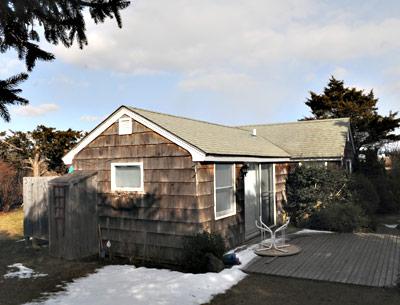
       East Hampton Village, which owns the 13 cottages near Main Beach, is soliciting sealed bids for the summer season, May 9 through Sept. 14, through 2 p.m. on Jan. 27 for number 14, a one-bedroom, one-bath cottage (named thus most likely for reasons of superstition).

       In the book “Images of America: East Hampton” John W. Rae writes that the Sea Spray Inn was built as a private house on Main Street, before being converted into a boarding house frequented by artists in 1888. It was moved to the dunes east of the one-year-old Main Beach pavilion in 1902. In 1924, both the inn and the pavilion were purchased by a cadre of summer colonists. When it burned down, only its cottages and a lone flagpole survived.

       The village purchased the 16-acre parcel with 1,200 feet of oceanfront and the cottages after the fire for . . . are you ready . . . $3 million (a true fire sale). The cottages are “nestled behind ocean dunes on a narrow strip of land between the Atlantic Ocean and Hook Pond just east of Main Beach,” according to a page from 2010 on the village website. 

       Though some of the cottages have both ocean and pond views, alas, cottage number 14 has neither. However it is standalone (some are attached), and is “one of the more secluded units,” according to Rebecca Molinaro, the village administrator. It is also located in the picturesque Ocean Avenue Historic District. According to the district’s guidelines, “the open space of the Sea Spray property makes an important contribution” to the beachscape.

       A writer for Forbes, who stayed in one of the cottages in 1976, called it “a grey driftwood beach shack . . . [that] smelled ocean-y and mildewy all at once.” She loved it. Once, the cottages were a true bargain, but rates were adjusted drastically upward when the village decided to award summer leas es by public auction in 2010.

       Rental rates in 2013 ranged from $34,067 to $108,150 for the season. The minimum bid for cottage 14 was $35,000 in 2010 when the leases were last auctioned off. This time it is $40,000.

       “You can’t touch anything like it for that kind of money,” said Nanette Hansen of Sotheby’s.

       “The prices are bargain basement for Hamptons’ standards.” Fifteen months ago Ms. Hansen sold a cottage across Ocean Avenue, in the little-known Bayberry Close (where Andrew Farkas recently bought a 500-square-foot unit for $1 million) for $1.25 million, which her customer flipped in November for $1.7 million.

       After leasing the cottages for three years in 2010, the village abandoned plans in 2013 to put their leases up for auction again because of damage caused by Hurricane Sandy, when most of the cottages suffered roof, shingle, and chimney damage. Tenants were allowed to renew and pay rent increases at the time. The vacancy of a cottage is a rare occurrence. As of 2013, all tenants had remained for the duration of their leases. The tenant in cottage 14 has decided not to renew for the 2014 season.

       Speaking on behalf of the village, Ms. Molinaro said, “I’m not sure when the full slate will be up for bid again.”

       As Gene Stilwell of Town and Country Real Estate said, “They’re tiny, tiny, but little jewels and gems, and they’re not making any more of them.”

       Inspection of the cottage is by appointment only. Information can be obtained from the village administrator’s office, 86 Main Street, or by e-mailing [email protected].