Stre-e-e-tch Class

Stre-e-e-tch Class

   Carolyn Giacalone gives stretch classes for men and women on alternate Sunday mornings, from 10:30 to noon, at the Y.M.C.A. East Hampton RECenter. “The classes concentrate,” she said in an e-mail this week, “on elongating all the muscle groups, which will reduce muscle stiffness and lower risk of injury while increasing flexibility and range of motion.”

The sessions cost $20. A women’s class is to be held Sunday; a class for men is to be held Feb. 19. The women stretch again on Feb. 26.

The Lineup: 02.09.12

The Lineup: 02.09.12

Thursday, February 9

BOYS SWIMMING, East Hampton at League III championship meet, Hauppauge High School, 4:30 p.m.

Friday, February 10

WRESTLING, county tournament, Stony Brook University, 10 a.m., also Saturday, 9:30 a.m.

BOYS BASKETBALL, Greenport at Pierson, Sag Harbor, 6:15 p.m., and Ross at Stony Brook, 7:30.

GIRLS BASKETBALL, Stony Brook at Ross, 6:15 p.m., and East Hampton at Amityville, 7.

Saturday, February 11

BOYS BASKETBALL  Amityville at East Hampton, 11:30 a.m.

Sunday, February 12

STRETCHING, for women, Y.M.C.A. East Hampton RECenter, 10:30 a.m.-noon.

WINTER TRACK, East Hampton at county boys and girls meets, Suffolk Community College-Brentwood, 11 a.m.

Monday, February 13

BOYS BASKETBALL, Pierson at Stony Brook, 4:30 p.m., and Bridgehampton at Ross, 6:15.

GIRLS BASKETBALL, Ross at Port Jefferson, 4:30 p.m., and Stony Brook at Pierson, Sag Harbor, 6:15.

Tuesday, February 14

GIRLS BASKETBALL, Pierson at Southold and Westhampton Beach at East Hampton, 6:15 p.m.

BOYS BASKETBALL, East Hampton at Westhampton Beach, 5:45 p.m.

Wednesday, February 15

BOYS BASKETBALL, Ross at Smithtown Christian, 4:30 p.m., Stony Brook at Bridgehampton, 6, and Southold at Pierson, Sag Harbor, 6:15.

GIRLS BASKETBALL, Smithtown Christian at Ross, 6:15 p.m.

Boys, Girls on the Upswing

Boys, Girls on the Upswing

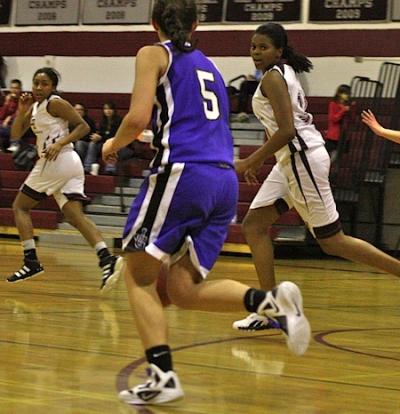
Sarah Johnson, at right, has been improving by leaps and bounds, according to the East Hampton girls basketball coach, Howard Wood.
Durell Godfrey
By
Jack Graves

   The East Hampton High School boys basketball team came up big at Elwood-John Glenn Monday night, defeating the Knights 59-52, thus improving to 5-3 in league play, good for third place, behind 7-0 Amityville and 7-1 Mount Sinai.

    Danny McKee, who hit three 3s, led the way with 21 points; Thomas King had 16; Juan Cuevas, 9; Patrick McGuirk, 7, and Thomas Nelson, 6. McGuirk also had 8 rebounds.

    Games remain with Bayport-Blue Point, Shoreham-Wading River, Amityville, and Westhampton Beach. Bayport is to play here tomorrow at 6:15 p.m. The Bonackers are to go to Shoreham Tuesday. Amityville plays here on Feb. 11 at 11:30 a.m., and Bill McKee’s team is to finish the regular season at Westhampton Beach on Feb. 14.

    It was the second time the Bonackers had defeated Glenn. They have wins over Westhampton, Shoreham, and Bayport, though they edged Shoreham by 1 point and Bayport by 2.

    East Hampton’s girls, who are to play at Bayport-Blue Point this afternoon, lost 50-30 here to Elwood-John Glenn on Friday, but Howard Wood said that for much of the game his team was competitive.

    “Allison McKenna [of Glenn] scored 27 points, but — I know it sounds strange to say this — we defended her well,” Wood said the next day. “Sarah Johnson did a great job on her. McKenna’s 6-2 and she can play, but she had to work for her points. . . . I’ve never seen Sarah play so well — it was great to see. She was going up and getting them. She’s become a lot more confident, she’s picked her game up.”

    Johnson finished with 11 points, “and she rebounded in double figures too.”

    It was 14-14 after the first quarter, during which Glenn’s coach was heard to tell his girls during a timeout that East Hampton “came to play.” Glenn led 26-20 at the half.

    Kaelyn Ward, who frequently draws box-and-one defenses and is double-teamed, also finished with 11 points for the Bonackers, leading Wood to say, “We do need one more scorer. The other teams are wearing Kaelyn down — she can’t be expected to do everything. We need a little more balance. That way we won’t be so predictable. I need one other girl to step up and say, ‘I can do it too.’ ”

    As for the playoffs, Wood said the team would have to win three of its final four to earn a berth, a tough row to hoe inasmuch as three of the four have wins over the Bonackers — Bayport by 47-35, Amityville by 44-43, and Shoreham by 54-28. Westhampton, which East Hampton defeated 43-41 the first time around, is to finish the regular season here on Feb. 14.

The Lineup: 02.02.12

The Lineup: 02.02.12

Thursday, February 2

GIRLS BASKETBALL, Pierson at Smithtown Christian, 4:30 p.m., and East Hampton at Bayport-Blue Point, 6:15.

Friday, February 3

GIRLS BASKETBALL, Shelter Island at Ross, 4:30 p.m.

BOYS BASKETBALL, Greenport at Bridgehampton, 6 p.m., Bayport-Blue Point at East Hampton, 6:15, Smithtown Christian at Pierson, and Shelter Island at Ross, 6:15.

Saturday, February 4

WRESTLING, East Hampton at league meet, Bellport High School, 9 a.m.

BOWLING, East Hampton at county tournament, Sayville Lanes, 9 a.m.

WINTER TRACK, East Hampton boys at small schools championship meet, Suffolk Community College-Brentwood, 2:30 p.m.

Monday, February 6

WINTER TRACK, East Hampton girls at small schools championship meet, Suffolk Community College-Brentwood, 5-9 p.m.

GIRLS BASKETBALL, Ross at Pierson, 6:15 p.m.

Tuesday, February 7

GIRLS BASKETBALL, Shoreham-Wading River at East Hampton, 6:15 p.m.

BOYS BASKETBALL, Bridgehampton at Southold, 5 p.m., Pierson at Ross, 6:15, and East Hampton at Shoreham-Wading River, 6:15.

Personal Trainer Has Been Keeping Tracksters on Track

Personal Trainer Has Been Keeping Tracksters on Track

In the season, when she’s wearing landscape designing and personal training hats, she works long hours and burns a lot of calories.
Jack Graves
By
Jack Graves

   Linda Silich, a personal trainer who has been working this winter with the East Hampton High School boys and girls indoor track teams, leading spin and TRX classes, was a football cheerleader at Wittenberg University in Springfield, Ohio, in the mid-1980s, “probably for lack of anything else to do,” she said, given the fact that the Title IX changes hadn’t fully kicked in yet.

    Her athleticism, Silich said during a conversation this week at The Star, probably came from her father, a Lutheran minister who played football for Youngstown State, and her musical ability — she can play the piano by ear and sings — from her mother, who was the pianist at her father’s church.

    “I burn a lot of calories,” said the lively mother of three, who, besides a busy personal training schedule, is a landscape designer with Groundworks, a company she and Kim Hren started a decade ago in the Siliches’ basement, and which now has 22 employees, all of them presumably in shape given the fact that they all work out with her on a regular basis.

    Asked if all her children — Erica, a freshman at High Point University, and Matthew and Patrick, East Hampton High School students — were athletic, Silich smiled and said she doubted they had a choice. “They’ve been in gyms with me ever since they were in the womb!”

    Her husband, Andy, Groundworks’ chief fiscal officer, “was a team guy” when she met him, “but I got him running. We did the Marine Corps Marathon together. “You see him running all over town now, the crazy guy in shorts.”

    The interviewee, who majored in speech and business and minored in musical theory at Wittenberg, was the national account manager for Computer Associates before she began to devote herself to personal training, beginning with young mothers in Res­ton, Va., where she and her Bonac-bred husband, whom she had met in Manhattan, lived for 11 years before moving here.

    Asked if it had been difficult to rear her children while giving strength training and cardio kick boxing classes and the like, Silich, who has “taught it all,” said, “All the gyms in the South have infant care.”

    Having overseen spin classes for the past dozen years, beginning in Reston, Silich has since last February been the spinning instructor at Flywheel Sports, near East Hampton Bowl, and has for the past year and a half given TRX training at Rich Decker’s Studio 89 off Route 114 in Sag Harbor.

    She readily assented when, in December, Chris Reich, who coaches the high school’s boys indoor track team, asked if she’d give some spin and TRX classes to his and Shani Cuesta’s charges.

    “TRX,” she said, in reply to a question, “stands for Total Body Resistance Exercise. It’s just one strap that hangs from a ceiling. It fits in my suitcase — you can take it on vacation with you. While TRX was developed by a Navy Seal, you don’t have to be a Navy Seal to do it. It’s for all ages, all levels of fitness. Though it is important how it’s taught and introduced. I have 10 teens doing TRX on Wednesdays, five from East Hampton and five from Sag Harbor. . . . My oldest student is a 72-year-old man, a runner from the city — he’s great.”

    Questioned further as to TRX, she said, “You’re using your own body weight and gravity to develop strength, balance, flexibility, and core stability — all at the same time. . . . You have to really think about what you’re doing with your body — you’re working your core the entire time, though it’s a great stretching and flexibility tool as well. . . . Close supervision is essential, you need to be safe and to understand the technique — that’s why I work with another trainer, Randy Leland, and won’t take more than 10 in a class.”

    Spinning offered an alternative way, she said, for tracksters to work their legs. And when it came to the sessions, she said, her musical bent and her eclectic choices designed to “appeal to the masses” enabled her to create “a training-learning experience to connect mind and body . . . I’m not just pounding out numbers and screaming at people.”

    Music, she added, “can take you to different places, it can remind you of happy times, it can help you visualize. With the kids at the session you were at the other day, I had them visualize that they were riding up to Hither Woods, or pretending they were passing the baton on the track, or finishing a race. Music’s not only a motivator, it drives the inner person to keep going, to stay with one’s goals and to stay healthy and focused. . . . We work hard, but we have fun.”

    Then, too, she said, when it came to teenage boys and girls, “Flywheel’s unique torque board display plays a big role because on it they can see everybody’s bike number, how fast they went, and how many calories they burned. The girls like it that they can see how many calories they’ve burned; the boys like it because they can say, ‘See, I beat so-and-so!’ ”

    Silich will oversee a free teen Valentine spin at Flywheel on Monday at 4 p.m., is working on getting TRX training into the high school, and is to give a TRX course next month to physical therapists and medical students to show how it can be used to rehab injuries.

    In sum, “I want everybody to stay active and healthy. It keeps the mind sharp. The body is like a car,” she said with a smile. “If you don’t use it and oil it and do the maintenance, it won’t run.”

Vasco Da Gama, Los Andes Win

Vasco Da Gama, Los Andes Win

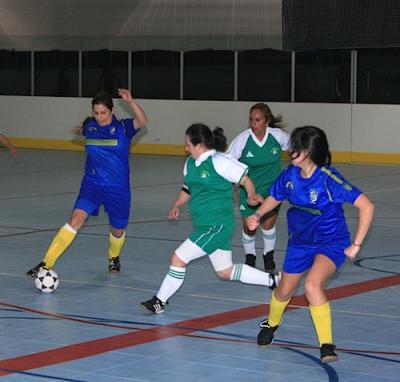
Emilse Gonzalez, with the ball above, won the women’s championship for Los Andes with her goal in the first half, and she was honored afterward for having been the season’s high-scorer.
Jack Graves
The men’s final was decided by penalty kicks
By
Jack Graves

Though the top-seeded team, Real Madrid, was eliminated because it did not show up for a semifinal game the night before, Saturday’s 6-on-6 indoor men’s soccer final contested at the Sportime’s Multi-Sport Arena in Amagansett by Liga Sayausi and Vasco Da Gama proved to be plenty riveting, going down to penalty kicks.

    With a large number of fans pressed up against the all-purpose floor’s perimeters, the evening included, besides the women’s and men’s league finals, a men’s 38-plus final that Aventura won over Solo Conocidos, and a women’s consolation game in which East Hampton Club bageled Sportime. Real Madrid, which had on it a number of players who ordinarily vie under the Maidstone Market banner, and Los Orientales were to have played in a men’s consolation game that night, but apparently did not.

    Thanks to an early goal by Emilse Gonzalez, Los Andes, the defending champion, went on to defeat Las Orquideas 1-0 in the women’s league final.

    “Every year we’re either first or second,” Magaly Toledo, one of Los Andes’s players, said afterward.

    It wasn’t a walk-over, however. Gonzalez, the tallest player on the floor, went down with a knee injury early in the second half. She went back into the fray soon after, but, with a little more than 12 minutes remaining, Gonzalez was forced by her injury to return to the bench again, this time for good. Meanwhile, Las Orquideas’ Elvia Castro, who frequently put the ball into play when Los Andes kicked it out of bounds, kept the pressure on, lofting balls into the goal area.

    Los Andes had a golden opportunity to put the game away when several of its players, including fleet forwards Tatiana and Jessica Gutierrez, converged on Las Orquideas’ goalie, Margarita Guanga, with 4:20 left, but Guanga repelled the attack, keeping her team in contention.

    As aforesaid, the men’s final between Vasco Da Gama and Liga Sayausi was hard fought, with plenty of collisions and bodies flying about.

    The winners’ lineup boasted six Bautista brothers, including Marco, the team’s foremost forward, and its acrobatic goalie, Luis. Liga Sayausi was led by Francisco Guazhinna, a tricky ball-handler, and the speedy John Morocho. Its goalie, Arquero Martinez, was almost Luis (Puchi) Bautista’s equal.

    Three and a half minutes into the game, Luis Bautista made a beautiful diving save of a hard shot, after which Marco Bautista came up empty on a couple of back-headers that sailed over the top of Liga Sayausi’s cage. With eight minutes left in the first period, Guazhinna, who had received a pass from Cesar Domingues, banged a shot off the lower left post, and three minutes later, Martinez parried a shot by Vasco’s Oscar Reinoso. Luis Bautista came up big again when, with three minutes until the halftime break, he stopped Morocho, who had broken in one-on-one, twice in succession.

    In the early going of the second half, Marco Bautista had his best chance, though, somehow, Martinez, who had landed on his back in blocking the close-in shot and was juggling the ball in the air, managed to prevent it from dribbling over the line.

    Guazhinna broke through Vasco Da Gama’s defense with seven minutes left, but again Luis Bautista made a diving save, punching the ball out at the left post.

    With neither team able to score in regulation, the championship was decided by penalty kicks, with each side fielding five shooters who alternately faced their opponent’s goalie, flicking the futsal ball from a spot seven yards out.

    After Luis Bautista parried Domin­gues’s try, Marco Bautista put Vasco Da Gama ahead, punching a shot by Martinez into the lower right corner.

    Walter Criollo then pulled Liga Sayausi even, his shot coming to rest high in the left corner of the nets. Ismael Penafiel countered with a goal of his own — the one that was to prove to be the winner — after which Luis Bautista went on to successively shut out Morocho, Carlos Guichay, and Guazhinna for the championship.

    In the ceremonies that followed, presided over by the leagues’ director, Raymond Naula, it was announced that Mario Olaya, who led the East Hampton High School boys soccer team to the county Class A championship this fall, and who played for Real Madrid’s entry in the men’s league, had been that league’s most valuable player.

    Marco Bautista was the men’s league’s high-scorer, and Emilse Gonzalez was the women’s league’s high-scorer. Jessica Gutierrez, also of Los Andes, was the M.V.P. of the women’s league.

    In the over-38 men’s league, Carlos Pilco was the “goleador,” the high-scorer, and Walter Criollo was that league’s M.V.P.

    A new season is to begin at Sportime on Friday, Feb. 10.

    “We hope it will be even bigger than the season we’ve just finished,” said the Arena’s manager, Sue de Lara, who noted that 16 teams had vied in the men’s fall league, with six in the men’s over-38 division, and six in the women’s league.

    “And,” she said, alluding to a promise Sportime made when it took over the Arena’s management a year ago, “the indoor bathrooms are on the way.”

A Flurry of Pins

A Flurry of Pins

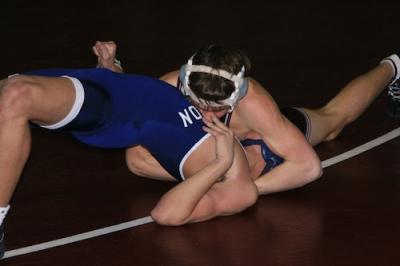
The Bonackers pinned five Huntington opponents here on Jan. 25. Among the pinners was Dallas Foglia, at 152.
Jack Graves Photos
By
Jack Graves

   But for the lack of two bodies, the East Hampton High School wrestling team might have wrestled toe-to-toe here in a match with Huntington on Jan. 25, though, despite a flurry of four pins that capped the competition, the Bon­ackers came up short, by a score of 45-33.

    Jacob Hands, a 195-pounder who was to go on to win the 220 division at the Port Jefferson invitational tournament Saturday, flattened Huntington’s Hector Rubio with 6.5 seconds remaining in the first period to start things off, after which Lucas Escobar decisioned John Arceri 3-1. But then the visitors began to take over, with wins at 113, 120, 126, 132, and 145 before Dallas Foglia began the comeback by pinning Melvin Canales midway through the first period at 152. Morgan Rojas, at 160, James Budd, at 170, and Kevin Heine, at 182, followed suit.

    Afterward, Steve Tseperkas, East Hampton’s coach, said that Foglia, a junior, who had been “on the bottom, executed what we call an elevator reversal and then finished the kid off with a cross-under step and a reverse half nelson.”

    “Rojas was winning 7-0 when he pinned his kid, Budd pinned his kid in 55 seconds, and Heine used a bear hug throw to pin his guy in 48 seconds. . . . Hands used a double-leg takedown and a half nelson to get his pin.”

    The most riveting match of the evening, however, came at 145 pounds, in which East Hampton’s Mike Peralta and the visitors’ Kevin Mendez were the opponents.

    Mendez got the first takedown, in the first period, Peralta got a point for an escape in the second, and then let Mendez up, sacrificing a point at the beginning of the third before executing a single-leg takedown to tie the score at 3-3 with 20 seconds remaining. And the score remained knotted through three 30-second overtime periods, until, in the fourth OT, Mendez, who had chosen the top position, rode Peralta out, thus winning 4-3.

    Sawyer Bushman, East Hampton’s 126-pounder, was pinned near the end of the first period of his match with Corey Jamison, but Tseperkas said that Jamison, the top-ranked 113-pounder in the county, was wrestling up that day, having weighed in at 120. Tseperkas added that Matthew Smudzinski, who lost 3-0 at 120, and Colton Kalbacher, who lost 4-1 at 132, had “wrestled tough.” East Hampton forfeited at 99 and at 285 pounds, giving up 12 points to the visitors as a result.

    Tseperkas took 11 wrestlers to Saturday’s tournament at Port Jeff, a tournament that, as is the case with the league tourney that is to be contested at Bellport this weekend, eliminated contestants who did not make it to the semifinal round.

    Of the 11, there were, said the coach, three place-winners — Hands, who, as aforesaid, won the 220-pound division, Bushman, who was the runner-up at 126, and Escobar, who placed third at 106.

    Before he lost 4-0 in the final to Patchogue-Medford’s Armani Hendricson, the sixth-ranked wrestler in the county at that weight, Bushman pinned Patrick Ciancimino, the Sayville B team’s entry and the third-place finisher in League V last year, 24 seconds into the second period. Tseperkas said that in the final “Sawyer rode Hendricson the whole time in the third period and was close to turning him to his back twice.”

    Kalbacher, who’s a freshman, while he did not place at 132, won his first match by pin, catching Hills West’s Kevin Ataniese, who had been leading 7-2, in a headlock midway through the third period. “Colton lost to Stephen Hirschfield of Comsewogue 12-8 in the quarters,” said Tseperkas, “but it was a great match for Colton. That kid beat him 14-3 in a dual meet two weeks ago. If they meet in the leagues, I think Colton can beat him.”

    Likewise, Budd won a first-round match at 170, decisioning Mount Sinai’s Steve Picciano 12-2, but was pinned by Josue Blanco of Brentwood’s B team in the second period of the quarters.

    As for Hands, “This is the first tournament he’s ever won,” said Tseperkas. “He was second at Sprig Gardner and second at the North Fork invitational at Mattituck. If he wrestles smart and hard all six minutes at the leagues, and if he listens to us, he’s got a good chance to go to the countys. That goes for all those other guys, Escobar, Bushman, Peralta [who sat out Saturday because of a wrist injury], Budd, and Heine.”

Indoor Track

    Turning to indoor track, Shani Cuesta, the girls coach, said that at the league meet Saturday Dana Cebulski won the 3,000-meter race in a personal-best 10 minutes and 58.35 seconds; that Ashley West was the 600-meter runner-up in a personal-best 1:39.53, and that the 4x200 relay team of Cebulski, Maggie Pizzo, Rachael Harty, and West placed third in a season-best 1:58.53.

    West also was fourth in the 300, in 43.89, a “p.r.,” and Cebulski was sixth in the 1,500, in 5:21.63.

    Though they did not place, Harty, with a 14-1/2 in the long jump, Cebulski, with a 28-3 1/4 in the triple jump, Pizzo, with an 8.21 in the 55-meter dash, and Katla Thorsen, with a 3:42.54 in the 1,000, recorded personal bests.

    The boys were to have vied in a league meet Tuesday. Deilyn Guzman, in the 300, and Adam Cebulski, in the 1,600 and 3,200, were given the best chances to advance to the small schools championships.

    Those East Hampton boys and girls who qualify are to compete in the state qualifier meet at Suffolk Community College-Brentwood on Feb. 12 from 11 a.m. to 3:30 p.m.

SURFING: Women Winter Warriors

SURFING: Women Winter Warriors

Lisa Spellman, about to set off in Montauk during Saturday’s snowstorm, finds surfing to be “an amazing equalizer.”
Tin Ojeda
By
Heather Dubin

   Pulling on a wetsuit and bounding into 43-degree water with a surfboard might not top your to-do list this winter. But for a group of local women, the hassle of layering up and contending with the cold is decidedly worth it.

    Bettina Schuler of Montauk has been surfing for almost nine years, and began her foray into winter waters about five years ago. “Surfing did not come easy. It took me three years to even feel like I vaguely knew what I was doing in the water and feel like I was having fun,” she said. “Once I felt more comfortable, I started surfing more in the winter.”

    Andrea Shapiro of East Hampton learned how to surf in the winter and has been at it for six years. “I’d rather surf in the winter than not surf,” she said. There are definite perks. “You have the waves practically to yourself or with one or two friends. It’s beautiful, and it’s nice to be able to exercise and enjoy the outdoors when most people aren’t outside,” she said.

    Evelyn O’Doherty of Springs has surfed for almost eight years, and was introduced to the sport by her husband. She loved it, and quickly became obsessed. A family tradition to surf together on holidays and birthdays landed her in the water during winter months. “Terrified at first, I was trying to please them, but after a while, it became the norm. It’s what we do now,” she said.

    Getting dressed for the water is half the battle. Schuler’s gear includes a five-millimeter wetsuit with an attached hood, five-millimeter gloves, and seven-millimeter booties. She also piles on long underwear, socks, and an extra fleece rash guard underneath her wetsuit for extra warmth.

    “Once you suit up, you want to get the most bang for your buck,” said Marissa McNaughton, a Montauk resident with seven years of surfing experience, including five winters in the water. Besides struggling into a super-thick wetsuit, and lobster claw gloves (the thumb and index finger are independent, and the last three fingers are clustered together), McNaughton has to braid her long, curly hair to keep it from becoming a tangled mess after surfing.

    Shapiro wears a one-millimeter liner under her wetsuit and a swimmer’s cap under her hood to ward off the wind. She also applies a balm to her skin for protection from the wind. “I’m warmer in the water surfing than bundled up in my warmer clothes watching,” she said. “The water ends up being warmer than the air. Outside, if it’s 20 degrees, the water is 40 degrees.”

    Lisa Spellman of Montauk and Manhattan, who “fantasizes about winter surfing in August all the time,” has been at it for the past two and a half years. “The wetsuits are pretty amazing. I feel like you get more credit than you deserve because you’re really warm with the wetsuit,” she said. However, the wrong size wetsuit can be a problem, as O’Doherty discovered while using her husband’s hand-me-down for her first winter in the water. “It was two sizes too big, which means water gets in. Nothing fit right.” Now she has her own wetsuit, which keeps her drier, and is more flexible. “It’s easier if you have the proper equipment to stay out there,” O’Doherty said.

    Typically, Schuler said, “I can only last an hour in the winter. You just get cold; it zaps your energy. And then I’m wiped out for the rest of the day.” To justify venturing out, Schuler makes sure the conditions are good. “I go in once a week or once every two weeks. I’m pickier.” Also, she selects her waves with more care. “I’m more conservative with the waves I take in the winter because I want to minimize my chances of going under the water,” she said.

    McNaughton, who surfs for two-hour sessions, said, “In December the water is still warm. When it washes over you it isn’t that bad, but in February, it’s brain-freeze temperature. If your wetsuit gets wet, imagine that going down your spine.” Spellman stays warm with the exception of her feet, “It can take hours for your feet to defrost when you get out. Also, your face takes a beating.” But none of this is enough to keep these women out of the water.

    There is a growing group of women who surf year round. “We used to have ‘surfer-girl’ potlucks and alternate at each other’s houses,” said Schuler. The dinners, which helped establish a network for women to meet and talk shop were held monthly for years, and still occur occasionally. “Typically surfing has been a male-dominated sport, and it’s great to have women to discuss the challenges of surfing. Guys have different body types and a different center of gravity. We have different fears and inhibitions that guys don’t understand,” she said.

    “There is a split between men and women,” said O’Doherty, “If I talk about surfing with confidence, men will not take it seriously or dismiss it. With other women, we’re mutually supportive.” O’Doherty also teaches surfing and has noticed a difference between the sexes. “I feel like with guys, it’s about the excitement, the adrenaline, stand-up and ride the waves. For women, it’s more about safety — wanting to make sure they can navigate in the water with that big, cumbersome board, getting comfortable in the water, and how to get away from the board when they do get knocked by a wave so they don’t get conked in the head,” she said.

    “Men are more competitive and aggressive with one another, and women are more supportive,” she said. While O’Doherty has noticed some equality in the water, she said men “try to outdo one another, and they don’t like it if women are catching more waves than they are. We hold our own.”

    “With women there’s less competition, the women that I surf with. It’s not like with men, it’s all about guys who want to get all the waves. The women, we have fun with each other and hoot each other on,” Schuler added. “There’s no difference between men in the water and the land,” said Spellman, “They steal your waves like crazy and totally specialize in snaking and dropping-in, for them that’s a huge distinction. We’re just buoys out there.”

    According to Spellman, if the women are unfamiliar, men assume they will not go for a wave, and take it for themselves. “In the summer it’s brutal. You’re like a gladiator; you have to just go for it,” she said. “For me, what I love about surfing is that it’s an amazing equalizer,” she added.

Bonac Is Stunned At the Buzzer

Bonac Is Stunned At the Buzzer

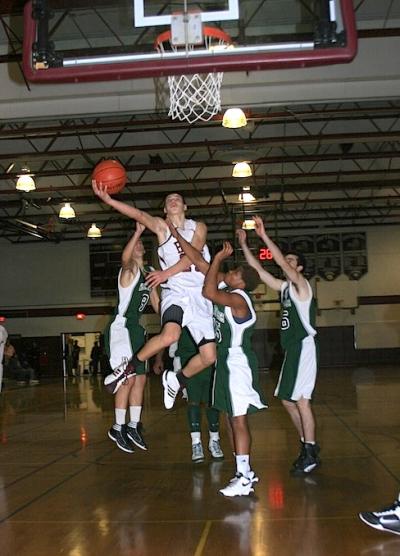
Bill McKee said he couldn’t have asked for anything more from Thomas King (above  going to the hoop against Westhampton Beach) during the span of East Hampton’s past three games.
Bill McKee said he couldn’t have asked for anything more from Thomas King (above going to the hoop against Westhampton Beach) during the span of East Hampton’s past three games.
Jack Graves
Mirror ending of Shoreham-Wading River game
By
Jack Graves

    Friday’s boys basketball game here with Mount Sinai looked, for a brief moment, as if it would provide East Hampton fans with the same thrill they’d felt 10 days before when Thomas King’s coast-to-coast layup drove a dagger into Shoreham-Wading River’s heart, sending the stunned visitors home on the short end of a 57-56 score.

    This time, however, it was Mount Sinai that made the fatal thrust and East Hampton, whose fans had been reveling in the 1-point lead King’s short jumper had treated them to with 7.5 seconds remaining, that was left to clutch its breast — a single-minded coast-to-coast drive having tilted things the visitors’ way, 49-48, at the final buzzer.

    Later, Bill McKee, East Hampton’s coach, said, “We didn’t lose because of that basket, though there were probably some things we, including me, could have done differently on that last play. We lost because we only scored 17 points in that whole second half. We’re moving the ball well enough, but no one besides Thomas has been attacking the basket. The only other player we had in double figures in the Mount Sinai game was Juan Cuevas, with 10. We’ve got to work on getting more people involved in our offense this week.”

    There ought to be ample time to iron things out. Because of midterm exams at the high school, the next game the 4-3 Bonackers are to play will be Monday at Elwood-John Glenn. “We’ve got two more weeks to get into the playoffs,” said McKee, whose team, in order to get there, will have to finish with an at least .500 record.

    Meanwhile, the coach couldn’t say enough about his junior point guard, who, he said, had had “a heck of a week. . . . He scored the game-winner against Shoreham, he scored 15 of the 17 points we had in the fourth quarter of the game with Westhampton, he hit the shot that put us ahead of Mount Sinai, and had 11 rebounds too. . . . You couldn’t have asked him for anything more.”

    East Hampton took a 10-point lead into the fourth quarter of the game here on Jan. 17 with Westhampton Beach, but the Hurricanes came back to tie it up at 51-51 with 2 minutes and 25 seconds left.

    At that point, King took the game over, outscoring the visitors 10-2 going down the stretch, bracketing coast-to-coast layups with 4-for-4 shooting from the foul line. He finished the night with 32 points.

    The Bonackers took a 31-24 lead into the third quarter of Friday’s game with Mount Sinai, but couldn’t make it hold up.

    A timely 3-pointer by Cameron Yusko, off a feed by King, snapped a 37-37 tie just before the buzzer sounded ending the third period, but the visitors were to go on to outscore the Bonackers 12-8 in the final frame as East Hampton shot 3-for-12 from the floor (0-for-5 from 3-point range) and turned the ball over several times.

    A team that could score only 45 or so points in a game would always run the risk of a heartbreaking ending, McKee said. “The others have to go to the basket, not just Thomas. We shot 4-for-6 from the foul line against Mount Sinai, which means we weren’t driving to the basket and getting fouled. We’re still in third, but we’ve put some pressure on ourselves. We need to win that game at Glenn. We beat them here. Our next home game is Feb. 3 with Bayport-Blue Point.”

    Item: Saturday’s cancellation of Biddy basketball practices at the John M. Marshall Elementary School because of the snowstorm was “the first time,” said McKee, who oversees the Biddy program here, “that’s happened since 1969.”

A Heated Wetsuit Is ‘Like the Sun on Your Back’

A Heated Wetsuit Is ‘Like the Sun on Your Back’

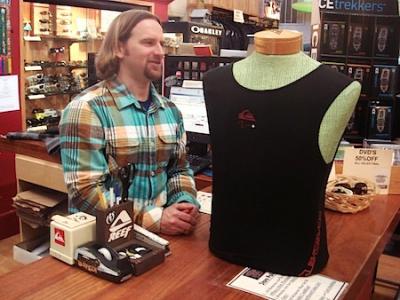
Lutha-Leahy Miller displayed the magic of the new battery-heated Quiksilver wetsuit vest at Main Beach Surf and Sport in Wainscott.
Russell Drumm
By
Russell Drumm

   The ocean smoked early on the morning of Jan. 15 as it relinquished the last of its summertime heat to 19-degree air. At Ditch Plain in Montauk, Steve White paddled into an ankle-snapper (small wave) and rode it to shore, a sight that would have spawned a myth 100 years ago.

    White wore a black Patagonia wetsuit, five millimeters thick, lined with merino wool, and with an attached hood. His boots and gloves were of seven-millimeter neoprene, a knight in state-of-the-art armor — almost.

    It only lacked a heated vest, what surfers have been dreaming about for decades, a magic doublet that could turn the northeast Atlantic into the Caribbean Sea. Well, it’s here!

    “It’s like feeling the sun on your back in the gray, dark, cold winter,” Lutha Leahy-Miller said as he hugged a headless, legless mannequin, the torso adorned in a Quiksilver Cypher Electric heated wetsuit vest.

    “It comes with a car charger. I plug mine in at home at night then put it on in the car. Takes three to five minutes to heat up. You don’t get that cold, tense back thing,” he said referring to the stiffening that occurs when a surf session goes beyond the ability of a suit heated only by a stack of pancakes to fend off the cold Atlantic.

    “Even when you duck dive [push the nose of a surfboard under a breaking wave] your back stays hot.”

    The Quiksilver vest is made of thin nylon with two heating pads located left and right at about kidney level. A lithium battery slips into a sleeve on the right side. Leahy-Miller said the ocean temperature was now about 48 degrees, warmer than usual for this time of year, but still very cold. The vest has a high and low setting to match the water temp.

    He explained there was always a tradeoff between warmth and flexibility. Winter suits are thicker and by and large less flexible. Suits generally come in three thicknesses, three, four, and five-millimeter for early summer, late fall, and winter respectively.

    Leahy-Miller said that he’d found he could experience greater flexibility while staying warm, “up until Christmas,” by wearing the electric vest under a four-mil suit instead of going to the five-mil he’d wear without the vest. “As long as it’s not arctic air.”

    When the water drops to its usual deep winter low of 35 degrees, he recommended the wool-lined Patagonia five-mil suit even without the heated vest. “The water was 39 degrees at Turtles the first time I wore one and I was still hot when I got out,” the surf salesman said, “Turtles” being Turtle Cove, a popular surf spot in Montauk.

    Leahy-Miller works at Main Beach Surf and Sport in Wainscott, but the Quiksilver vest is available at the Air and Speed Board Shop in Montauk and online. Stu Foley at Air and Speed swears by it.

    It’s said that necessity is the mother of invention, but panic or extreme discomfort more likely deserves the credit. Winter surfing in the northeast was simply impossible before the invention of wetsuits.  

    Neoprene suits already had been invented for divers by the late 1950s, but they were stiff, leaked all over the place, and featured a “beaver tail” that was attached to the back of the top half of the suit. The tail was pulled under the crotch and fastened to snaps on the front in order to hold the top and bottom of the suit together. This arrangement was too confining for surfers so they left the tail unsnapped to flap in the wind and let cold water attack one’s tender torso in a wipeout.

    There is such a thing as a watertight drysuit under which one wears long underwear, but most surfers dislike the feel.

    Over the years, wetsuits have become fitted for surfers. The material itself improves continually, thinner, stretchier stuff with no leaky seams or zippers, one-piece cocoons against the cold. Even so, when slush begins to form in the shore break like it usually does this time of year, the cold will eventually creep in, especially when sitting exposed to a 20-degree wind.

    The magic vest’s power supply will get you through a two-hour session at maximum heat. Leahy-Miller said a quick recharge in the car will buy enough time for another go-out. Two hours are needed to fully recharge the battery.

    “It’s just one other thing with wires that you’ve got to plug in, but I guess I’ll get one eventually,” White said. Suiting up to beat the elements is not cheap. A Patagonia R-4 winter suit goes for around $650, boots and gloves another $130, and a Quiksilver vest for another $250. The total comes close to the cost of a plane ticket to the Caribbean or Hawaii. Tough choice.

    White leaves for Hawaii this week.