Undaunted in Ultra Test

Undaunted in Ultra Test
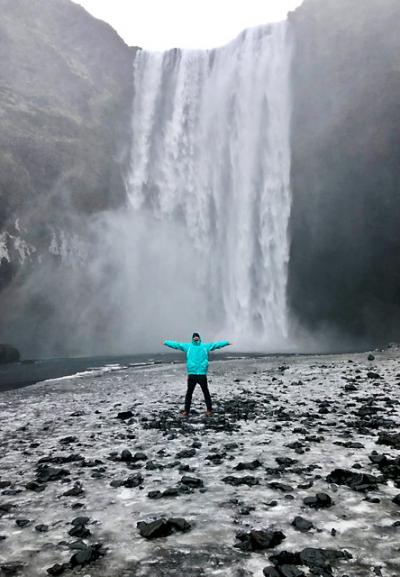
After the Spartan Ultra world championships, Anthony Daunt visited the 200-foot-high Skogafoss waterfall on Iceland’s south coast.
Erica Daunt
A world Spartan Ultra champion in the 25-to-29-year-old age group
By
Jack Graves

About a week after returning from the 24-hour Spartan Ultra World Championships in Iceland, Anthony Daunt said, during a conversation Friday morning at Groundworks Landscaping in Amagansett, that he was beginning to feel okay again.

When talking with the quiet-spoken 26-year-old former Montauker, who now lives in Springs, you don’t immediately appreciate the enormity of what he underwent to become a world Spartan Ultra champion in the 25-to-29-year-old age group. 

This kind of competition, which involves running up and down mountainous — and in Iceland’s case, windy — terrain and satisfying during the course of each loop (6.6 miles in this case) the demands of 25 obstacles, requires speed and strength, not to mention stamina.

“There were guys there who were built, but they weren’t necessarily fast, though some were. I’m usually the smallest guy there.” 

Daunt, who sees to Groundworks’ maintenance division, came to Spartan Ultras by way of long-distance running, having found half-marathons and marathons “very boring.” 

In the months leading up to Iceland, he won his age group in the North American championships in West Virginia, and placed third in his age group at another world competition at Lake Tahoe.

A number of family members, including his wife, Erica, his in-laws, Linda and Andy Silich, and his sister, Lacey, with her boyfriend, Steven Bahns, as well as Kady Field, made the trip.

“They saw me start and they were there when I finished. The race started with a 5K in the town they held it in. It wasn’t Reykjavik, it’s hard to pronounce, I couldn’t tell you the name [Hverageroi]. . . . The idea was to do as many 6.6-mile loops as you could within 24 hours.”

“What’s Iceland like? Awesome, beautiful, mountains and geothermal rivers 

. . . they get heat from volcanic activity. It’s the third-windiest place in the world. The two places ahead of it are uninhabitable. It was really cold and windy when we were there, though it didn’t rain.” 

“There was snow on the mountain, 1,400 feet of elevation. You ran up to the top on every lap, went across a ridge, and then down a steep, slippery slope, hanging on to ropes that were nailed into the ground. It was probably the hardest thing I’ve ever done in my life. We started at noon and had to finish by noon the next day. There were only three hours of daylight. The rest I did with a headlight. I did seven loops, 49.3 miles with the 5K figured in, in 21 hours. I didn’t have enough time for another lap.”

As for the obstacles placed about the course, a list from Spartan’s competitors guide ought to suffice: pipe hurdle, hurdle, sandbag 1, sandbag 2, ice cube carry, barbed wire crawl, Atlas carry, bucket brigade, eight-foot lattice wall, A-frame cargo net, plate drag, Yokohama tire drag, cargo bridge, rope climb, monkey bars, vertical cargo 1, vertical cargo 2, bender 1, bender 2, Olympus, Tyrolean traverse, twister, spear throw, Hercules hoist, and multi-rig.

“You swing from one hoop to the next, three feet off the ground, you climb ropes, you carry 60 to 70-pound sandbags a quarter-mile . . . each lap has 25 obstacles, and if you fail at some of them they make you do 30 burpees. I try not to do them.”

After two laps in the freezing wind he had wanted to stop, but was impelled by his sister to go on. He’d raised money online to help pay for surgeries his grandmother’s 1-year-old great-grandson, T.J., was undergoing in Florida, and didn’t want, he said, to let his donors or his entourage down.

As aforesaid, Daunt’s family and friends saw him off, “and they came back for the end of the second lap.

Then they left and came back in the morning. Meanwhile, they’d been tracking me the whole time.” 

“It was crazy timing: I was coming out of the woods and running toward the finish line with only a couple of obstacles left when I saw my sister and her boyfriend walking up to it. They ran alongside me on the sidewalk. It was still dark at this point; the sun doesn’t come up there until 10:50 in the morning. At 9 a.m. it’s still dark. . . .”

“People did drop out. I was fourth in my age group for a while, but I passed two, and then another one dropped out. There were only two people in my age group that did seven laps.”

He agreed that just to finish one of these arduous races was quite something.

“You keep telling yourself to keep going, that there’s one more lap. And then at the end of that loop, you say, ‘One more lap. . . .’ The guy who came in second to me did it in 22 and a half hours.”
A Tense Two Weeks in Trans-Atlantic Sailing Race

A Tense Two Weeks in Trans-Atlantic Sailing Race

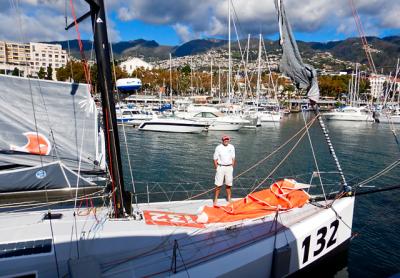
Having returned to the island of Madeira, the trans-Atlantic sailor could smile.
Courtesy of John Niewenhous
A 3,542-mile single-handed quadrennial race
By
Jack Graves

When John Niewenhous, a retired pilot who lives in the Bay Point neighborhood near Sag Harbor, was visited on Dec. 2, some competitors in the Route du Rhum race to Guadeloupe were still heading across the Atlantic for that Caribbean island, having set off a month earlier, with much fanfare, from Saint-Malo, in northwest France.

The 3,542-mile single-handed quadrennial race, “which I was told is the second most popular sporting event in France this year,” drew a fleet of 123 boats, including Niewenhous’s Class40 Loose Fish, a tall-masted, wide-beamed 40-foot monohull with two gigantic 750-liter water ballast tanks.

Hounded by equipment setbacks that worsened as he continued beating upwind, and which persuaded him to turn around after having sailed about a third of the way, the two-time former commodore of the Breakwater Yacht Club was among those who did not finish. 

The around-the-world record-holder had capsized, he said, and another craft had to be abandoned after hitting a cargo boat. “Thirty-five of the 53 Class40s finished. Every boat had a problem.” 

Josh Hall, an English pro with whom the experienced Sag Harbor amateur sailor had crossed the Atlantic on Loose Fish, from Cherbourg to Antigua, a year ago — a training run for Niewenhous, but not for Hall, whose 27th Atlantic crossing it was — told him better weather lay ahead, about a couple of hundred miles farther, but Niewenhous, whose mast was in danger of toppling, had made up his mind by then, about 1,400 miles and 13 days out, to sail back to the island of Madeira, off Morocco.

Hall, who returned Loose Fish to France from Madeira, had competed in four solo around-the-world races, as well, said Niewenhous. “The first time, he was dismasted, the second time he sank and was rescued by a fellow sailor. . . . There are many professional sailors in France and England — it’s a way of life for them. The number of professional sailors in France is probably tenfold what it is in the U.S., though I have no facts to base that on. Over two million people visited Saint-Malo in the weeks and days leading up to the start. . . . It’s a way of life for these professionals, versus a pastime.”

Niewenhous and Hall also sailed in the Royal Ocean Racing Club’s 600-mile race in the Caribbean last February, “a very windy and rough race. Only half the boats finished. We were the only double-handed one to finish. Eighty-four started, only 40 or so finished.”

He and his wife, Audrey, have sailed a lot over the years, throughout the country in JY-15s, in four Bermuda One Design race weeks, and to the Caribbean and around the islands in it, though the Route du Rhum was his second solo long-distance effort, the Bermuda One-Two, from Newport, R.I., in 2005, at the urging of Michael Hennessy of Mystic, Conn., being the first. (Hennessy also competed in the Route du Rhum, finishing 12th after more than 21 days at sea.)

“There’s a solo leg and a double-handed one in the Bermuda One-Two, which I did with Fred Boursier, a Frenchman. I came in third in class — third on the solo leg and second on the double-handed one.”

Asked if there were any comparisons to be made between flying and sailing, the 60-year-old retired pilot said, “Yes, the sail is basically an airfoil that generates lift, just like a wing, and the lift is used to propel the boat — it’s the same principle. There are pilots who sail, but probably more of them are piloting powerboats.”

He was the third eldest in the Class40 monohull class, the biggest one in the race. “The 61-year-old withdrew, the other guy, who’s 60, a South African, finished a few days ago. The youngest guys were 21 or 23. Maybe five or 10 of us in that race didn’t have corporate sponsorships. Most were paid sailors.”

Asked what it was that he loved about sailing, Niewenhous, a member of the Sag Harbor Yacht Club and a member of the Breakwater Yacht Club almost as long as his wife, who was a founding member, said, “I guess it’s the skill that’s required to make a boat go using the wind. It’s a nice feeling. But,” he added, with a smile, “it can be very frustrating. Very light winds can be frustrating, or extremely heavy winds.”

To qualify for the Route du Rhum he sailed solo more than 1,400 miles from Antigua to Charleston, S.C., last spring. In July, he said, he sailed Loose Fish solo from Charleston to Portland, Me., and, at the end of August, shipped it back to France.

As for the Route du Rhum, “We had very bad weather. I knew the day after the start that we were going to get hit. For 12 days there were gale conditions, huge seas, big winds, lots of squalls . . . the wind blew and blew, 25 to 35 or 40 knots with gusts to 60. It was unremitting.”

“The first thing I lost,” he said, with a laugh, “were my wind direction instruments, from the top of the mast. Without them — they enable you always to steer at a true wind angle — I just had my compass. The compass steers to a certain heading — the boat doesn’t automatically turn when the wind shifts so as to maintain the same true wind angle. Losing two masthead wind vanes increased the workload, but I kept going.”

“For a time the wind died down and I had more sail up [eight sails are the max on a Class40] with two reefs in the main. In the middle of the night a couple of days later — big winds and squalls always seemed to come in the middle of the night — I was running the motor to charge the batteries when a squall came up. I didn’t hear it — usually you hear the wind kick up and the rain with it, but I was down below. It came up very fast. The wind speed went from 15 or 20 knots to easily over 40. All of a sudden, the boat was sidewise. I wasn’t able to furl the Solent sail, the big jib, and it got destroyed.”

“One of the Solent’s battens was hanging out, and I couldn’t get it down. The flapping batten then punched a hole in the staysail, so two of my sails were out of commission. . . .”

“I was probably 45th out of the 53 Class40s at the start, and I’d worked my way up to maybe 15th by the time I withdrew. The biggest reason I quit was because of the Solent being partially unfurled. It shook around so much that the forestay chafed.”

Holding out a four-foot-length of severely frayed rope, he said, “This attaches to the bow and holds the forestay. If this had let go, I probably would have lost the mast, with thousands of miles to go.”

He was, as aforesaid, 13 days out when he made the decision, six to eight days shy of fetching Guadeloupe. 

It was disappointing, he agreed, “but you weigh the odds. First of all, you don’t want to injure yourself. In addition to everything else, my reefing lines for the mainsail had failed. I had to manually tie the lines, standing up, with the boat rocking and rolling. I was wearing a harness, but a swinging main could have sent me flying. I could have been thrown back and hit my head. The motion of the boat is very violent in big seas — you have to brace yourself all the time. It was all I could do to heat water and pour it on the freeze-dried food. It’s hard doing sail changes with the boat moving around so much. . . .” 

“So, you start to weigh all of these things, and the safer course of action, with two head sails destroyed, and with the mast having the potential to fall because the forestay, which anchors it, was about to give way — I didn’t want to be thousands of miles from the nearest shore without a mast — was to withdraw.”

He was unsure that he’d do a solo ocean race again. Fall generally is a good time to make the crossing, the hurricane season having theoretically passed and with the trade winds blowing from east to west. “But the stream of low-pressure systems that went across the Atlantic messed up the trade winds. I should have been sailing off-wind rather than going upwind all the time.”

“What would I have done differently . . . ? I guess I might have sailed a little more conservatively, but it was a race and I was pushing the boat hard.”

He would, he added, have the manufacturer analyze the two broken check stays, “continuous multi-strand carbon cable stays that run from the stern to about three-quarters the way up the mast. When they failed, I had to drop the staysail — the mast could have been damaged.”

He’d maintained communications with his wife and with Hall all the while, the interviewee said. “The boat has two satellite phones in addition to a tracking device. My wife was wondering why I was going in the direction I was going in.”

“The boat would stop, or go in a different direction,” Audrey Niewenhous said. “He was going zero knots, and he was supposed to be averaging 10 to 15.”

“When the check stays went, I deeply reefed the main,” said her husband. “To take the sails down I had to climb the mast. . . . I had vastly less sail area, but I was still going pretty fast because the wind was blowing so hard. . . .”

Asked again if he’d do it again, he thought a moment. “We’ll see . . . my hands are still a mess, my knees are sore. . . . Yes, I probably will,” he said, laughing.

Ava Engstrom Breaks School 3K Record

Ava Engstrom Breaks School 3K Record

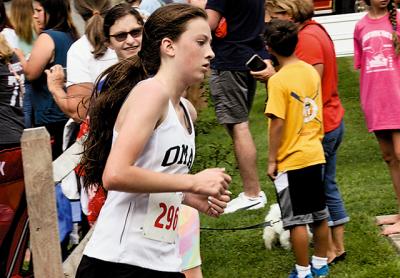
Ava Engstrom, above, and 11 other girls are on Yani Cuesta’s winter track team, which the coach says is “off to a great start.”
Jack Graves
A time of 10 minutes and 57.36 seconds
By
Jack Graves

Ava Engstrom, an East Hampton High School sophomore who is among a dozen on Yani Cuesta’s winter girls track roster, broke Dana Cebulski’s indoor 3,000-meter record at Suffolk Community College in Brentwood Saturday with her time of 10 minutes and 57.36 seconds. Cebulski’s mark of 10:58.35 was set in January of 2012. It was the first time Engstrom had run the 3,000 this season. 

Cuesta, in an email, said the team was “off to a great start,” citing Penelope Greene’s personal best 5:11.86 in the 1,500 on Saturday, Mimi Fowkes’s personal best of 8:51.45 in the 1,500 racewalk that day, and personal bests by Bella Espinoza in the long jump and by Lillie Minskoff in the 300, in the team’s first outing on Dec. 2. Espinoza’s leap of 14 feet 31/2 inches equaled her previous best in the long jump. Minskoff, who ran the 300 in 45.68, long-jumped 14-2.

Nick West Named Nation’s Division III Player of the Year

Nick West Named Nation’s Division III Player of the Year

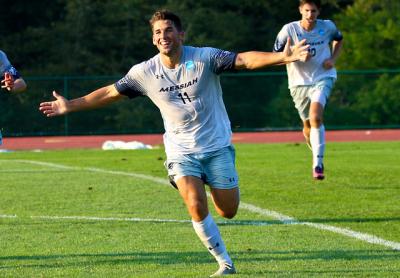
Nick West of East Hampton wound up as the high-scorer among thousands of collegiate men’s soccer players throughout the country this fall.
Messiah College Athletics
30 goals in 23 games
By
Jack Graves

Nick West, the former East Hampton High School soccer star, received a singular honor this week inasmuch as he was named as the national player of the year in Division III.

A senior at Messiah College in Mechanicsburg, Pa., West, who tried out this past weekend with the United Soccer League’s Charlotte Independence entry, finished as the National Collegiate Athletic Association’s high-scorer — in all divisions — with 30 goals in the 23 games he played. He also finished as D-III’s leader in total points, with 65.

Matthew Fenton, Messiah’s sports information director, said when queried that that there are 828 collegiate D-I, II, and III men’s soccer programs, each with rosters of between 28 to 30 players. In Division III alone, he said, there were 414 programs.

Brad McCarty, West’s coach at Messiah, whose program has been the dominant one in Division III men’s soccer for the better part of the past 20 years, said of West, in a gomessiah.com article, “Nick was a great player up top who produced consistently for us over the course of the regular season, and then, in the postseason, he somehow finished even stronger.”

“His work rate and his area of influence allowed him to score in a variety of ways, in the run of play, working in the system and with teammates, on breakaways, on free kicks, off corners, and penalty kicks.” 

“Messiah’s Sweet 16 match against SUNY-Cortland might have been the finest of his career. With Messiah trailing 1-0 in the 70th minute he scored three goals in a 16-minute span, each one showcasing his varied scoring skills. He hammered home a header to tie the game, netted a free kick from 29 yards out, the ball passing just under the bar, to give us the lead, and capped it off with a penalty kick that clinched a 3-2 victory.”

Messiah, which won the national D-III championship last year, lost in the quarterfinal round to the University of Rochester, by a score of 2-1, a game in which West’s 30th goal tied the count at 1-1, in the 50th minute.

A Messiah website account of that game, played on Nov. 17, said, “The Falcons nearly took the lead just moments later, but another shot by West was blocked on the goal line by a defender.” 

“Both teams had opportunities throughout the remainder of the second half, but a Yellowjackets cross in the 82nd minute deflected high into the air by a Messiah defender crossed the goal line for an ‘own’ goal and a 2-1 Rochester lead. . . . It was the Falcons’ first defeat of the season.”

The Bonacker’s 30 goals were the second most in a single season at Messiah, one shy of the mark set by Adrian Oostdyke in 1973. 

“I thought Oostdyke’s record was simply untouchable,” McCarty said, “but Nick showed that it wasn’t. . . . His 15-game scoring streak [obliterating Messiah’s mark and tying an all-time N.C.A.A. D-III record] was impressive — it wasn’t like teams weren’t keying in on him. People knew who he was because, as a junior, he was a Final Four M.V.P. who had scored 14 goals.”

In October, West’s coach said he was most impressed by “the percentage of shots that he puts on goal. Many targets [strikers] put around 25 percent of their shots on goal, but Nick, who can receive the ball with his back to the goal, is currently 44-for-63, for a shots-on-goal percentage of 69.8.”

Back to gomessiah.com’s latest story, “A four-time all-MAC Commonwealth honoree in his career, West earned his first MAC Commonwealth offensive player of the year, all-region, and all-America honors this season. While his play in the regular season was phenomenal, he seemed to hit another gear in the N.C.A.A. tournament. Last year, he scored three goals and added three assists [as Messiah went all the way]. This year, he netted six goals and added two helpers as the Falcons advanced to the Elite Eight.”

Again McCarty: “Nick’s greatest attribute is his work ethic, both on the field and in preparation. His durability, strength, and fitness have allowed him to play so many minutes at such a high level. What’s unique about Nick is his footwork prior to shooting and his ability to get his shots on goal — he just hits it so hard.”

The Lineup: 12.13.18

The Lineup: 12.13.18

Local Sports Schedule
By
Star Staff

Thursday, December 13

BOWLING, Middle Country vs. East Hampton, All Star Lanes, Riverhead, 4 p.m.

BOYS SWIMMING, East Hampton at Lindenhurst, 5 p.m.


Friday, December 14

WRESTLING, East Hampton at Eastport-South Manor, 4 p.m.

GIRLS BASKETBALL, Sayville at East Hampton, 4:30 p.m.

BOYS SWIMMING, East Hampton at Central Islip, mandatory nonleague, 5 p.m.

BOYS BASKETBALL, Bridgehampton at Southold, 5 p.m.; Pierson at Ross School, 5:45, and East Hampton at Shoreham-Wading River, 6:45.


Saturday, December 15

WRESTLING, East Hampton at Doc Fallot tournament, Hampton Bays High School, 9 a.m.

BOYS BASKETBALL, Port Jefferson at Pierson, Sag Harbor, nonleague, 2 p.m.


Sunday, December 16

GIRLS TRACK, East Hampton at crossover meet, Suffolk Community College-Brentwood, 9 a.m.


Monday, December 17

BOYS BASKETBALL, East Hampton at Miller Place, 4:30 p.m., and Bridgehampton at Smithtown Christian, 6:15.

BOYS SWIMMING, East Hampton at Deer Park, 5 p.m.


Tuesday, December 18

BOWLING, East Hampton vs. Longwood, Coram Country Bowl, 4:30 p.m.

GIRLS BASKETBALL, Westhampton Beach at East Hampton, 5 p.m.


Wednesday, December 19

BOYS TRACK, East Hampton at crossover meet, Suffolk Community College-Brentwood, 5 p.m.

WRESTLING, Kings Park at East Hampton, 6:15 p.m.

BOYS BASKETBALL, Shelter Island at Pierson, Sag Harbor, 6:15 p.m.

Swimmers Win, Hoopsters Lose

Swimmers Win, Hoopsters Lose

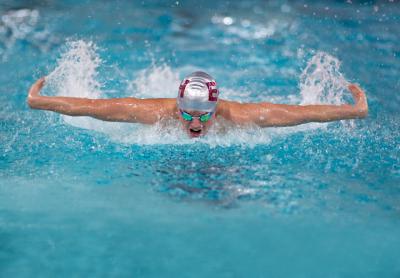
Ethan McCormac swam a state-qualifying time in the 100-yard butterfly at the Y in the meet with Ward Melville on Dec. 5.
Craig Macnaughton
Bees’ coach Ron White thinks team will go upstate
By
Jack Graves

East Hampton High’s boys swimming team, the largest the program has ever fielded, trounced Ward Melville, Division II’s runner-up last year, in a season-opening mandatory nonleague meet at the Y.M.C.A. East Hampton RECenter on Dec. 5.

The score was given as 86-71, owing to the fact that East Hampton “exhibitioned” in the final three events, the 100-yard backstroke, the 100 breaststroke, and the 400 freestyle relay, but the real margin of victory was much greater.

The boys basketball team also made its debut this week, though with disappointing results, in the Kendall Madison Tip-Off tournament on Friday and Saturday at the high school. The Bonackers lost 79-78 in overtime to Mattituck Friday, and 75-55 to Southampton, the tournament’s dominant team, Saturday.

The worst news for Dan White, East Hampton’s coach, though, lay in the fact that his 6-foot-4-inch senior center, Bladimir Rodriguez Garces, his chief rebounder and a solid scorer, will be out for around a month and a half as the result of breaking a foot.

Garces, after missing a shot in the final seconds of O.T. Friday night, apparently kicked an immovable object, which won out.

White had no time, he said following the Southampton game, to realign his offense and defense earlier on Saturday. When this writer remarked on the Mariners’ repeated offensive rebounds that night, he said, “It’s hard to rebound when you have guys who are 5-11.”

Southampton, a whirlwind of a team led by twin senior guards, Marquise and Marcus Trent, overwhelmed Bridgehampton’s Killer Bees Friday by 30 or so — even with the starters having been summoned back to the bench early in the fourth quarter — and, as aforesaid, breezed by the Bonackers by 20 the next night.

Asked if he foresaw any challenges ahead for the Class B team, Rickey Taylor, one of Herm Lamison’s assistants, said, “Center,” meaning Moriches.

Coached by Nick Thomas, Center Moriches won the Long Island Class B championship last year, and, according to Sunday’s Newsday, “returns much of its talent, including Sean Braithwaite, a 6-5 senior swingman who averaged 21 points, 11 rebounds, and 5 assists per game last year.” The Red Devils’ roster also includes Micah Snowden, a 6-5 senior transfer from Southampton, who, according to Newsday, “averaged 21 points and 15 assists per game at Southampton.”

The Trents, as well as Dakota Smith and Sincere Faggins, acrobatic players all, hounded the Bonackers at both ends of the court, though Jeremy Vizcaino, Bonac’s senior point guard, who has grown greatly basketball-wise since last season, held his own, and, frequently faced with double teams, did his best to keep East Hampton in the game. 

A 3-pointer by Christian Johnson, who’d come off the bench, narrowed Southampton’s lead to 21-18 with five minutes left to play until the break, but after that the sky-walking Mariners pulled steadily away.

The players’ warm-up jerseys had “Southampton Never Stops” imprinted on them, and, judging by Saturday’s high-energy, relentless performance, it seems that way.

“We’re still young,” said Taylor, a former Mariner himself who once played for the Washington Generals. “The Trents are our only two seniors. Hopefully, we’ll go upstate this year.” Lamison’s biggest challenge, he agreed, might lie in keeping his players fired up.

Mattituck, a Class B team as well, also went 2-0 in the Kendall Madison tournament, and, like East Hampton, Bridgehampton went 0-2, losing 71-57 to the Tuckers in Saturday’s first game.

The Bees, who have returned everyone from last year’s squad, had their moments, but only moments, despite their coach Ron White’s inspirational urgings during timeouts.

After one of these, with three and a half minutes remaining and with the Bees trailing 62-56, Elijah White, the coach’s son, seemed to have himself planted squarely in the path of an onrushing Xavier Allen, who knocked White back several feet, but was himself assessed, to the surprise of many, a blocking foul. Allen made both of his free throws, and Mattituck was unheaded thereafter.

The elder White was sanguine afterward, however. Once his charges get back to playing “Killer Bee defense,” he said, and begin believing in themselves, as they should, he was confident they’d come around. 

“Hopefully, in March” his Class D team would “be going upstate with Southampton.”

Getting back to boys swimming, it was clear from the get-go that East Hampton was the better team as it won 12 points in the opening event, the 200 medley relay, 9 in the second, the 200 freestyle, 12 in the third, the 200 individual medley, and 9 in the fourth, the 50 free. 

And so it went, as spectators, for the first time, could follow the running score on the new $10,000 scoreboard the East Hampton Kiwanis Club had donated. (The club also gave the Y a new timing system that cost around $8,000, the total gift being the largest, Kiwanis’s president, Rick White, said, in the club’s history.)

East Hampton also benefited from its superior numbers — the roster was recently trimmed to 31 as the result of about a dozen cuts, said the coach, Craig Brierley — putting up three competitors in each event while Ward Melville sometimes entered two or one.

In winning the 100 butterfly, Ethan McCormac, who recently received the first William A. O’Donnell Founders Award from the Old Montauk Athletic Club, turned in a state-qualifying time of 53.70 seconds. 

Sectional (county) qualifiers that day were Edward Hoff, in the 200 free; Ryan Duryea and Joey Badilla in the 200 I.M.; Thor Botero, Colin Harrison, and Ethan and Owen McCormac in the 50 free; Nicky Badilla and Ethan McCormac in the 100 fly; Jack Duryea and Hoff in the 100 free; the 200 free relay team of Joey Badilla, Ryan Duryea, Ethan McCormac, and Owen McCormac; Joey Badilla in the 100 back; Jack and Ryan Duryea in the 100 breast, and the 400 free relay team of Ethan McCormac, Hoff, Joey Badilla, and Aidan Forst.

Others on the squad, not named above, are Ryan Bahel, Ben Berkhofer, Miles Coppola, Kai Esposito, Conor Flanagan, Christian Gaines, Emmett Harrington, Ramses Jimenez, Avery Martinsen, Aidan McCormac, Callum Menelaws, James Midson, Will Midson, Curran O’Donnell, Kevin Pineda, Daniel Piver, Kenny Sanchez, Tenxin Tamang, Luke Tyrell, and Jordan Uribe.

East Hampton’s swimmer of the meet was Tyrell, a senior, whom the captains chose “because, even without goggles, he was able to go a lifetime best, dropping three seconds, in the 100 backstroke.”

Tuxpan Unheaded in Men’s Soccer Final

Tuxpan Unheaded in Men’s Soccer Final

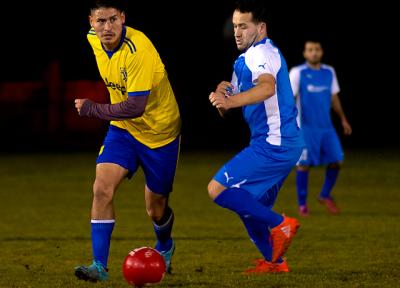
Donald Martinez, at left, scored two goals in the 7-on-7 men’s soccer final for F.C. Tuxpan Monday, while Nick Escalante of Tortorella Pools, at right, also had two. Tuxpan was the winner, though, by a score of 7-2.
Craig Macnaughton
A 7-2 rout
By
Jack Graves

F.C. Tuxpan, Antonio Chavez’s team, had not until Monday night won a 7-on-7 men’s soccer championship in 21 seasons, which is to say since the fall of 2007. 

The way Tuxpan played in the final with Tortorella Pools at East Hampton’s Herrick Park that night you would have thought Tuxpan, not Maidstone Market, the tournament’s top seed, was the perennial power.

Tortorella, which had upset the Market owing to a one-touch goal by George Naula in the semifinal round, didn’t have a chance as the regular-season runners-up repeatedly beat defenders on their way to a 7-2 rout.

By the time Nick Escalante buried a shot with 10 minutes left in the first half, Tuxpan had already scored twice, and within the next few minutes it was to score twice more again to take a 4-1 lead into the halftime break.

Faustino Dominguez Meza, a hard-charging wing, had done most of the damage, recording a hat trick within the first 30 minutes of play. Donald Martinez, who largely controlled the center of the field, scored the other goal.

Tortorella, which was missing one of its chief defenders, Romulo Tubatan, who suffered a hamstring pull in the last game of the regular season, remained on the defensive in the second frame, though another goal by Escalante, who in the 34th minute converted a free kick in close taken by Leonel Uchupaille, picked up Tortorella’s spirits momentarily. 

Several minutes later, Meza broke away again as Craig Caiazca, Tortorella’s goalie, rushed out to make what, for a moment, seemed to be a save, though following Meza and Caiazca’s collision the ball rolled back into the goal. Caiazca protested that there was contact after he’d had possession, though to no avail: 5-2 Tuxpan.

Tortorella’s hopes, albeit slim, were dashed even further when Escalante was ejected, apparently for undeleted expletives, leaving Tuxpan a man-up with 12 minutes left to play. Martinez made it 6-2 in the 53rd minute, and Meza capped the scoring with his fifth goal of the night, in the 54th.

Caiazca, who had been injured in his collision with Meza, came out with two and a half minutes left as Leslie Czeladko, Tortorella’s manager — and the league’s overseer — came in to replace him.

Besides Meza and Martinez, Tuxpan’s roster includes Pedro Agudelo, Justin Carpia, Jorge de los Santos, Alberto Carreto, Jose Gutierrez, Christian Neira, and Giovany Espinoza.

As aforesaid, Maidstone Market finished the regular season in first place, at 6-2-2, with Tuxpan at 6-4-0, Hampton Construction at 5-4-1, Tortorella at 4-4-2, Sag Harbor Industries at 3-6-1, and Hampton F.C.-Pool Shark at 3-7-0 following.

Hampton F.C.-Pool Shark won the spring season’s final in August, but, according to Czeladko, “quit playing” midway through the fall.

In other soccer news, East Hampton’s over-30 team, Hampton United, played to a 3-3 tie with Charruas 1950 at Hampton Bays High School Sunday, “an exciting game,” according to the team’s manager, Glen McKelvey, that Hampton United could have won in the final seconds had one of its players not missed a “sitter” (an easy scoring opportunity). 

Gerard Lynch scored all of the locals’ goals, though one of them was an “own goal,” resulting from a mistake made by a defender near whom he was standing. One more game, with Celtic, and Hampton United, which is in fourth place at the moment among the first division’s nine Suffolk teams, will take the winter off before the spring half begins in March.

In still other soccer news, Nick West, a former East Hampton High School soccer star, finished the season as the nation’s leading scorer, with 30 goals. Messiah College, for which West plays in the National Collegiate Athletic Association’s Division III, was knocked out of the playoffs by the University of Rochester in the Elite Eight round. West, who at one point this fall rode a 15-game scoring streak — tying an all-time D-III record — tallied Messiah’s goal in the 2-1 loss.

His 30 goals (the most among those playing D-I, D-II, and D-III collegiate men’s soccer in the United States this season) were the second most in Messiah’s history, one short of the single-season mark set by Adrian Oostdyke in 1973.

West and his fellow six seniors compiled a four-year record of 76-9-7, including trips to the Sweet 16 in 2016, the Elite Eight this year, and to the Division-III championship game, which Messiah won, last year. 

In addition, West was named recently as the All-MAC Commonwealth’s offensive player of the year. All-American teams had as of this writing yet to be picked.

Trial by Fire at Sprig Gardner Wrestling Tournament

Trial by Fire at Sprig Gardner Wrestling Tournament

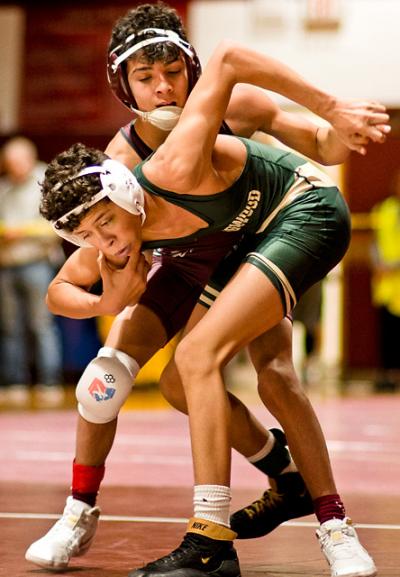
Santi Maya, foreground, an East Hampton freshman who lost to a county champion in the quarterfinal round of the Sprig Gardner tournament here Saturday, “has a very, very bright future.”
Craig Macnaughton
Weight losses by some wrestlers may lead to wins
By
Jack Graves

Anthony Piscitello’s wrestlers, several of them new to the sport, were thrown into the fire at East Hampton’s Frank (Sprig) Gardner invitational tournament Saturday, and while the team finished last, the third-year coach said his charges (he’s got 16 on the squad) “did pretty well.”

The tourney was held a week earlier than in the past, which effectively prevented some of the Bonackers from wrestling at the lighter weights they would settle into in the near future, he said.

Three, for instance — Marco Rabanal, Brian Barrera, and Carson Tompkins — were bunched in the 160-pound division; two — Danny Suculanda and Alejandro Pantosian — were at 152; two — Brahian Usma and David Alvarez — were at 145; two — Ben Barris and Caleb Peralta — were at 132, while East Hampton had no entries in the 99, 113, 120, 126, 138, 195, or 220-pound divisions.

During the season, Piscitello, who is subbing at the high school now and is free therefore to promote wrestling in the halls, expects to have three holes — at 99, 113, and 195. 

The main thing, he said, was to give his charges as many chances to wrestle this winter as he can, which meant giving preference to dual-meet tournaments over individual ones, “where you might go one-and-out and have to sit in the stands for the rest of the day.”

East Hampton had three fourth-place finishers in Saturday’s tourney, named after “the father of New York State wrestling,” who coached briefly at East Hampton High School in the early 1930s before leading Mepham to storied heights, after which he retired here.

The fourth-place finishers were Santi Maya, at 106, David Peralta, at 182, and Aniello Facendola, at 285. 

Maya lost 11-5 to the defending Division II county champion, Bayport-Blue Point’s Joe Sparacio, in a quarterfinal-round match, just missing a pin in the third period — a result that left him shaking his head afterward. “There was no shame in the loss,” Piscitello said. “He had the kid on his back and the kid rolled through. Santi went 2-2 in the wrestlebacks. He’s only a freshman — he’s got a very, very bright future.”

Peralta, a first-year senior, one of several such on the team, “is raw, but strong, like Danny Villa, who wrestled for me last year. He’ll be good. I wish he’d come out two years ago. . . . He’s very coachable — he’ll get better.”

Caleb Peralta, a freshman, placed fifth at 132, avenging himself in the wrestlebacks on a Hampton Bays wrestler, River Orlando, who had defeated him in the first round of the main draw. “There were only 11 kids in Caleb’s bracket, but he got to wrestle five matches — that’s what I’m looking for,” said Piscitello.

Ben Barris, a sophomore, also wrestled at 132. “He’s a tough kid — he’ll do better at 126,” East Hampton’s coach said.

Usma, who was “one match shy of all-league last year,” went 0-2 at 145. “He was in the same boat as Santi — he had the other kid on his back, but the kid rolled through.” Bonac’s other 145 entry, David Alvarez, was “a first-year wrestler, but he’s learning quickly.”

Suculanda, a first-year senior, had the misfortune, said the coach, of wrestling the 152-pound division’s top seed, Danny Horton of Bayport-Blue Point, in the first round.

At 160, Rabanal, a senior who’s been helping Piscitello with recruiting this year, and Barrera wrestled each other for fifth place, with Rabanal prevailing 4-3. Tompkins, a freshman, the other East Hampton entry in that division, went 0-2, but “has a bright future if he sticks with it.”

Sebastian Cruceta, a first-year senior who wrestled at 170 Saturday, “will 

become more confident when he wrestles at 160.”

Ward Melville won the tournament, followed by Westhampton Beach, Longwood, Bayport-Blue Point, Hampton Bays, and East Hampton.

East Hampton’s first league meet will be here on Wednesday with West Babylon, a team it defeated last season.

Sas Peters at Top of His Ultimate Game

Sas Peters at Top of His Ultimate Game

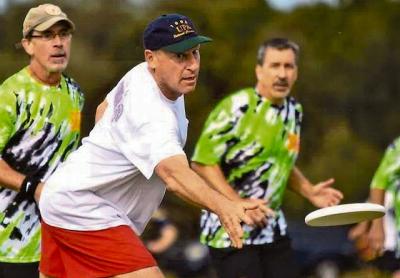
Sas Peters keeps up with far younger fellow Ultimate competitors through plyometrics, lifting weights, and riding a stationary bike.
UltiPhotos/Kevin Leclaire
A silver medal winner in the national Ultimate championships in Sarasota, Fla.
By
Jack Graves

Sas Peters of Amagansett, who has extended the competitive career of Ultimate Disc players many years by founding three divisions for men and women — grand masters (over-40), great grand masters (over-50), and legends (over-60) — won a silver medal recently, as a member of Surly, a great grand masters team, in the national Ultimate championships in Sarasota, Fla.

Surly, he said during a conversation the other day at The Star, was a Minneapolis-based team, “with a few ringers from out of state.”

Surly and the Boston-based Death or Glory, whose players, Peters said, were six-time national champs earlier in their careers, locked horns in Sarasota.

“We beat them 15-11 the first time out, but in the final on Sunday, unfortunately, they beat us 15-13. It could have gone either way, but we made some throwing errors and they converted.” (In Ultimate, a thrown disc that hits the ground results in a turnover.)

“There were several great teams there, but Death or Glory was really amazing.”

The gold medalists had several ringers too, New Yorkers who formerly played with Peters’s team. “What can I say?” he said, with a smile. “I’m a ringer too.”

All summer long he had played “against 20-year-olds,” the 62-year-old Peters said when asked how he was able to continue playing in the younger divisions. “I ride a stationary bike, lift weights, do plyometrics, the German sprint drills. That’s the reason, by the way, that East Germany, a tiny country, was able to dominate in the sprints for years. The drills involve skipping, hopping, jumping, and sprinting. They enable us old white guys to jump three feet in the air and to sprint like 20-year-olds.”

“It’s so important that we keep it up, not only for our bodies, but also for our brains. Aging athletes have an advantage over their peers who are sedentary. . . . Most of the games last an hour and a half to two hours, and in these tournaments you play three games a day, seven on a team, playing offense and defense.”

The multi-division national tournament in Sarasota — Peters’s team won the great grand masters division last year — was, he said, the season’s penultimate one, the Turkey Bowl in Bridgeport, Conn., over the Thanksgiving weekend being the last. 

When told that the silver medal he wore to the interview looked like gold in the office’s light, Peters said, “I wish it was.”

He would continue, he said, to “break barriers” insofar as extending the competitive lives of Ultimate Disc aficionados. “I’m working with U.S.A. Ultimate to include a demonstration legends [over-60] division in the national championships next year. Everybody wants to play this [non-refereed] sport [whose players acknowledge their fouls] — we need this. We don’t slam each other into the ground or cavort ridiculously after we score the way they do in football. . . .”

Every year, the week before Memorial Day, Peters, who has won numerous national and international titles, oversees an Ultimate Disc tournament for the three older divisions he founded on the John M. Marshall Elementary School fields. “This was its 19th year,” he said. Play in all of the aforementioned divisions “began here, in East Hampton,” he said. “East Hampton’s where it all began. . . . Ultimate is the fastest-growing team sport there is, and East Hampton is at the center of its growth. We held the first grand masters tournament here 15 years ago, and now there are world championship and  national championship tournaments for these teams.”

Ultimate has not been Peters’s only sport: Trained by Andre de Leyer, Joe Fargis, and Conrad Homfeld — the latter two Olympian medalists — he rode horses competitively for a decade when he was younger, he said, on the Northeast jumper circuit. 

“I still ride, on a sweet old guy, a paint named Merlin, at Rita’s Stables in Montauk. He has one blue and one yellow eye. We gallop on the beach at Ditch Plains late in the late afternoon light, which is spectacular.”

Masters Squad Shines, Bonac Boys Team Plunges In

Masters Squad Shines, Bonac Boys Team Plunges In

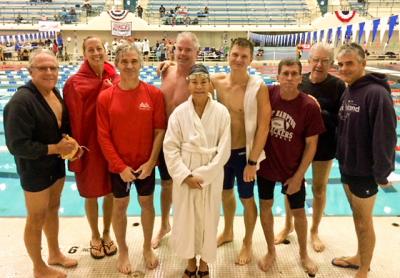
The Y.M.C.A. East Hampton RECenter squad that competed in a recent masters swim meet included, from left, Joe Viviani, Angelika Cruz, Mike Wootton, Tim Treadwell, Ellen Clark, Andrey Trigubovich, Kelly McKee, Dick Monahan, and Ed Mulderrig.
Mike Bottini
“Our showing provides proof that swimming is a lifelong sport"
By
Jack Graves

A squad of masters swimmers from the Y.M.C.A. East Hampton RECenter registered a number of impressive finishes at the Dr. Bill Ross Memorial Masters (18-and-over) meet at the Nassau County Aquatic Center last month.

Among the local Y’s competitors, whose ages ranged from 30 to 77, were:

Angelika Cruz, who won her age group’s 50-meter butterfly and the 200-meter individual medley, placed second in the 100 I.M. and 100 freestyle, and was a member, along with Tim Treadwell, the squad’s coach, Mike Bottini, and Andrey Trigubovich, of the 160-199-year-old 200 free relay. (Treadwell said in an email that the ages of the quartet from here equaled 196.)

Ellen Clark, who won her age group’s 50, 100, and 200-meter butterfly races, and placed second in the 100 breaststroke.

Dick Monahan, the team’s senior member, who won the 100 backstroke, the 100 free, the 200 free, the 400 free, and the 800 free.

Bottini, who was first in the 200 I.M., second in the 200 breaststroke and in the 400 I.M., was third in the 100 free and the 50 breast, and, as mentioned above, was a member of the winning 200 free relay team.

Kelly McKee, who was second in the 100 free and third in the 50 fly.

Treadwell, who, aside from being a member of the winning 200 free relay team, was first in the 50 breast and third in the 100 free.

Mike Wootton, who won the 50 free and 50 back, placed second in the 100 free, and was third in the 100 I.M.

Trigubovich, who won the 50 fly, and, as aforesaid, was a member of the winning 200 free relay team.

Joe Viviani, who was second in the 50 breaststroke.

And Ed Mulderrig, who was third in the 50 breast. 

“Our showing provides proof that swimming is a lifelong sport,” said Treadwell, who oversees masters swim sessions at the Y here. 

The meet raised money for pancreatic cancer research. Both of its honorees, Dr. Ross and Terry Laughlin — for whom a relay was named — were lifelong top-flight swimmers in the metro area until they died of pancreatic cancer in their mid-60s. 

Treadwell, who oversees a masters meet at the home of Bill and Dominique Kahn in East Hampton each summer to raise money for the Lustgarten Foundation for Pancreatic Cancer Research, lost his mother to the disease, as, he said, did Wootton.

There were, said Treadwell, 151 competitors at the meet, ranging in age from 18 to 88.

In related news, Craig Brierley, who coaches East Hampton High’s boys swimming team, said this week that the team’s captains, chosen by their teammates, are Ryan Bahel, Ryan Duryea, Ethan McCormac, and Jordan Uribe. 

A Maroon and Gray intrasquad meet — won by the Maroon team 53-48 — was held at the Y Saturday morning, followed by a breakfast provided by the swimmers’ parents. 

Brierley said Nicky Badilla was named by Bahel and Duryea as the Gray team’s swimmer of the meet; Callum Menelaws was named by the Maroon team’s captains, McCormac and Uribe, as its swimmer of the meet.

East Hampton’s season was to have begun here yesterday with Ward Melville, a nonleague opponent. A new scoreboard, donated by the East Hampton Kiwanis Club, was to have been dedicated before the meet began.