
The Market Is the Motive

The Market Is the Motive

By
T.E. McMorrow

Two controversial applications for subdivisions moved a step closer to a vote by the East Hampton Town Planning Board on April 1 after clearing a procedural hurdle.

The board concluded, after some contentious debate, that neither proposal, at 55 Wainscott Hollow Road in Wainscott and 38 Indian Wells Highway in Amagansett, required a lengthy evaluation under the State Environmental Quality Review Act.

For 55 Wainscott Hollow Road, what matters is not whether the roughly 40-acre parcel can be divided into seven buildable lots, with 28 acres set aside as an agricultural reserve — that is a given — but what the final map should look like.

One board member, Bob Schaeffer, has championed the current layout. Another, Diana Weir, has repeatedly called it “bad planning.” Both are Wainscott residents.

Jeffrey Colle, whose firm specializes in developing large estates, is the developer. Michael Dell, the founder and chief executive officer of Dell Computers, is reportedly one of the owners of the property.

The problem is the placement of five buildable lots along the northwestern border of the property, on what has historically been open farmland. According to the current map, the lots would be accessed from a long drive off Wainscott Hollow Road, although Sayre’s Path, to the east, could provide an easier way in for at least three of them. Mary Jane Asato, representing the applicants, told the board early in the process that a Wainscott Hollow address is worth more on the open market than a Sayre’s Path one.

Mr. Schaeffer, who is undergoing radiation and chemotherapy for cancer, has been unable to attend board meetings for the past two months, save for those involving Mr. Colle’s application, and has had to miss even those a few times recently. When he is absent, Ms. Asato has asked that the application be tabled, and the board has agreed.

Even with Mr. Schaeffer’s vote, reaching the magic number of three more votes required for approval of the proposed layout from the other six members is far from certain, although Reed Jones, the board’s chairman, who was reached by phone this week while on vacation, said that four had previously okayed it. He himself is opposed.

The Planning Department said this week that a final vote on the map as it now stands could come as soon as the board’s next meeting, on April 22.

The proposed subdivision in Amagansett, meanwhile, is in a more precarious position. The owner, Thomas Onisko, is facing two votes over the next few weeks; first from the town’s zoning board of appeals, and then from the planning board. A no vote from either will kill the application.

The zoning board must grant Mr. Onisko a variance to allow the creation of two undersized lots before the planning board can make a final decision on his proposal. The argument for splitting the one-acre-plus property in two is that there are already two houses on the land, though the code calls for only one in that residence zone. The two structures take access from opposite sides, one from Indian Wells and the other from Further Court. They are separated by a hedgerow.

As with the Wainscott Hollow proposal, financial gain is a motivation for the proposal. Britton Bistrian, representing Mr. Onisko, told the zoning board recently that the lot would realize more money as two parcels than as one, and that a prospective buyer would likely back out if the subdivision application were not approved.

After Mr. Onisko’s proposal cleared the SEQRA procedure on April 1, by a 4-2 vote, planning board members agreed to send their comments on it to the Z.B.A. But with members commenting that “this smacks of downzoning” (Mr. Jones) and “I haven’t liked it from the beginning” (Job Potter), its chances of success appear dubious.

Endorse Carry-In, Carry-Out

Endorse Carry-In, Carry-Out

By
Christopher Walsh

While the East Hampton Town Trustees, who manage many of the town’s beaches and waterways on behalf of the public, have signaled grudging acceptance of the town board’s intention to ban alcohol at Indian Wells Beach in Amagansett during lifeguard-protected hours on weekends and holidays during the summer, they expressed greater enthusiasm at their meeting on March 25 for a pilot program aimed at reducing litter by removing trash receptacles and instituting a carry-in, carry-out policy there.

Town Councilman Peter Van Scoyoc and Dell Cullum, a wildlife removal specialist and photographer who is on the town’s litter committee, had attended the trustees’ prior meeting, on March 10, at which the issue was discussed. Mr. Cullum told the trustees that, with the tourist season approaching, it was “time to get attentive about this garbage situation we go through every summer.” Garbage cans on the beach, he said, “give lazy people more opportunity to be lazy” and only cause a greater litter problem in the long run, while Mr. Van Scoyoc had suggested a pilot program at the same meeting. Mr. Cullum also told the trustees that the second annual Shoreline Sweep, a beach-cleanup effort he is organizing, would take place on April 11, and asked for their participation.

At last week’s meeting, Deborah Klughers, a trustee, said carry-in,  carry-out programs had been successful in national parks and other locations. She suggested the policy could be announced at the attended booth on Indian Wells Highway where nonresident vehicles, taxis, and buses are turned away and prohibited from entering the parking lot. Vendors, she said, would be responsible for garbage they generated.

Rona Klopman, a member of the town’s recycling and litter committee who attended the meeting, told the assembled that the committee had endorsed a carry-in, carry-out policy. “If you carry in stuff, it’s going to be carried out,” she said, predicting that the policy would reduce the costs of town garbage pickup. Signs explaining the policy, as well as public service announcements on LTV and WLNG, she said, could publicize the program.

Nat Miller, Ms. Klughers’s colleague, was concerned that, if implemented, it   might seem as if the policy is working, but only because the town’s Parks Department staff was doing what beachgoers were unwilling to do. “I find it appalling that we have to buy a beach rake,” Mr. Miller said. “I want it known that it’s working, but did the beach rake pick up seven times more stuff?” The pilot program, Ms. Klughers conceded, “does have a personal-accountability component.” If the policy proved unsuccessful, she said, it could be discontinued immediately. “We don’t have to live with it for any specific amount of time, and it totally depends on the town board,” she said.

While he agreed that the concept is good, Bill Taylor, a trustee, was also concerned about the program’s efficacy. “You’d like to think about some kind of way to make it really work,” he said.

Before the meeting was over, the trustees agreed to send a letter of support for the pilot program to the town board, which is expected to discuss it at a work session on Tuesday. 

With regard to the alcohol ban at the beach, the trustees maintained their insistence on a sunset clause, proposing its expiration on Sept. 30. “I can deal with this,” Sean McCaffrey, a trustee, said, “but just for one year.”

With the collective feeling that they are compromising more than the town board is by agreeing to another ban, the trustees again moved to ask the town to increase enforcement of existing laws and stiffen fines for littering.  “Sometimes,” Mr. Miller said, “I think the town is afraid to spank the tourists.”

East Hampton Waters Are (Almost) Fine

East Hampton Waters Are (Almost) Fine

By
Christopher Walsh

The water quality in bodies overseen by the East Hampton Town Trustees is generally excellent, according to a presentation at Town Hall on Monday, but algal blooms that can be harmful to shellfish, finfish, and humans remain a concern.

For the last two years, the trustees have funded water sampling, performed by Christopher Gobler of Stony Brook University’s School of Marine and Atmospheric Sciences, at sites including Napeague Harbor, Fresh Pond, Accabonac, Hog Creek, Northwest Harbor, Three Mile Harbor, and Georgica and Hook Ponds. On Monday, Dr. Gobler presented his findings from 2014 to an audience that included most of the trustees as well as Supervisor Larry Cantwell and Kim Shaw, the town’s natural resources director.

Surrounded by the Atlantic Ocean and Block Island Sound, strong tidal flushing and wave movement keeps East Hampton’s water quality high, Dr. Gobler said, as does the town’s distance from the metropolitan area. However, he said, development can cause impairments, “problems that trickle down marine ecosystems.”

Phytoplankton, or algae, is at the base of all aquatic food chains and therefore “incredibly important for controlling the productivity of marine fisheries.” But, Dr. Gobler warned, “sometimes there can be too much of a good thing.”

With the exception of Georgica Pond in East Hampton, tidal flushing maintains high salinity and oxygen levels in town waterways, he explained. In the pond, however, a bloom of cyanobacteria (blue-green algae) caused its closure for much of last summer, during which crabs and other marine life could not be harvested. Cyanobacteria can produce a gastrointestinal toxin called microcystin.

When the pond was opened to the ocean in October, Dr. Gobler said, the bloom shrank dramatically, while the natural flushing of the water raised oxygen and salinity levels.

While the overall oxygen level in East Hampton Town waterways was well above the State Department of Environmental Conservation’s standard and conducive to healthy fisheries, he said, levels at the head of Three Mile Harbor fell below the standard in August and early September, when the water was warmest. Poor water circulation and nutrient loading, such as nitrogen, were behind the drop.

High levels of alexandrium, or red tide, which has been “fairly widespread on Long Island in recent years,” were measured last year in Three Mile Harbor, Dr. Gobler said, and were lower than in 2013. When filter-feeding bivalves such as clams, mussels, and oysters consume a lot of this microalgae, they can accumulate toxins and be unsafe for human consumption. “We do have firm evidence,” he said, “that a high level of nitrogen-loading promotes these events and can lead to more areas being closed.”

Dinophysis also produces a toxin. “We knew it was on Long Island for a very long time, but just a few years ago we found that not only is the organism present but the toxins are getting into shellfish.” Dinophysis was found “everywhere, but the levels were quite low.”

Cochlodynium, or rust tide, was measured in Three Mile and Accabonac Harbors. While it does not pose a threat to humans, it is potentially lethal to marine life.

A trend revealed in the federal government’s national climate assessment in 2014 has important implications, Dr. Gobler said, and may be a signal of climate change affecting New York State. “In the last 50 years or so, the incidence of heavy rainfall events . . . is up by 71 percent,” he said. While the total amount of rainfall is unchanged, “that rainfall is typically happening all at once.”

Rain, he said, delivers nutrients and, potentially, bacteria from the land into the water, where it can impair water quality and accumulate in shellfish. High levels of fecal coliform bacteria were measured in Accabonac Harbor and Hog Creek in September, coincident with rainfall, Dr. Gobler said. The D.E.C. closes water bodies to shellfishing either seasonally or permanently if there is concern over fecal coliform bacteria.

Dr. Gobler is assembling a plan for water-quality monitoring in 2015.

‘Politicizing’ the C.A.C.

‘Politicizing’ the C.A.C.

By
Joanne Pilgrim

A dozen new members were appointed to the Springs Citizens Advisory Committee by the East Hampton Town Board on March 19.

Councilman Fred Overton, who is the board’s liaison to the committee, declined to offer the resolution and voted against it; it was offered instead by Councilwoman Kathee Burke-Gonzalez, who, like Mr. Overton, is a resident of Springs.

While he said he had no issues with the appointees, Mr. Overton complained that Phyllis Mallah, a member of the committee and a Democrat, had politicized the process of committee appointments by sending an email to other Democrats urging them to join the C.A.C., which, he said she had charged in the email, was up to “Republican high jinks.”

“I believe this woman, this person, is trying to politicize the C.A.C., and this is not the place for politics,” Mr. Overton said. “I am so angry about this that I can’t stand it.”

The town board normally adds anyone to a citizens committee who has requested it, or acts on recommendations from the committee chairperson, without regard to political affiliation.

“We shouldn’t be sending out emails to the Democratic-registered people in Springs telling them that we need more Democratic representation on the committee. It’s wrong,” Mr. Overton said.

Debra Foster, a former town councilwoman active in Democratic circles, was among those contacted, he said.

Ms. Foster, commented Supervisor Larry Cantwell, is “well regarded” and her “wealth of knowledge will be an asset” to the committee. Mr. Overton agreed but said he could not support her addition to the citizens group because of Ms. Mallah’s effort.

The councilman, the only Republican among his colleagues on the board, said the town board members are working well together despite the difference in their party affiliation.

Mr. Cantwell agreed. But, he said, “as far as politicizing any C.A.C., I don’t think that’s good policy.”

Ms. Foster was among those appointed by a 4-to-1 vote of the board. The others were Pat Brabant, Judy Freeman, Susan Harder, Connie Kenney, Tina Plesset, David Weinstein, Judy Grodin, Cile Downs, Michael Antonelle, Mary Beth LaPenna, and Rita Wasserman.

Further Protection for Springs General Store

Further Protection for Springs General Store

The exterior and grounds of the Springs General Store on Old Stone Highway in that hamlet will remain unchanged after a deal in which the Town of East Hampton paid its owners $170,000 for a preservation easement was approved.
Morgan McGivern
By
Joanne Pilgrim

The sense of place and time evoked by the Springs General Store, which sits along Accabonac Harbor and across from Pussy’s Pond in the Springs Historic District, will be further protected with the recently approved purchase by East Hampton Town of a facade easement that will assure that the property will continue to look as it has since the building was constructed in 1884.

The store is one of 10 19th-century structures in the historic district, which also includes Ashawagh Hall, the Parsons Blacksmith Shop, and several houses. Inclusion in the district “offers some protection,” according to a resolution approving the easement purchase, “but not as specific, restrictive, or as enforceable” as the easement.

The $170,000 purchase, using money from the community preservation fund, will preclude the addition of new structures on the 1.4-acre site, protect the store, old gas pumps, and existing outbuildings from external change, and protect the view of the property.

The store site, owned by Mike and Jan Collins of Springs under a corporation called M C Jan, has been on the market, and a reported buyer, who has not been named, has offered Kristi Hood, who operates the store, a lease extension.

The town board unanimously approved the easement purchase last Thursday. The historic district encompassing various sites in the heart of Springs, according to the board resolution, “maintains the relationships between the farmhouses, community buildings, country store, and blacksmith shop. These structures represent many facets of life in this thriving agrarian community during the 19th century.”

“There’s something special about being able to preserve an important icon in Springs,” said Supervisor Larry Cantwell. He asked Councilman Fred Overton, a native of the hamlet, whether he had ever gotten into any trouble behind the store as a youth.

Mr. Overton took the Fifth. But, he said, “I bought my first gallon of gas there.” It was Gulf, he said, at 25 cents a gallon.

Refinancing Bond Will Save $1.76 Million

Refinancing Bond Will Save $1.76 Million

By
Joanne Pilgrim

The remainder of a $31 million bond issued by East Hampton Town in 2006 will be refinanced, enabling the town to save $1.76 million in interest while paying off the debt over the next 12 years.

The money was borrowed for land acquisitions ($25 million), for construction of the town justice court ($2 million), and for the rehabilitation and reconstruction of the Montauk Playhouse Community Center ($4 million).

Almost 10 years later, the town has paid off almost $10 million of that debt, with $22.12 million remaining.

While the town has been paying interest at a rate between 4.25 and 4.37 percent on the original bond issue, Len Bernard, the town budget officer, said Tuesday, investment advisers expect that, with an AA2 Moody’s credit rating, East Hampton should be able to get a rate at about 2.15 percent by refinancing. That will yield a $145,000 savings this year. The move will not extend the overall payback period of the original borrowing, which runs through 2026.

In addition to approving the refinancing of the 2006 bond, the town board voted last week to issue a number of new bonds to cover various purchases and capital projects. Issuance of the bonds is subject to permissive referendum.

The planned expenditures are as follows: $30,000 for radios for the Harbors and Docks and Ordinance Enforcement Departments; $55,000 for police headquarters building improvements; $180,000 for vehicles and equipment; $250,000 for computer equipment; $140,000 for renovations to the Highway Department building; $120,000 for roof repairs, and $465,000 for improvements to various parks.

In Montauk, spending plans include $150,000 for repairs to the Fort Pond House in Montauk; $40,000 for improvements to the Montauk Playhouse parking lot, and $100,00 for improvements to the downtown public bathroom.

Bonds will also be issued for $85,000 to replace reduced pressure zone valves; $10,000 to replace beacon lights; $500,000 for a basin cleaning truck; $350,000 for road reconstruction; $75,000 for sidewalk reconstruction; $40,000 for a fence and gate at the Sanitation Department, and $20,000 for improvements to the Justice Court building.

Thiele Wants PSEG Review

Thiele Wants PSEG Review

By
Joanne Pilgrim

Assemblyman Fred W. Thiele Jr., who has been critical of PSEG-Long Island, the utility company that operates the Long Island Power Authority grid, for a number of its practices, is calling for a review of payments, including executive pay and fees to consultants and contractors, made by PSEG under its contract with LIPA.

He is sponsoring legislation that would empower the Long Island office of the State Department of Public Service to undertake the review. In a press release this week, the assemblyman said that last week PSEG-Long Island “refused to make public the executive compensation for its 18 top officials,” claiming that the information is “exempt from state scrutiny or public disclosure under the LIPA Reform Act passed in 2013.” The legislation is meant to bring “transparency and oversight” to the utility’s salary spending, according to Mr. Thiele.

Under a 12-year management contract between LIPA and PSEG-Long Island, the fee paid to PSEG is due to increase from $45 million to $73 million in 2016.

The Department of Public Service has no decision-making authority over electricity rates but does make recommendations to the LIPA board about petitions for rate changes and other PSEG matters. Mr. Thiele said that PSEG-Long Island has been accused of hindering the department’s scrutiny of a proposed three-year rate hike by failing to respond to more than two dozen separate information requests.

“PSEG-LI is a contractor for a public authority (LIPA) that has as its mission the supplying of a most basic societal need: electricity. Its revenue is generated by the payment of the monthly electric bill of every Long Island resident and business,” said Mr. Thiele in his press release. “The people’s right to review the documents and information related to the operation of its utility company should be obvious in a democratic society. Access to such information should not be thwarted by shrouding it with the cloak of secrecy or confidentiality.”

Project Not ‘Shovel Ready’

Project Not ‘Shovel Ready’

By
Joanne Pilgrim

Concerned Citizens of Montauk is arguing that the Army Corps of Engineers plan to build a seawall along the ocean beach in downtown Montauk, for which bids have now been awarded, is not “shovel ready.”

“There’s a long list of items that need to be addressed,” Jeremy Samuelson, the executive director of C.C.O.M., said at an East Hampton Town Board meeting last Thursday. Mr. Samuelson is also quoted in a separate story on C.C.O.M.’s stand on a lawsuit challenging the project.

The work, which was to have been completed this spring, was split into spring and fall phases when it became clear that time was too short to get it done before the summer tourist season. The town board has been steadfast that work has to be suspended before Memorial Day.

Town officials and engineers have been working on outstanding details, such as stormwater flow onto the beach and the design of walkways over the dune, but Mr. Samuelson said “major drainage and structural issues” remained to be resolved.

“There’s a huge volume of stormwater that’s going to need someplace to go before they build this dune on the beach,” Mr. Samuelson said. If proper drainage is not installed before the seawall goes in, he said, it will be “in fact a levee,” creating downtown flooding.

Noting that the state’s Department of Transportation is poised to begin repaving Montauk Highway between Amagansett and Montauk this spring, at the same time truckloads of sand would be shipped in for the seawall, Mr. Samuelson said the two projects are on a “crash course.”

Government Briefs 03.26.15

Government Briefs 03.26.15

By
Joanne Pilgrim

East Hampton Town

C.P.F. on the Upswing

The Peconic Bay Region Community Preservation Fund has raised more than $1 billion for open space, farmland, and historic preservation in the five East End towns since its inception in 1999, and revenues this year are on an upward swing. According to Assemblyman Fred W. Thiele Jr., the fund, which receives the proceeds of a 2-percent real estate transfer tax, had $15.3 million in income during the first two months of this year, a 4.9-percent increase over the same period last year. Over the last 12 months, the transfer tax has generated $108 million.

The revenue to date, from January through the beginning of March, for East Hampton Town was more than $4 million, a close to 14-percent jump from 2014. Southampton Town saw the most proceeds during January and February — $9.7 million — while Shelter Island and Riverhead Towns both reaped $360,000. In Southold, the transfer tax raised $680,000 in the first two months of this year.


Extend Air Traffic Contract

A contract with Robinson Aviation, which has been providing air traffic control services at East Hampton Airport, was extended through 2015 by a vote of the East Hampton Town Board on March 17. The control tower hours will be reduced this year. It will operate from 9 a.m. to 8 p.m. from May 21 until Sept. 13, at a cost of $399,162.


The Cost of Snow Removal

The winter took its toll on East Hampton Town’s Highway Department budget, in which $338,449 had been set aside for the costs of snow removal in 2015. Given the repeated snowstorms this year, that wasn’t enough, and the town board voted last week to transfer a total of $235,000 from other highway budget lines to cover the additional snow removal costs.


A Driver Is Suspended

Also last week, the town board suspended Dennis Snyder, a driver for the Human Services Department, without pay, pursuant to pending disciplinary charges against him. Eileen A. Powers, an attorney who was appointed as a hearing officer, will prepare findings and recommendations for the town board.


Seek to Unify Election Dates

Following a request from Southampton Village Mayor Mark Epley, the town board voted last week to support an initiative to set one unified election date for all of the special election districts on Long Island, such as library, fire, water, parks, and sanitation districts. According to a resolution passed by the board, there are more than 900 different taxing entities making up Long Island’s local governments. Calling voters to the polls on one date, versus varying dates for the special district elections, “will focus media and voter attention on relevant issues, increasing the likelihood that the public’s interest is served,” along with voter turnout, the resolution says.

The resolution will be forwarded to state officials, and town officials will work with groups focused on voter reform issues, such as the League of Women Voters, to “enlist their assistance in raising public awareness and developing an educational campaign” to gain support for the unified election date idea.


Land Buy Hearings

The town board will hold hearings next Thursday on several proposed land purchases. In Montauk, property at 169 East Lake Drive, both upland and underwater land, is on the list. If approved, the town would use money from the community preservation fund to buy .77 acre of upland and .55 acre of underwater land from Lawrence and Roslyn Saltzman for a total of $1.3 million.

A second hearing will center on the proposed purchase from Suffolk County of a .12-acre lot at 57 Lincoln Road in Montauk for $2,091. It would be used for municipal purposes. The hearings begin at 6:30 p.m. at Town Hall. 

Federal

To Replace Old Diesel Engines

The United States Environmental Protection Agency is providing $1.18 million to help two organizations in the New York metropolitan area replace boats’ old diesel engines with less-polluting models. The projects will cut emissions of, among other pollutants, nitrogen oxides and particulate matter, which are linked to asthma, lung and heart disease, and premature death.

The Connecticut Maritime Foundation will use a $600,000 E.P.A. grant to replace two engines on the Cape Henlopen, which is in the Cross Sound Ferry fleet operating between New London and Orient Point, with new and cleaner E.P.A.-certified engines. The project is expected to reduce nitrogen-oxide emissions by 24.4 tons per year and particulate matter by 0.94 tons per year, in addition to conserving 12,400 gallons of fuel annually.

The New Jersey Clean Cities Coalition will use a $589,025 grant for new E.P.A.-certified engines on five cruise and excursion vessels and two tugboats that operate out of New York Harbor. The project is expected to reduce emissions of nitrogen oxides by 55.4 tons and particulate matter by 2.85 tons per year. More than 184,000 gallons of fuel are expected to be conserved annually.

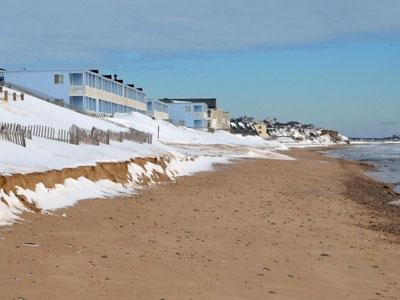
Opponents Head to Court to Block Montauk Sandbags

Opponents Head to Court to Block Montauk Sandbags

Downtown Montauk's beach during the winter of 2015
T.E. McMorrow
By
Joanne Pilgrim

An Army Corps of Engineers plan to build a sandbag-reinforced artificial dune along the downtown Montauk ocean beach will be challenged in court. Defend H2O, an environmental advocacy organization, along with four individual petitioners, announced that it had filed notice on Friday in State Supreme Court.

The group intends to file an Article 78 lawsuit next month against the East Hampton Town Board, Suffolk County, and the New York State Department of Environmental Conservation, along with the Army Corps, and seeks to overturn the approvals that have been granted.

East Hampton Town Supervisor Larry Cantwell said yesterday that the town had not received formal notice of the lawsuit, but, he said, the town will vigorously defend itself.

The specifications for the $8.4 million project, which would be paid for with federal money, call for installation of a 3,100-foot-long and 50-foot-wide revetment from the Atlantic Terrace motel to Emery Street made of 14,560 geotextile sandbags. These would be covered with three feet of sand, some stockpiled from an excavation of the beach and the rest trucked in from an off-site sand mine. The Army Corps formally awarded the job to H&L Contracting of Bay Shore on Friday.

The project has been cast as a temporary solution that would be removed when the Army Corps undertakes a more extensive project as part of its Fire Island to Montauk Point reformulation study. However, when that project might happen has been questioned.

According to a Defend H2O press release, the structure "will span the narrow beach creating an unnatural 'bump-out,' " and will result in "the inevitable loss of a coveted recreational beach" by inducing scouring and erosion. Risks of flooding will be increased, the group also says, because of the destruction of natural erosion-protective features.

The project, the court filing claims, will also "create a physical obstruction to public beach access, insufficiently contain and dispose of stormwater runoff," and destroy recreational opportunities and the commerce related to them.

The plan, called the Downtown Montauk Stabilization Project, the lawsuit says, conflicts with shoreline policies in the town's Local Waterfront Revitalization Plan that outlaw hard structures on the ocean beach.

"Sand-filled geotextile bags and tubes are hard structures," according to the press release. By authorizing permits and providing the federal funding for the project, the county, Army Corps, and state D.E.C. are complicit in "not adhering to town coastal policy," the release says.

The additional plaintiffs in the lawsuit are Rav Friedel and Jay Levine, both Montauk residents, Michael Bottini, and Thomas Muse, also of Montauk. Mr. Bottini, Mr. Muse, and Mr. Levine are affiliated with the Eastern Long Island Chapter of the Surfrider Foundation, which has spoken out vigorously against the project; Mr. Bottini is the group's volunteer chairman.

Also in the press release, Kevin McAllister, the founder of Defend H20, charged that officials "made a conscious decision to sacrifice a public beach in favor of private property interests."

The assertion, he said, that the sandbag installation "is not shoreline hardening, will have no adverse impacts to the beach," and can be seen as temporary, "is scientifically indefensible and fundamentally wrong," he said.

"If implemented, this project sets a terrible precedent for the Town of East Hampton, whose economy is largely driven by it natural beaches," Mr. Bottini said in the press release.

"Let it be known that nobody, not the Town of East Hampton, the Army Corps, Suffolk County or the DEC are going to ruin the Montauk beaches! Not without a knock-down, drag-out fight" said Mr. Freidel, a plaintiff in the action.